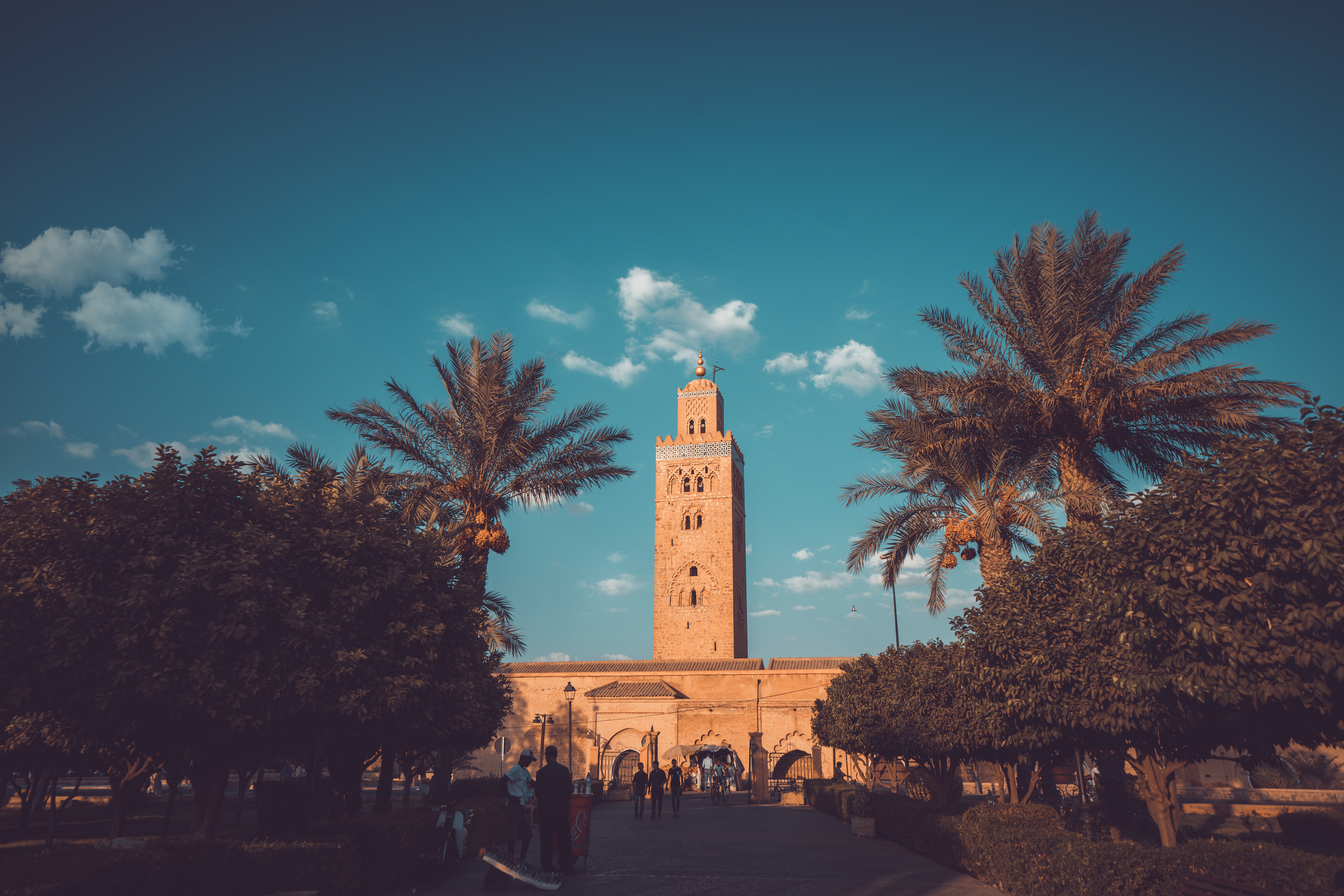
Let yourself be engulfed in Marrakech's magic and constant movement, and you’ll see that you won’t regret it. The city was first founded by Almohadi in 1062, and since then, countless dynasties and rulers have gone by, while the city has continually changed and transformed itself. Be attentive to Marrakech’s architecture; its palaces, mosques and gardens will allow you to uncover its amazing history, and as you notice how most of its buildings have a reddish color, you’ll understand why it is called “The Red City”.
Today, let us guide you through some of the essential places of Marrakech, the ones with the most interesting stories about the city and its encounters with art, gastronomy and fashion, some of the elements that have made it so eclectic and full of life. Cities like this cannot be thoroughly explored in just a few days, because there’s so much to do, taste and see, that you’d need weeks and months to discover the last hidden gem of Marrakech. Nonetheless, what you’re about to see encapsulates at least a part of the city’s DNA and will give you a vivid idea of what you’ll live once you visit it. Just as we said before, it is time to let yourself be carried by the flow of the marvelous city and enjoy.
Inside Marrakech’s art and culture:
We’re going to begin our journey through Marrakech by immersing ourselves in its artistic and cultural facet. The best way to do this is by visiting the Maison de la Photographie, an archive on Morocco that first opened its doors in 2009, but that holds stories about the country from long ago. It all started when Patrik Menac’h and Marrakshi Hamid Mergani joined forces to open a photography museum for both their collections of vintage Moroccan photography. This resulted in exhibitions organized from 4500 photos, 2000 glass negatives and 80 documents dating from 1879 to 1960, which showcase the diversity of Morocco and the different stories and ways in which people have lived in the country. Regardless of the source of the material (whether it was taken anonymously or by a famous photographer), there’s something extraordinary about watching so many lives through distinctive lenses and recreating a whole country through that experience. The museum is located in a three-story riad, and there’s a great rooftop terrace where you can enjoy a delightful coffee or pot of tea while you watch some of the best views of Marrakech.
On the other hand, we also have to mention the Musée Yves Saint Laurent, living proof of how the city’s beauty inspired world-renowned French designer Yves Saint Laurent. The museum is an interesting way to explore the profound connection between the designer and Marrakech, while watching some of his most precious designs spanning his 40-year career. It was first opened in 2017 and even those who aren’t as interested in fashion can appreciate it, because the sole design of the building, with its gardens, bookshop, café, and auditorium are enough to keep everyone captivated. Precisely, the 150-seat auditorium is dedicated to the YSL’s Theater, used for the projection of different international films, live and theatrical performances, as well as their broadcast. Just outside its entrance, you’ll find “Costumiere”, a display of Saint Laurent’s sketches of costumes made for cinema and theater. Quite impressive, don’t you think?

The Maison de la Photographie is a very special archive of the history of Morocco, where you’ll have the opportunity to explore the diverse life experiences of people from all over the country through different times.
Nature takes over Marrakech:
As “The Red City”, Marrakech looks like a desert, and all of its gardens and patios are like a chain of oases scattered across the city. Let’s have a look at two of the most beautiful ones. Since we were just talking about Yves Saint Laurent, let’s begin with Jardin Majorelle, a garden created by French painter Jacques Majorelle that was later bought by Saint Laurent and his partner Pierre Bergé in 1980, in an attempt to safeguard its creator’s vision and keep the garden open to the public, so that everyone could enjoy this lush and colorful landscape. The Jardin started in 1924 and Majorelle arranged it like a canvas with 300 plant species from five continents. In the middle of the garden, you’ll find a bright blue building, and before you think that you’ve lost your way, let us tell you that it is the Musée Berbère, which presents the history of Berbers, the indigenous inhabitants of Morocco. Majorelle’s art deco studio was converted into the Musée, although it preserves its creative atmosphere. In the last few years, the Jardin has become one of the most popular attractions in all of Morocco, and over 900,000 visitors come annually. This means that it isn’t as peaceful as one would expect from an oasis, but that doesn’t mean that it is a must-see place in Marrakech.
Additionally, we would like to mention Le Jardin Secret, an astonishing example of the Arab-Andalusian and Moroccan palaces tradition. Even though its origins date back four hundred years ago to the Saadian Dynasty, the complex was rebuilt in the mid-19th century and since then it has gone through certain renovations to create an incredible experience for all its visitors. What makes this place so special is the restored khettara, an underground irrigation system unique to Morocco, which now keeps the garden alive. You’ll notice that Le Jardin Secret is divided into two parts: one is a beautiful exotic garden, while the other is a traditional Islamic garden, where fig, dates, pomegranate and olive groves grow to remind us of an ancient past.

What’s waiting for you in Jardin Majorelle is an explosion of colors and the most exquisite landscape.
Marrakech’s heart: Djemaa El Fna
There’s no better way to end our journey through Marrakech than by talking about its heart, Djemaa El Fna, the place that may best represent what this city is all about: movement, entertainment, tradition and the best food. This vast open square right in the center of the medina is a place where every night, the most wonderful, strange and unique characters of Marrakech come out to entertain all those walking by. The origins of Djemaa El Fna can be traced back to the 11th century, when the Almoravids were founding Marrakech. It has been a food market, street theater and basically the central place where locals’ lives happened. Today, it is all of this and more, the thing is that it has changed its schedule, and now Djemaa El Fna prefers to come alive at night, when the stoves get heated and musicians tune their instruments. It becomes pretty obvious why UNESCO declared the square as a Masterpiece of World Heritage in 2001 and has tried to protect its customs against the irremediable passage of time and arrival of modernity. This is Marrakech in all its chaotic magnificence.

This is the real heart of Marrakech: Djemaa El Fna, the main square where an electric atmosphere and the true personality of the city shines on its own.
Now that you’ve seen some of the most popular and beloved parts of Marrakech, you’re ready to discover the rest of the city on your own. Even though this was a very short guide, we tried to include some of the key elements of “The Red City”, such as nature, fashion, architecture, art and culture, embedded in its buildings, its history and its people. Marrakech is none other than the heart of Morocco, and as such, it is a special place to start exploring the wonderful things that the country has to offer.
Enjoyed this article?