The first afternoon I had in Plovdiv, I meant to find a shaded café and stay in it. I walked until dark instead, which seems to be what the city does to people. Everything you came for sits inside about two square kilometres, so a bus never enters the conversation, and the layers arrive quickly: a Roman stadium buried under the shopping street, a 15th-century mosque standing at the north end of it, and a hill above both where people have been living since roughly 4000 BC. Doing all of that on your own suits the place. Nobody is waiting for you at the bottom of a staircase, and the best hours here are the quiet ones anyway.
Quick Guide: Walking Plovdiv Solo
- Primary recommendation: Walk south to north and low to high. Start in Tsar Simeon's Garden, follow Main Street to Dzhumaya Square, cut through Kapana, then climb into the Old Town and finish on Nebet Tepe for sunset.
- Top choice for history: The Ancient Theatre of Philippopolis, roughly €4 for adults. Pro tip: students and pensioners get in free on the first Thursday of the month across most Old Plovdiv sites, and the theatre still hosts opera and concerts through the summer, so an evening ticket buys you the ruin and a show.
- Value pick: Nebet Tepe. Free, open at all hours, restored and reopened in March 2025, and the single best view in the Old Town. Alcohol is not allowed up there and the rule is enforced.
- Best for a break from the sun: The Bishop's Basilica of Philippopolis on Knyaginya Maria Luiza Boulevard. Climate-controlled, over 2,000 square metres of late-antique mosaic, €7.67 for adults.
- The best way to see the city: Take a private, personalised walking experience with Lokafy in Plovdiv and see the six hills with somebody who grew up climbing them.
Why Plovdiv works so well on foot
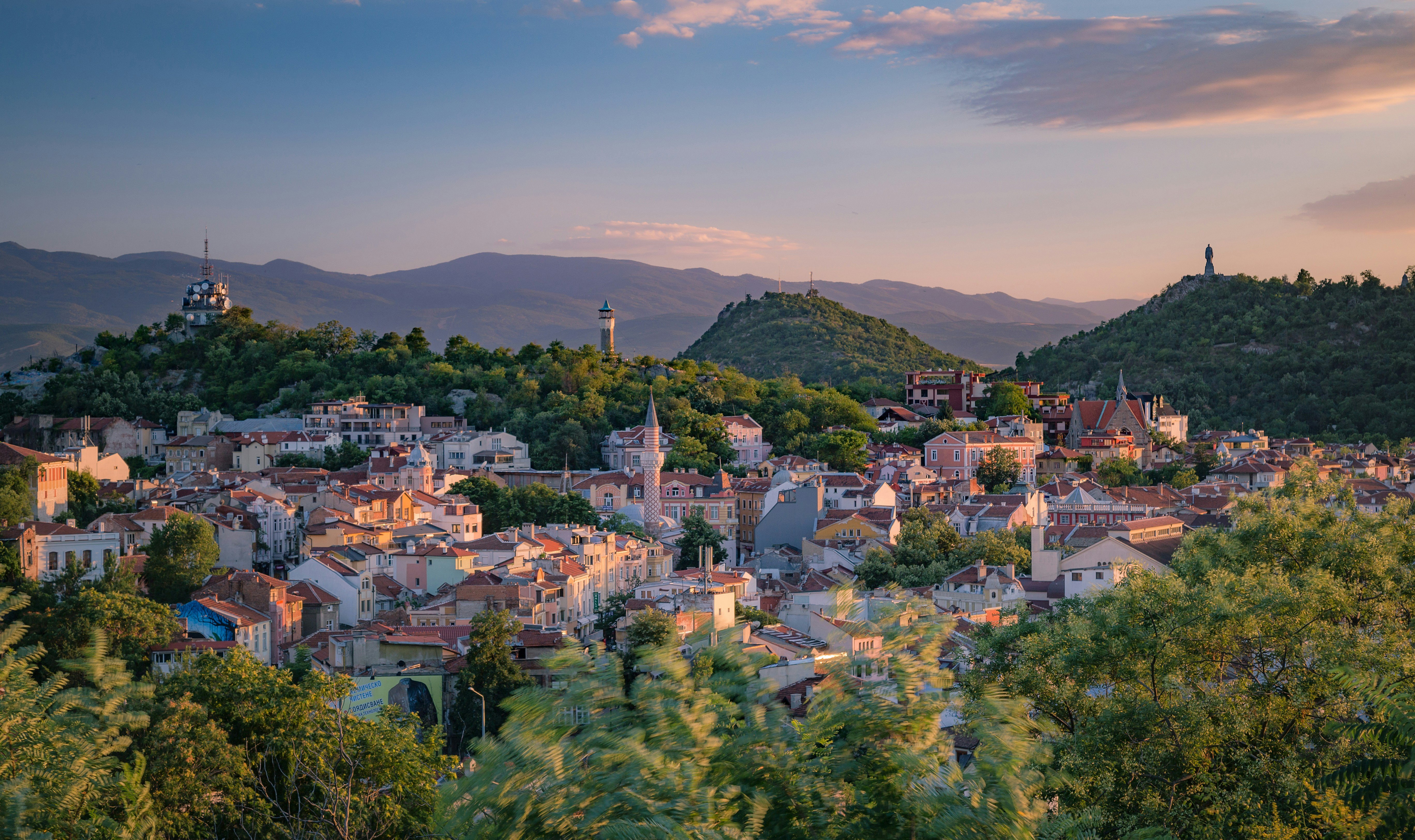
Plovdiv is built around hills that the locals still call by their Turkish names. There were seven. Markovo Tepe was quarried away for building stone, so six remain: Nebet Tepe, Dzhambaz Tepe and Taksim Tepe carry the Old Town between them, Sahat Tepe holds the clock tower, Bunardzhik holds the Alyosha monument, and Dzhendem Tepe is the tallest of the lot.
What that means in practice is that you are either on the flat or on a slope, with very little in between. The flat part is the pedestrian centre, which is properly flat and pram-smooth. The slopes are cobbled, uneven and steeper than photographs suggest. Plan the day so you do the flat bit while the sun is high and the climbing after five o'clock, and Plovdiv becomes an easy city. Do it the other way round in August and you will hate everyone.

Morning: the longest pedestrian street in Europe
Begin in Tsar Simeon's Garden, laid out in 1892 by the Swiss landscape architect Lucien Chevalas, who the city liked so much it made him an honorary citizen and started calling him the minister of flowers. The Demeter fountain by Arnoldo Zocchi is the only surviving piece of the First Bulgarian Exhibition that the garden was built for. It is shaded, it has benches, and at that hour it is mostly pensioners and dog walkers.
From the garden's north edge you step onto Main Street. On maps it is Knyaz Alexander I to the south and Rayko Daskalov to the north, but nobody in Plovdiv calls it either of those. Ask for Glavnata and you will get pointed the right way. It runs close to two kilometres from Central Square to the covered bridge over the Maritsa, and Plovdiv will tell you it is the longest pedestrian street in Europe.
Halfway up you will pass a bronze man in a hat with suspiciously shiny knees. That is Milyo, a much-loved local character who spent his days on this street last century, and the knees are shiny because people rub them for luck in love. Rubbing both at once is apparently the correct technique.
The better trick on this street is underground. You are walking on top of the Roman Stadium of Philippopolis, built in the early 2nd century AD on the model of the stadium at Delphi, with a track around 240 metres long that once seated tens of thousands. Only the northern end is exposed, at Dzhumaya Square, where you can walk down to the marble seating. For the rest of it, go into the Excelsior shopping centre and take the escalator down, or find the eastern sector under the Star Gallery building, opened to visitors in 2021, where ancient seating sits inside a working shop. It is one of the odder sights in the Balkans and it costs nothing to look.
Dzhumaya Mosque stands at the top of the same square. A mosque has been on this spot since shortly after the Ottoman conquest in the 1360s; the building you see went up in the 15th century, with nine domes and courses of brick and stone that borrow from local Byzantine and Bulgarian building habits. It is an active mosque, so cover shoulders and knees if you want to go in, and take your shoes off.
Late morning: Kapana at its calmest
North of the mosque, the grid tightens into Kapana, the creative district, six blocks of narrow pedestrianised streets full of bars, galleries and small kitchens. The name means "the trap", which is what the old craftsmen's quarter felt like to anyone who wandered into it.
Solo travellers should come here between about ten and two. Service is fast, the tables are empty, and you can sit with a coffee and a book without anyone hovering. Kapana after nine on a Friday is a different animal and worth returning for, but it is not a place to eat alone at eight on a Saturday unless you have booked. If you want the full picture of the district, we wrote a separate guide to Kapana and how locals use it.
Two things to know. Bakery Art draws queues for its bagels, and the queue moves. And Supa Bar does a rotating menu of homemade Bulgarian soups, which sounds unremarkable until you eat cold tarator on a 35-degree afternoon and understand why the entire country lives on it in August.
Afternoon: into the Old Town through Hisar Kapia
The climb into the Old Town starts properly at Hisar Kapia, the eastern gate of the medieval town, sitting on Roman foundations. Walk through it and the cobbles change character. This is the Bulgarian Revival quarter: 19th-century merchant houses with painted facades and upper floors that lean out over the street, built by traders who had money and wanted the neighbours to know.
Two of them are open as museums. Balabanov House and Hindliyan House are a couple of minutes apart, around €3.60 each, with carved wooden ceilings and painted rooms that show you exactly where the money went. Old Plovdiv sites keep long summer hours, roughly 9:30 to 18:00 from April to October, and shorter ones in winter. Hindliyan House closes on Mondays and takes a half-hour lunch break at one o'clock, which catches people out.
Then the Ancient Theatre of Philippopolis, on Tsar Ivaylo Street. Built in the late 1st century AD under Domitian, lost for centuries, and rediscovered after a landslide in the 1970s. Twenty-eight rows of marble seats face the stage, the modern city and the Rhodope Mountains stacked up behind it. Adult entry is around €4. Give it 45 minutes to an hour.
If the heat has beaten you by now, drop back down to Knyaginya Maria Luiza Boulevard and the Bishop's Basilica of Philippopolis, which opened to visitors in April 2021 after decades of excavation. It is the largest early Christian basilica in Bulgaria, over 80 metres long, with two layers of floor mosaic covering more than 2,000 square metres: birds, rosettes, meanders, all of it late Roman and much of it astonishing. Entry is €7.67, or €3.58 for students and over-65s, and a combined ticket covers this, the Small Basilica and the late-antique Irene building. It is air-conditioned, which on an August afternoon is not a minor point. The whole group sits on the UNESCO tentative list.
Evening: Nebet Tepe, and the hills nobody photographs
Everything ends on Nebet Tepe, the highest of the three Old Town hills and the place Plovdiv started. The earliest settlement layers here go back around 6,000 years. What you see now is Thracian walling, later Roman and Byzantine additions, a water reservoir and a postern gate that once ran down towards the river. The site was restored and reopened in March 2025 and is managed by the Regional Archaeological Museum, which runs specialist guided talks by prior arrangement. Access is free and there are no facilities on top, so bring water. There are benches. There is also a no-alcohol rule that guards do enforce, so the bottle of Bulgarian red you were planning to open at sunset should stay in the bag.
If you have a second evening, the local city guide LostInPlovdiv makes a good case for Sahat Tepe, also called Danov Hill, as the only hill from which you can see every open-air stage in the city at once. Its clock tower is among the oldest working ones in the Balkans: a wooden original from the late 16th century, rebuilt in stone in 1812, fitted with a Viennese mechanism in 1883. It still rings on the hour. The hill is a two-minute detour off Main Street and locals treat it as the place to go when they want to be left alone in the middle of town.
Bunardzhik, the next hill west, carries the 11-metre Alyosha monument put up in 1957. The politics around it are complicated and Bulgarians will happily tell you why. The view is the best in Plovdiv, full stop: the whole city, the Maritsa, and the Rhodope range behind. Allow 20 to 30 minutes on foot from the centre and another 15 up the paved paths.
Eating alone in Plovdiv without feeling like a spare part
Bulgarian restaurants are built for groups, which can make solo dinners awkward. A few places make it easy.
Pavaj in Kapana does modern Bulgarian cooking, including a pink tarator made with beetroot, in a room small enough that eating alone at the bar reads as normal. It fills up every night, so book. Fotoclub sits inside the Old Town but off the main tourist line and does proper Bulgarian food with a friendly room and a menu that includes plenty of offal for anyone feeling brave. Near Grozdov Pazar square at the foot of Sahat Tepe, the Armenian restaurant everyone calls Yerevan (its real name is September 22) has been a local favourite for years and does a lunch menu. And Kotka i Mishka, the Cat and Mouse beer bar in Kapana, is the sort of place where sitting at the bar on your own gets you a conversation rather than a pitying look.
Order shopska salad once and then move on to things nobody writes about: patatnik from the Rhodopes, kavarma, and lyutenitsa on bread.
See Plovdiv With a Local

A route gets you to the right places. It does not tell you which of the six hills your host proposed to their partner on, why the Alyosha monument is still standing after four separate attempts to remove it, or which shop on Rayko Daskalov has been run by the same family since before the war.
Take a private, personalised walking experience with Lokafy in Plovdiv and walk the city with somebody who lives here. Lokafy pairs you with a local rather than a tour guide, so the pace and the route bend around what you came to see. For solo travellers it solves the harder problem too: you get company for a few hours, and you get to eat dinner somewhere you would never have found on a map.
Frequently Asked Questions
Is Plovdiv walkable? Yes. The entire tourist centre fits inside roughly two square kilometres and the main sights are 10 to 20 minutes apart on foot. The pedestrian centre is flat and paved; the Old Town is cobbled and steep. You will not need public transport unless you are heading to the railway station or out of town.
How many days do you need in Plovdiv? Two days is comfortable. One long day covers Main Street, the Roman Stadium, Kapana, the Old Town, the Ancient Theatre and Nebet Tepe. A second day gives you the Bishop's Basilica, Sahat Tepe, Bunardzhik and time to sit still.
Is Plovdiv safe for solo travellers? Plovdiv is a low-crime city and the walking centre is well lit and busy into the evening. Normal precautions apply: watch your bag on crowded Main Street and at the fountain shows. The Old Town cobbles are the bigger hazard, particularly after dark, so wear shoes with grip.
What is the best walking route through Plovdiv Old Town? Enter through Hisar Kapia, walk up past Balabanov House and Hindliyan House, cut across to the Ancient Theatre on Tsar Ivaylo Street, then continue up to Nebet Tepe. Coming down, take the stairs towards Kapana rather than retracing your steps.
Is Nebet Tepe free to visit? Yes. Entry is free and the site is accessible at any hour. Guided talks from the Regional Archaeological Museum need to be arranged in advance. Alcohol is not permitted on the hill.
What currency does Plovdiv use now? The euro. Bulgaria joined the eurozone on 1 January 2026 and the lev stopped being legal tender on 1 February 2026 at a fixed rate of 1.95583 lev to the euro. The dual-pricing period ran to early August 2026, so menus and tickets now show euro prices. Cards are accepted almost everywhere; carry €20 or so in small notes for markets.
When do the singing fountains run in Tsar Simeon's Garden? Summer evenings on Thursday, Friday and Saturday. The city tourism office lists the show at 21:30, though start times shift slightly across the season, so check on the day. It is free, it draws a crowd, and the mosquitoes near the lake are enthusiastic.
What is the best time of day to walk Plovdiv in summer? Out by eight for Main Street and Kapana, indoors or under trees between one and five, back out at five thirty for the Old Town climb and Nebet Tepe. July and August regularly sit above 33°C in the middle of the day and the Old Town has very little shade.
Do you need a guide in Plovdiv or can you do it alone? The route above works perfectly well on your own. A local host is worth it for context and for the places that are not signposted: neighbourhood restaurants, the history behind the monuments, and the parts of the city that never make it into a guidebook.
Enjoyed this article?