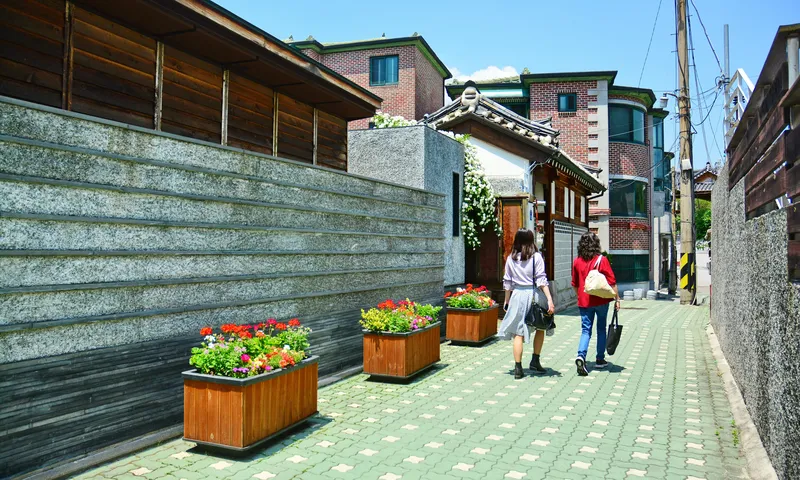
I arrived in Shanghai expecting to spend my trip looking up at skyscrapers, and I ended up spending it looking down at breakfast. The Pudong skyline is worth the twenty minutes you will stand there staring at it. But the city that stays with you is the one at seven in the morning, when the lanes off Wuyuan Road fill with steam from soy milk pots and half the neighbourhood is walking to the metro holding a paper bag of fried dough. Shanghai rewards people who slow down. It punishes people who arrive with a ticklist.
This guide is built around how the city works in practice: what you need to sort before you fly, how to move around, where to eat, and a three-day route that does not leave you crossing the city four times a day.
Quick Guide: Shanghai in 2026
- Primary recommendation: Give Shanghai three full days. One for the Bund and the Old City, one on foot in the former French Concession, one for Pudong and Suzhou Creek. Anything less and you see the postcard without the city.
- Top choice for food: Street breakfast, eaten between 6:30 and 9:00am in a residential lane.
- Value pick: Shanghai Museum East in Pudong is free, needs no reservation for individual visitors, and holds one of the finest bronze collections in China.
- Sort before you fly: Install Alipay, link an international card, and complete passport verification at home. Nearly everything in Shanghai runs on a QR code, including the metro turnstiles.
- The best way to see the city: Take a private, personalised walking experience with Lokafy in Shanghai and spend a few hours in the lanes with someone who lives in them.

Is Shanghai worth visiting?
Short answer: yes, and more so now than at any point in the last decade.
Time Out published its tenth annual Best Cities ranking in March 2026, built from a survey of more than 24,000 city residents plus a panel of over 100 of its own city editors. Shanghai came second in the world, behind Melbourne and ahead of Edinburgh, London and New York. That is a ranking voted by people who live there, which makes it a different kind of signal from a magazine listicle.
The other thing that changed is access. Citizens of around fifty countries can now enter China without a visa for stays of up to 30 days, an arrangement the government has extended through 31 December 2026. Separately, there is a 240-hour visa-free transit scheme, worth 10 days on the ground, available at 65 ports across 24 provinces to travellers holding an onward ticket to a third country. Two things to know about the transit route: the official term is Transit Without Visa (TWOV), and airline check-in staff will sometimes ask for a physical visa if you use the phrase "transit visa" instead. Rules shift, so confirm your own passport's status with a Chinese embassy or consulate before booking.
Set up your phone before you land
This is the single piece of preparation that changes your trip, and most guides bury it at the bottom.
Shanghai runs on Alipay and WeChat Pay. Street carts, taxis, museum ticket desks and metro gates all read a QR code. Foreign Visa and Mastercard cards have worked inside both apps since the 2023 policy changes, and the transaction limits that used to make them useless have been raised substantially since then. The app shows your current limits, so check there rather than trusting a blog post.
Do this at home, over a week before you fly:
- Install Alipay, link your card, and complete passport verification.
- Install WeChat and set up WeChat Pay as a backup. Some merchants' codes reject one app and accept the other.
- Make one small test payment so you find out about a bank block while you can still phone your bank.
- Download Amap (高德地图) for navigation. Google Maps is unreliable in China and its metro exits are frequently wrong.
- Tell your bank you are travelling to China and enable international online purchases.
Carry a few hundred yuan in cash as a fallback. You may not spend it, but a dead phone battery in Hongkou is not the moment to discover that.
Getting around
The metro does almost everything. Fares start at ¥3 for the first 6km and rise by ¥1 in increments, so most central journeys land between ¥3 and ¥6, and a cross-city run rarely exceeds ¥9. In Alipay, open the transport section, generate the Shanghai Metro code, and scan it at the gate going in and going out. There is no day pass worth buying for a normal visitor.
Six lines cover almost everything you will want. Line 2 is the workhorse, linking Pudong airport, Lujiazui, Nanjing East Road for the Bund, People's Square, Jing'an and the Hongqiao hub. Line 10 gets you to Yu Garden. People's Square, where Lines 1, 2 and 8 meet, is the most congested station in the system, so avoid changing there between 7:30 and 9:30am or 5:30 and 7:30pm.
From Pudong airport you have three options. Line 2 is around ¥8 and takes an hour or so, with a compulsory change at Guanglan Road where everyone gets off and waits a few minutes for the onward train. The Maglev covers the first stretch at 300km/h and reaches Longyang Road in eight minutes for ¥50, or ¥40 if you show a same-day flight ticket. A DiDi to the city centre runs roughly ¥180 to ¥280 and takes about fifty minutes off-peak.
Two smaller things locals use constantly. The Huangpu River ferries cost around ¥2 and give you a better view than the tourist boats. Shared bikes unlock through Alipay for ¥1.50 to ¥3 a ride and are the fastest way to cover the flat, tree-lined streets west of People's Square.
Day one: the Bund, the Old City and Yu Garden
Start at the Bund early. By ten in the morning the promenade is shoulder to shoulder, and by eight in the evening it is a slow-moving crowd. At seven, it belongs to people doing tai chi and walking dogs, and you can see the whole curve of 1920s banking houses without a phone in front of your face.
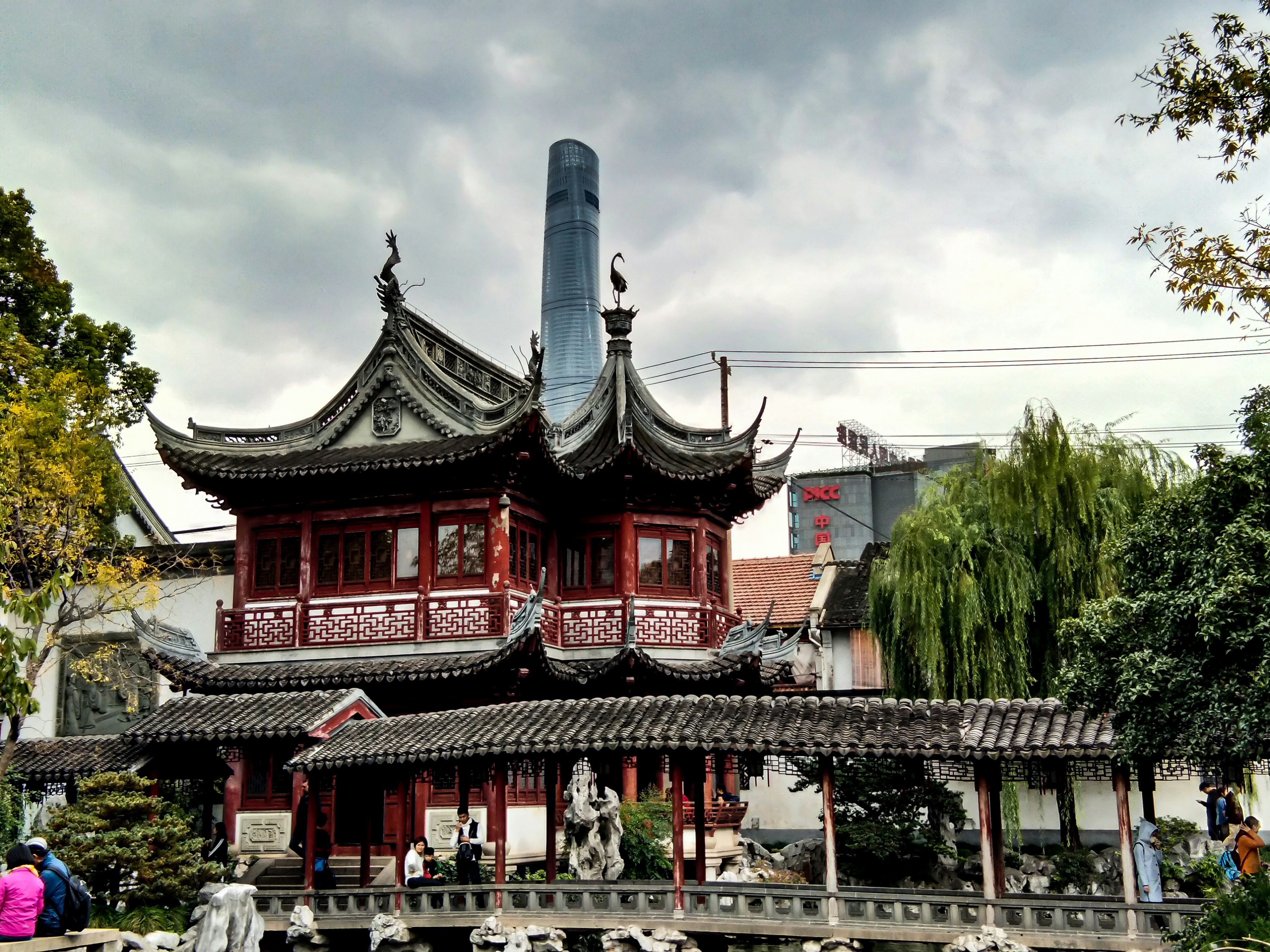
Walk south towards the Old City and give yourself an hour in Yu Garden. Tickets are ¥40 for adults, and the garden runs 9:00 to 16:30 with last entry at 16:00. Note the closure day, because it catches people out: the garden shuts on Mondays, though the surrounding Yuyuan Bazaar stays open as normal. Take Line 10 or 14 to Yuyuan Garden station.
Yu Garden is 450 years old and dense with rockeries, halls and small courtyards, and it is also one of the busiest sites in the city. Arrive at opening. The first hour is a different place from the third.
For the evening, cross to the Pudong side on the ferry and look back. The Bund viewed from the east bank, lit up, with the ferry engine grumbling under you, costs about a tenth of what the observation decks charge.
Day two: the former French Concession on foot
Technically the name no longer exists and the area now sits inside Xuhui and Huangpu districts. Everyone still calls it the French Concession, and one walk under the plane trees tells you why.
Start early with breakfast in the lanes around Wuyuan Road, Anfu Road or Wukang Road. Then walk. There is no fixed route worth prescribing here, which is rather the point, but a few anchors are worth building around.
Columbia Circle (上生新所), at 1262 Yan'an West Road near Panyu Road, is a restored 1920s American country club with an open-air swimming pool at its centre. Entry to the grounds is free. The Sun Ke Villa on the site was designed by László Hudec, the Hungarian architect responsible for much of the city's best pre-war architecture. There is a large Tsutaya bookshop and a run of cafés with outdoor seating. Weekday mornings are quiet. Weekend afternoons are not.
Wukang Mansion, the wedge-shaped 1924 building at the junction of Wukang and Huaihai Roads, is the most photographed corner in Shanghai. See it, then walk away from it. The streets behind, Wuyuan Road, Tai'an Road and Yuqing Road, hold the same architecture with a fraction of the crowd.
Fuxing Park in the late afternoon shows you something no attraction will. Retired residents dance in formation, play cards under the trees, and practise the erhu with total disregard for anyone listening. It is free, it happens daily, and it is the most local thing in central Shanghai.
Day three: Pudong, museums and Suzhou Creek
Cross the river and go to Shanghai Museum East at 1952 Century Avenue. It opened in stages across 2023 and 2024 and is now the flagship site, at roughly three times the size of the original, with more than twenty permanent galleries. Admission is free and individual visitors do not need a reservation. Bring your passport and enter at the B1 East Gate near Dingxiang Road. It runs 10:00 to 18:00, last entry 17:00, and closes on Tuesdays, which is the opposite of most museums in the city. Take Line 2 to Shanghai Science and Technology Museum station.
The original Shanghai Museum on People's Square is also free, opens 9:00 to 17:00, closes Mondays, and admits individuals by walking in with a valid ID. The two collections have been rebalanced between the sites, so the People's Square displays are no longer the full set they once were. If you only have time for one, make it the Pudong building.
In the afternoon, walk a section of Suzhou Creek. Around 42km of paths along the creek have been opened to the public, and the Jing'an stretch, curving past converted mills and 1930s warehouses, is where the city's industrial history sits in plain sight. The Sihang Warehouse on the north bank was the site of the 1937 stand by the soldiers remembered as the Eight Hundred Heroes, and the shell damage on its west wall has been preserved.
Where to eat

Breakfast is the meal to get right. Between 6:30 and 9:00am, residential lanes fill with carts. The core lineup is known as the four warriors, 四大金刚, borrowing the name from the guardian kings at Buddhist temple gates: da bing (a sesame flatbread pulled from the wall of a drum oven), you tiao (a fried dough stick), ci fan tuan (a sticky rice roll wrapped around dough, pickles and pork floss), and dou jiang (fresh soy milk, sweet or savoury). Rectangular da bing tends to be savoury and round tends to be sweet. The full set runs about ¥15 to ¥20. Follow the queue. A stall with a line is turning over fresh food fast, which is exactly what you want.
Xiaolongbao. Jia Jia Tang Bao started as a family shop in 1986 and remains the name locals reach for. One detail worth knowing: the flagship moved from 90 Huanghe Road to 127 Huanghe Road, and a different shop with a similar name now occupies the old address. It is not bad, but it is not Jia Jia. The Liyuan Road branch serves the same made-to-order dumplings with a much shorter wait. Wrapped and steamed on the spot means a ten-minute wait after ordering and dumplings that arrive dangerously hot. Bite a small hole, drink the soup, then eat.
Shengjianbao, the pan-fried pork bun with a crisp base and a soupy centre, is the dish plenty of Shanghainese will name before xiaolongbao. It is a breakfast and mid-morning food more than a dinner one.
Noodles. A small bowl of scallion-oil noodles or pork rib noodle soup runs ¥8 to ¥15 at a neighbourhood shop and is one of the best-value meals in the city.
Coffee, seriously. Shanghai passed 10,000 coffee shops for the first time, reaching 10,336 outlets according to the China Urban Coffee Development Report 2026, presented by Xu Jian of Shanghai Jiao Tong University in April 2026. That is up from 9,115 the year before and more than any other city in the world. The density in the former French Concession is absurd, and the standard is high enough that you can walk into an unmarked shop and get a properly pulled espresso.
When to go
October and April are the two months that reliably deliver. October averages a high near 23°C with few wet days and the plane trees turning gold. April brings blossom and mild weather.
Avoid the traps. The Meiyu plum rain period usually runs from around 19 June to 10 July and brings weeks of saturating humidity. July and August sit between 27 and 35°C with typhoon risk peaking in August. And the National Day holiday, 1 to 7 October, fills every attraction in the country, so aim for mid to late October instead.
What most visitors get wrong
- Treating Pudong as the city. The towers are a view, not a day. Most of what makes Shanghai worth three days is on the Puxi side of the river.
- Booking too much. Nearly everything except Disneyland and a few special exhibitions can be bought the same day.
- Eating only where the English menus are. The best food in Shanghai costs under ¥30 and is served in shops with no English at all. Pointing works. So does the photo menu on the wall.
- Skipping the parks. Fuxing Park, Zhongshan Park and Xiangyang Park in the late afternoon show you daily life more clearly than any museum.
See Shanghai With a Local
Shanghai is a city of lanes, and lanes are hard to research. The good breakfast stall is the one on the corner two streets from where you are staying, not the one with 4,000 reviews. The quiet stretch of the French Concession is the block after the photographed one. Knowing which is which takes a resident, not a guidebook.
Take a private, personalised walking experience with Lokafy in Shanghai and spend a few hours with a local who will show you their neighbourhood, order for you at the counter, and explain what you are looking at. Every Lokafy experience is private and shaped around what you care about, so if you want to spend the whole time eating, that is the tour you get.
Book a Shanghai experience with a local
Frequently asked questions
Do I need a visa to visit Shanghai in 2026? Possibly not. Citizens of around fifty countries can enter China visa-free for stays of up to 30 days under an arrangement extended through 31 December 2026. A separate 240-hour (10-day) Transit Without Visa scheme covers eligible travellers with a confirmed onward ticket to a third country, available at 65 ports across 24 provinces. Confirm your own passport's status with a Chinese embassy or consulate before booking.
How many days do you need in Shanghai? Three full days covers the city properly: one for the Bund and the Old City, one walking the former French Concession, and one for Pudong's museums and the Suzhou Creek waterfront. Two days works if you skip the museums. Five lets you add a water town or a day trip.
Can I use my Visa or Mastercard in Shanghai? Direct card swiping works mainly in international hotels and high-end malls. For everything else, link your card inside Alipay or WeChat Pay and pay by QR code. Set this up before you travel, including passport verification, and test one small payment while you are still at home.
How much does the Shanghai metro cost? Fares start at ¥3 for the first 6km and rise by ¥1 in increments. Most central journeys cost ¥3 to ¥6, and the run to Pudong airport on Line 2 is around ¥8. Pay by generating the Shanghai Metro QR code in Alipay and scanning it at the gate on entry and exit.
Is Yu Garden worth visiting, and when is it open? It is worth an hour if you arrive at opening. Tickets are ¥40 for adults, hours are 9:00 to 16:30 with last entry at 16:00, and the garden closes on Mondays. The surrounding Yuyuan Bazaar stays open on Mondays and is free to walk through.
Is Shanghai Museum East free? Yes. Admission is free and individual visitors do not need a reservation. Bring your passport, enter at the B1 East Gate at 1952 Century Avenue in Pudong, and note that it opens 10:00 to 18:00 and closes on Tuesdays rather than Mondays.
What is the best time of year to visit Shanghai? Mid to late October and April. October offers highs near 23°C, dry weather and autumn colour, but avoid the National Day holiday from 1 to 7 October. Skip mid-June to mid-July for the plum rains, and July and August for heat between 27 and 35°C with typhoon risk.
What should I eat in Shanghai? Start with street breakfast: the four warriors set of da bing, you tiao, ci fan tuan and dou jiang, at roughly ¥15 to ¥20. Then xiaolongbao (soup dumplings) and shengjianbao (pan-fried pork buns). A bowl of scallion-oil noodles at a neighbourhood shop costs ¥8 to ¥15 and is one of the best meals in the city.
Is Shanghai safe for tourists? Yes. Violent crime is rare and the city is comfortable to walk at night. Normal big-city caution applies in crowds around the Bund and Nanjing Road. The bigger practical risk is a payment app that has not been set up properly, which is why the phone preparation matters.
Enjoyed this article?