The first thing I noticed in Zagreb was how many people were sitting down. Not eating, not waiting for anything. Sitting, with a small coffee, at eleven on a Tuesday morning, in no hurry at all. It took me two days to understand that this is the city in miniature, and that any walking route which marches you past those terraces has slightly missed the point. Zagreb is compact enough to see on foot in a morning. It is also the kind of place that punishes you for rushing.
So here is the route, in the order that makes sense on the ground, with the timings that matter and the stops worth your legs.
Quick Guide: Walking Zagreb
Primary recommendation: Start at Dolac Market before 10am, climb into the Upper Town through the Stone Gate, and time your arrival at Lotrščak Tower for the noon cannon.
Top choice for history: Zagreb Cathedral. Entry is free because it remains an active place of worship.
Value pick: The Grič Tunnel, a 1943 air-raid shelter running under the Upper Town. Free, open daily 9am to 9pm, and about ten degrees cooler than the street in August. Ideal for anyone travelling with children or walking in a heatwave.
The best way to see the city: Take a personalised walking experience with Lokafy in Zagreb and see the Upper Town with someone who grew up climbing it, including the coffee stop that no itinerary will ever tell you about.
The Route, Stop by Stop
The whole loop is short. You could power through it in ninety minutes. Give it four hours and you will have seen Zagreb properly.

1. Ban Jelačić Square
Every walk starts here, and locals still arrange to meet "at the horse", meaning the statue of Ban Josip Jelačić in the middle. Tour guides use the same landmark, so if you see a cluster of people around an orange umbrella at 11am, that is a free walking tour forming up.
Look for Manduševac, the fountain at the eastern end. The legend attached to it gives the city its name, and it is the sort of story that lands much better told out loud than read off a plaque.
2. Dolac Market
Climb the stairs on the north side of the square and you arrive at rows of red parasols. Dolac has fed Zagreb since 1930, and it still does: this is where restaurant kitchens shop in the morning.
Hours are 7am to 3pm Monday to Saturday, and 7am to 1pm on Sunday, but ignore the closing times. Come before 10am or you are walking through the aftermath. The upper level is fruit, vegetables and flowers. The covered level below holds the butchers, the cheese counters and the fish market, and it is the more interesting half. Ask for Zagorje cottage cheese with cream, which costs almost nothing and is what a Zagreb breakfast looked like for a century.
3. Kaptol and the Cathedral
Two minutes uphill from the market is Kaptol, the old ecclesiastical settlement, and the cathedral that has defined the skyline since Hermann Bollé rebuilt it in neo-Gothic style after the 1880 earthquake.
The 5.5-magnitude earthquake of 22 March 2020 snapped the top of one spire onto the roof. The other was taken down in a controlled demolition weeks later. For six years the building sat behind steel and cranes, and the reopening in April 2026 was a very big moment in the city. Work on the towers continues, so expect scaffolding overhead. The interior is open again, free to enter, and quietest first thing in the morning.
4. Tkalčićeva and Krvavi Most
Walk west from Kaptol and you cross Krvavi most, which translates as Bloody Bridge. There is no bridge now and no blood, but the name records centuries of fighting between Kaptol, the bishop's town, and Gradec, the merchants' town on the neighbouring hill.
What separated them was a stream, and the stream is now Tkalčićeva, the sloping café street that everyone photographs. Water still runs beneath the paving. In the evening this is Zagreb's busiest strip. In the morning it is calm and considerably better for coffee.
5. The Stone Gate
Turn uphill and you pass through Kamenita vrata, the only surviving gate of the medieval walls. Inside the passage there is a shrine, a painting of the Virgin Mary that survived a fire in 1731, rows of candles and stone plaques carved with the word "hvala", meaning thank you.
It is open around the clock and it is free. It is also, quietly, the most moving thirty seconds on the route. People come here on their way to work.
6. St Mark's Square
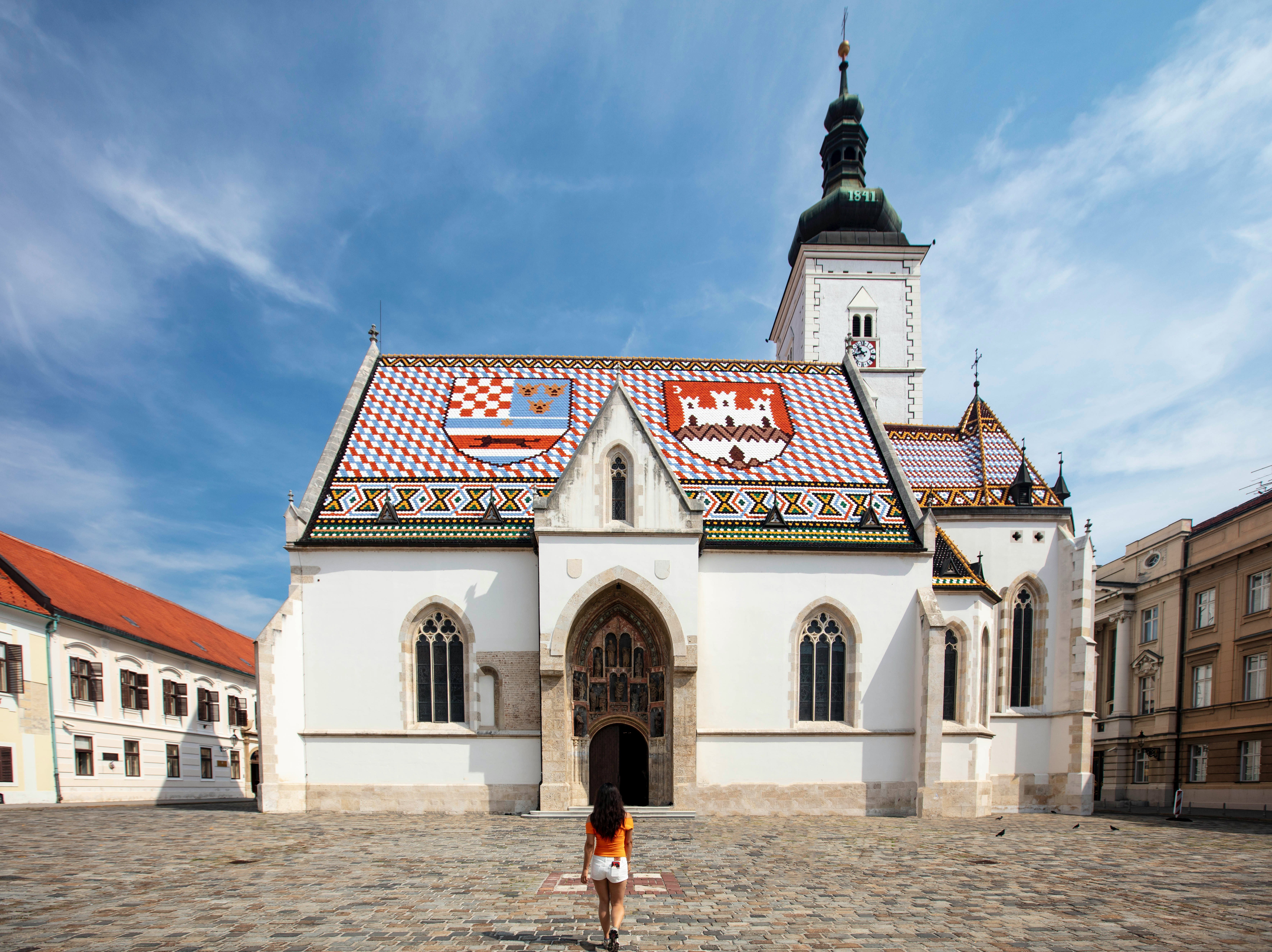
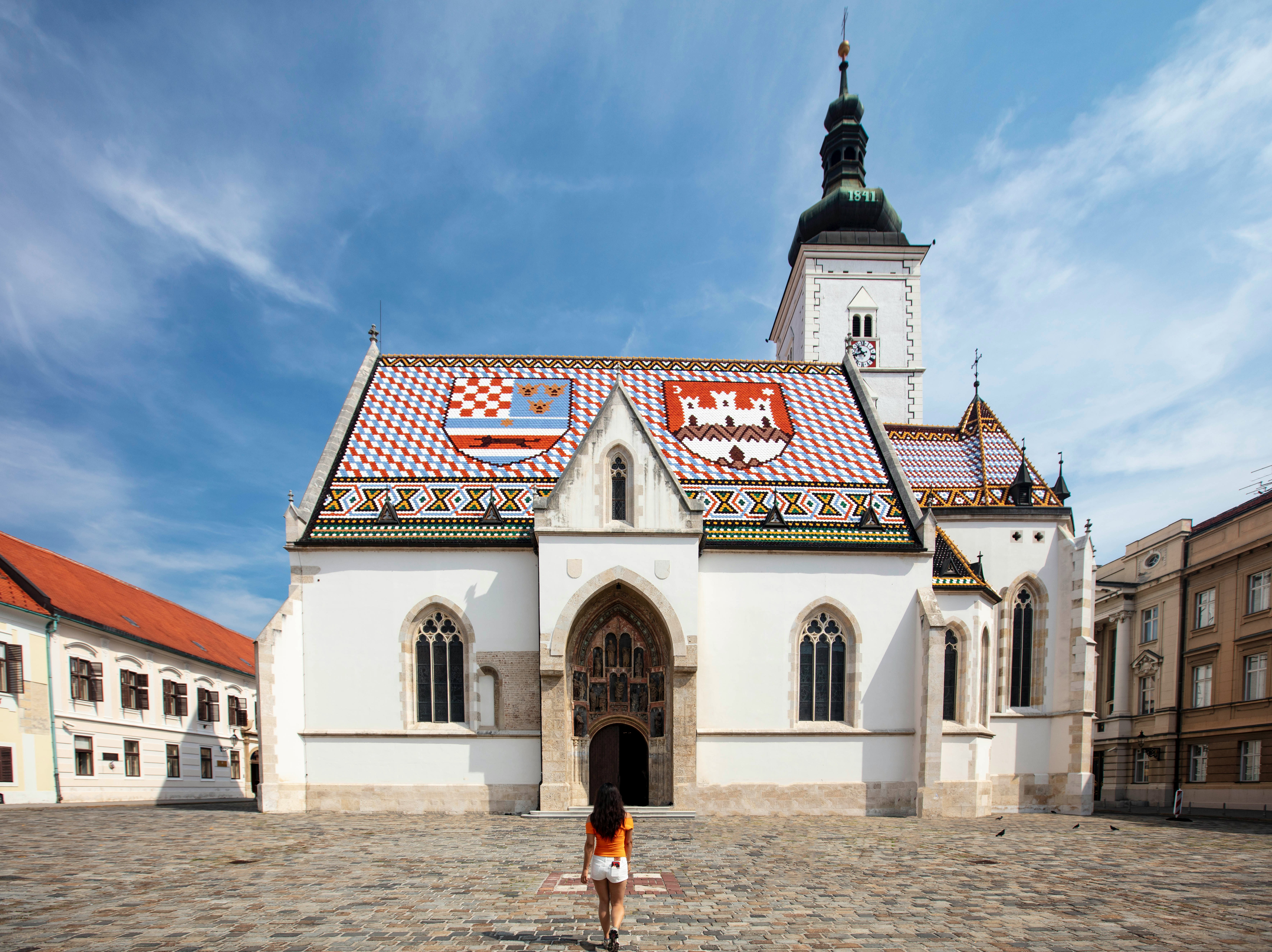
Through the gate you reach the political heart of Croatia: parliament on one side, the government building on the other, and between them the church with the tiled roof you have seen on every postcard. The tiles were laid in 1880 and show the arms of the Triune Kingdom of Croatia, Slavonia and Dalmatia alongside the coat of arms of Zagreb.
The interior has been closed for restoration and access remains limited, so plan on admiring it from outside. From April to October the Cravat Regiment performs a changing of the guard here at noon on Saturdays and Sundays, in replica seventeenth-century uniforms. It is free, brief and worth the detour if you are walking on a weekend.
7. Museum of Broken Relationships
A two-minute walk from the square at Ćirilometodska 2. Two Zagreb artists, Olinka Vištica and Dražen Grubišić, ended a relationship and started collecting the objects people keep after breakups, along with the stories behind them. It won the Kenneth Hudson Award for Europe's most innovative museum in 2011.
Adult entry is €9. Allow an hour, more if you read everything, and be warned that the axe exhibit stays with you.
8. Lotrščak Tower and the Noon Cannon
Time your walk to be here before twelve. Since 1 January 1877 a cannon has fired from the top of this thirteenth-century tower every single day at noon, originally so the city's bell-ringers could synchronise. Nobody warns the tourists, which is half the fun. Locals do not flinch.
You can climb the tower for the view, or stand outside and wait for the bang.
9. Strossmayer Promenade
Directly beside the tower, running along the line of the old walls under a canopy of chestnut trees, this is the best free viewpoint in Zagreb. Look for the bronze figure of the poet Antun Gustav Matoš sitting on a bench, permanently taking in the same view.
Through the summer, roughly late May to early September, the promenade hosts Strossmartre, an open-air programme of concerts, art and outdoor film. Everything is free. Come back after dark.
10. The Funicular

The descent is the fun bit. Zagreb's funicular has connected the two towns since 1890, covers 66 metres, takes 64 seconds, and is widely described as the shortest funicular in the world.
It closed in January 2025 for its first full reconstruction in more than fifty years and reopened on 19 May 2026 after a €9.1 million restoration. The new cabins were built as replicas of the 1974 ones, so it looks exactly as it always did. A one-way ride costs €0.66 and is not covered by a standard tram ticket.
11. Grič Tunnel
At the bottom, cut back into the hillside. The Grič Tunnel was dug in 1943 as a shelter from Allied bombing, used again during the war of the 1990s, and opened to the public in July 2016. It runs roughly 350 metres between Mesnička and Radićeva with branches heading south.
Free, open 9am to 9pm, and often hosting a temporary exhibition. In summer it is the coldest place in central Zagreb.
12. Zrinjevac
Finish in the Lower Town. Zrinjevac is the first of a chain of linked parks and squares known as the Green Horseshoe, laid out in the nineteenth century when Zagreb was building itself an Austro-Hungarian downtown. Plane trees, a bandstand, a meteorological column, and benches that are usually full.
This is where the walking stops and the sitting starts, which brings you back to the point of the city.
Where to Eat Without Leaving the Route

Zagreb's signature dish is štrukli, sheets of thin dough filled with cottage cheese, either baked until the top blisters or served in a broth. La Štruk at Skalinska 5, a minute off Tkalčićeva, cooks nothing else and opens 11am to 10pm daily. Order one savoury and one sweet between two people.
For the cheapest good lunch on the route, Plac Kitchen & Grill sits at Dolac 2, at the edge of the market, and grills ćevapi to order. For something more substantial, Gostionica Ficlek at Pod zidom 5 does old Zagreb home cooking, including turkey with mlinci, the flat baked pasta that turns up on every Croatian holiday table. HERITAGE on Petrinjska 14 does regional Croatian ingredients in flatbread form, which is the easiest way to taste Istria and Slavonia in one sitting.
Coffee deserves its own paragraph, because in Zagreb it is a social institution rather than a caffeine delivery system. Eli's Caffe at Ilica 63 is run by a former national barista champion and closes at 5pm on weekdays, earlier at weekends. Cogito at Varšavska 11 roasts its own. Velvet on Dežmanova, tucked off Ilica, is where you go when you want to lose an hour on a terrace and not feel guilty about it.
Timing: The Day You Walk It Matters
Saturday morning in Zagreb belongs to špica. Between roughly 10am and 3pm the terraces along Bogovićeva and Cvjetni trg fill with people who have dressed for the occasion, and the entire city appears to be having coffee at the same time. It is a genuine local ritual and it is free to join. Walk the route early, then position yourself at a terrace by eleven and watch.
Sunday is the opposite. Dolac shuts at 1pm, many shops stay closed, and the centre is slow. That makes it the best morning for the Upper Town, which empties out.
Practicalities: tickets bought at a Tisak kiosk or on the MojZET app cost €0.53 for 30 minutes, €0.93 for 60 and €1.33 for 90, and are notably more expensive from the driver. A daily ticket is €3.98. You will barely need any of it, because the centre is walkable end to end, but it is useful for Mirogoj and the outer neighbourhoods. Wear shoes with grip. The Upper Town is cobbled, steep in places, and slippery after rain.
If You Have a Second Morning
Sunday at Britanski trg, known to everyone as Britanac, is the best antiques and flea market in Croatia. Stalls are properly set up by 9am and it is a ten-minute walk west of the centre along Ilica.
Mirogoj is a short bus ride north of the Cathedral and is one of the most beautiful cemeteries in Europe, designed by the same Hermann Bollé who rebuilt the cathedral. Arcades, ivy, domes, and Croats of every faith buried alongside one another. Entry is free and it opens at 7:30am.
Trešnjevka, west of the centre, is where Zagreb stops performing for visitors. Second-hand record shops on Tratinska, a large working market, and cafés with no English menu. Take tram 3, 9 or 12.
See Zagreb With Someone Who Lives There

A route gets you to the right places. A local gets you the reason those places matter, and the four or five spots that never make it onto a list because nobody thinks to write them down.
Take a personalised walking experience with Lokafy in Zagreb and explore the Upper Town, Dolac and the streets in between with a local host who shapes the walk around what you came to see. Not a script, not a group of thirty. One person showing you their city, at the pace Zagreb is meant to be taken.
Zagreb Walking Tour FAQs
How long does a Zagreb walking tour take?
The standard Old Town loop, covering Ban Jelačić Square, Dolac, the Cathedral, the Stone Gate, St Mark's Square, Lotrščak Tower and the Strossmayer Promenade, takes about two hours at guided pace. Walking it yourself with market and coffee stops, allow four.
Is Zagreb walkable?
Yes. The historic core is one of the most compact of any European capital, and the entire route above sits within roughly a kilometre of Ban Jelačić Square. The only real climb is from the Lower Town into Gradec, and the funicular removes even that.
What time does the cannon fire in Zagreb?
Every day at noon, from Lotrščak Tower in the Upper Town. The tradition began on 1 January 1877 and has continued since. It is loud, so if you are standing directly beneath the tower, expect the surprise.
Is Zagreb Cathedral open in 2026?
Yes. It reopened to visitors on 17 April 2026 after six years of repairs following the 2020 earthquake. Entry is free. Restoration of the two 108-metre towers continues, so scaffolding is still part of the view.
Is the Zagreb funicular running again?
Yes. It reopened on 19 May 2026 after a €9.1 million reconstruction, its first complete overhaul since the 1970s. A one-way ticket costs €0.66 and the ride takes 64 seconds.
Is St Mark's Church open to visitors?
Access to the interior has been restricted during restoration work, so plan on seeing the famous tiled roof from St Mark's Square rather than going inside. Check locally before you climb up, as the situation has changed several times.
What is the best day for a walking tour of Zagreb?
Saturday, if you want the city at full volume: markets busy, špica in progress from mid-morning, and the changing of the guard on St Mark's Square at noon between April and October. Sunday, if you want the Upper Town almost to yourself, though Dolac closes at 1pm and many shops stay shut.
Do I need to book a walking tour in Zagreb in advance?
Tip-based group tours generally require booking a day ahead in summer. Private and personalised experiences should be arranged further out, particularly for June through September and the Advent season in December, when Zagreb is at its busiest.
Enjoyed this article?


