The first time I visited Munich in December, I lasted about twenty minutes on Marienplatz. The tree was enormous and the town hall looked like a gingerbread cathedral, but I had a stranger's elbow in my ribs and a mug of Glühwein that cost more than my breakfast. The best advice I got that trip came from a Munich local: walk away from the main square, and keep walking. Munich has more than a dozen Christmas markets, and the best of them sit within an easy stroll of each other, tucked into a palace courtyard, a corner of the English Garden and the squares of the old town. This guide strings them into one walking route, the way locals do it, with the snacks, drinks and timing that make the difference between a crowded afternoon and a proper Advent evening.
Quick Guide: Munich Christmas Markets
- Primary Recommendation: Walk a route from the English Garden down to the Glockenbach quarter instead of spending the whole day on Marienplatz. Around 5 km covers six markets and the city's most famous hot drink.
- Top Choice for Atmosphere: The Medieval Christmas Market on Wittelsbacherplatz. Go before dark, when the torches are being lit and the queues for hot mead are short.
- Value Pick/Vibe: The Haidhausen market on Weißenburger Platz, a neighbourhood favourite since 1976 with a mechanical Santa pedalling over the stalls. Best for travellers who want the local version of Christmas.
- The Best Way to See the City: Take a private, personalised walking experience with Lokafy in Munich and discover the neighbourhood markets, Advent traditions and food stops with a local.
How This Munich Christmas Market Route Works

The route runs north to south through the old town, roughly 5 km of walking spread over five or six hours. Start around noon in the English Garden, reach Marienplatz near dusk when the lights come on, and finish in the Glockenbach quarter, where the evening crowd is local and the markets stay open later.
A few things shape when you should go:
- Pick a Wednesday to Saturday. The Chinese Tower market has only opened Wednesday to Sunday in recent seasons, and Café Frischhut (stop five) is closed on Sundays.
- Avoid Totensonntag. On the Sunday before the first Advent weekend, Germany's day of remembrance for the dead, the central markets close for the day. Marienplatz opens on the Friday before it, so the opening weekend has a gap in the middle.
- Weekdays beat weekends. Saturday evenings at Marienplatz and the Residenz are shoulder to shoulder. A Tuesday or Wednesday feels like a different city.
Sunset in Munich comes early in December, around 4:20pm, so the timing below puts you in the daylight markets first and saves the glowing ones for after dark.
Stop 1: The Christmas Market at the Chinese Tower
Start where Munich goes to escape Munich. In summer, the wooden pagoda in the middle of the English Garden anchors one of the city's biggest beer gardens. In Advent, the benches give way to small wooden huts selling local crafts, and the smell of roasted almonds drifts across the frozen lawns.
This is the most relaxed market on the route, and the one most visitors skip because it feels too far out. It isn't. Take the U3 or U6 to Giselastraße and walk ten minutes into the park, or catch bus 54, which stops close to the tower. Locals come here for Eisstockschießen, Bavarian curling, played on lanes beside the stalls. Watching a team of office workers take it very seriously over a mug of punch is one of the better free shows in Munich.
It closes earlier than the city centre markets, at around 8:30pm in recent seasons, which is another reason to do it first.
Walk to the next stop: Head south through the English Garden and the Hofgarten to Odeonsplatz. Allow 30 minutes. In fresh snow, this stretch is the prettiest walk in the city.
Stop 2: The Medieval Christmas Market on Wittelsbacherplatz
Wittelsbacherplatz sits a few steps west of Odeonsplatz, and from mid-afternoon it smells like woodsmoke and roasting meat. This is the Mittelaltermarkt, also billed as the Munich Advent Spectacle, and it's the market Munich locals argue about most. Some find it a bit theatrical. Plenty of others call it their favourite in the city, and once you see it, you understand why.
Traders work in period costume, drinks arrive in stoneware mugs, and the mulled wine goes by names like Hexentrunk (witches' brew). Jugglers and musicians wander between the stalls, and the light comes from torches and open fires rather than fairy lights. The food here is a step up from the standard bratwurst stand, with grilled meats and hearty stews built for standing outside in the cold.
The market runs daily from 11am to 9pm, and the hot mead is worth the small extra deposit for the clay cup. Plenty of people take it home.
Stop 3: The Christmas Village in the Residenz
Walk back across Odeonsplatz and down Residenzstraße to the entrance of the Kaiserhof, one of the courtyards of the former royal palace. Inside is the Weihnachtsdorf, a Christmas village of decorated huts set against the palace walls. Entry is free.
What makes this one different is the fairy-tale trail. Scenes from stories like Little Red Riding Hood and Frau Holle are staged with puppets in small cabins around the courtyard, and children (and a surprising number of adults) move from one to the next. Look out for artisans demonstrating their crafts, and for the occasional live band.
The Christmas Village usually opens a few days before the other markets, in mid-November, and runs 11am to 9pm. It gets packed on weekend evenings, so a weekday afternoon visit is the move here.
Walk to the next stop: Follow Residenzstraße and Dienerstraße south to Marienplatz. About eight minutes.
Stop 4: Marienplatz, Done the Smart Way
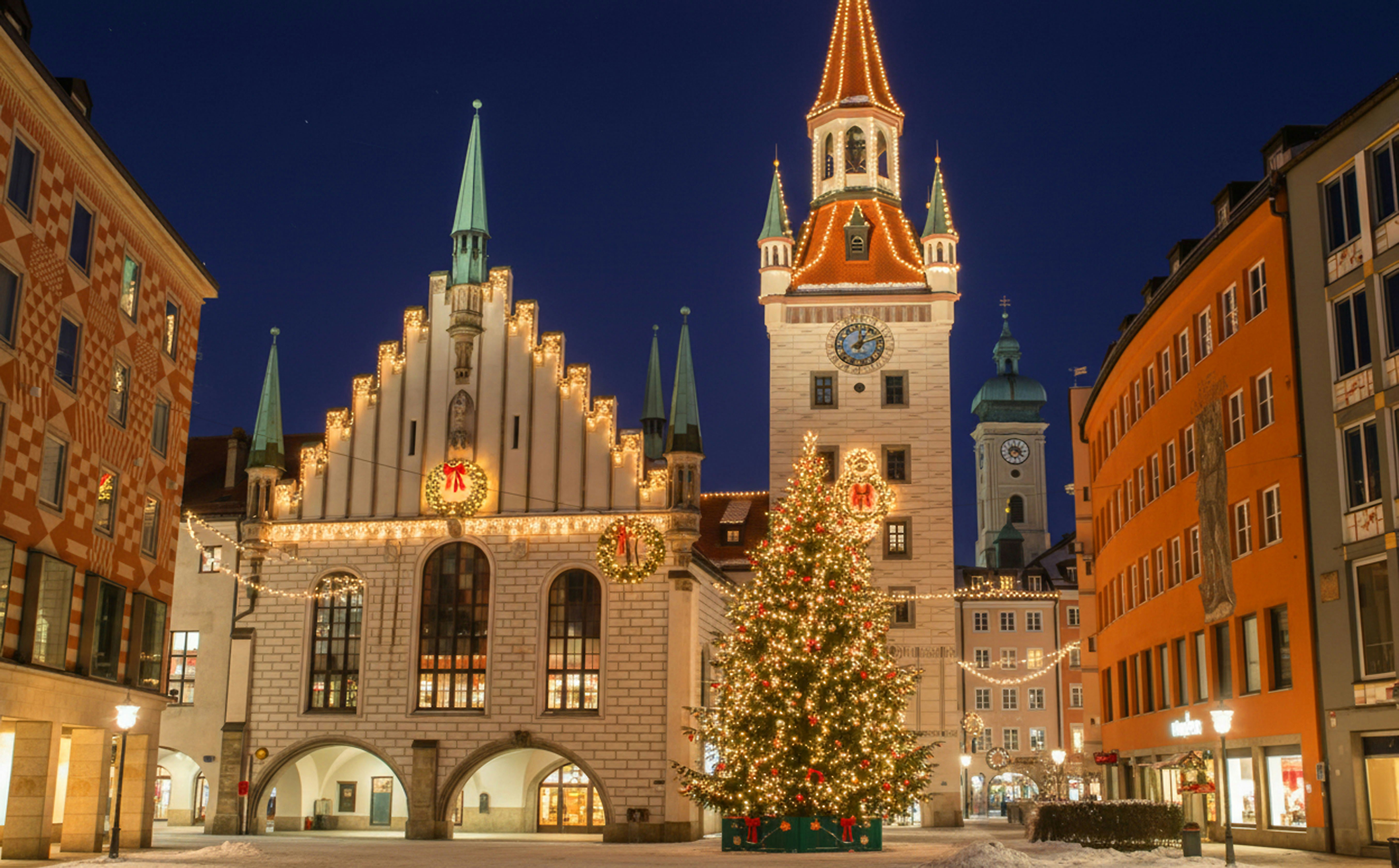
You should still see Marienplatz. Time it for dusk, when the Christmas tree in front of the Neues Rathaus lights up and the square feels like a snow globe. The market here is the original, with roots going back to the 14th century and more than 130 stalls spilling down the pedestrian zone. The tree is donated each year by a different town in Austria or Italy, and on Advent evenings there's live music from the town hall balcony.
The trick is to treat Marienplatz as a viewpoint rather than a place to settle in. Three ways to do that:
Climb Alter Peter. The tower of St. Peter's Church looks straight down onto the market. The climb is narrow and the stairs are steep, but the view of the lit square from above is the best photo in Munich at Christmas.
Browse the Kripperlmarkt. Right beside St. Peter's sits the nativity market, probably the largest of its kind in Germany. Stalls sell hand-carved figures, tiny lanterns and miniature stables, and Munich families have been adding to their nativity scenes here for generations.
Find the Sternenplatzl. Behind the church on Rindermarkt, the trees are strung with star-shaped lights. It's part of the main market but feels like a separate little world, and it's the calmest place near Marienplatz to stand with a hot drink.
Stop 5: A Schmalznudel and the Big Feuerzangenbowle
From Rindermarkt, wander down to the Viktualienmarkt, Munich's daily food market. Your target is Café Frischhut on Prälat-Zistl-Straße, a family-run café since 1973 that locals call "die Schmalznudel" after its signature pastry. A Schmalznudel (or Auszogne) is yeast dough stretched by hand and fried in lard until the edges go crisp and the centre stays soft. You can watch them being made by the door. The café closes at 6pm and stays shut on Sundays, so don't leave this stop too late.
Next, head to Blumenstraße 22, behind the Schrannenhalle and beside the old concrete bunker. This is where the Münchner Feuerzangenbowle has set up in recent winters, while its usual home at the Isartor is under renovation. The kettle holds 9,000 litres. Above it, a rum-soaked sugar loaf is set alight and drips caramel into the hot spiced wine below. It's sweeter and stronger than Glühwein, and one mug is plenty.
Unlike the markets, the Feuerzangenbowle keeps going after Christmas, right through to 6 January, which makes it the only spot on this route that works for a trip between Christmas and New Year.
Stop 6: Sendlinger Tor and Pink Christmas
Ten minutes south-west, the old Sendlinger Tor city gate frames a small Christmas market that photographs beautifully around sunset. It's compact, with a carousel and a cluster of stalls under the medieval towers, and it makes a good warm-up for the last stop.
A few minutes further south on Stephansplatz, in the heart of the Glockenbach quarter, is Pink Christmas, Munich's LGBTQ+ Christmas market since 2005. Think pink lights, drag performances on a small stage, glitter where you least expect it, and some of the friendliest crowds of the season. Everyone is welcome, and it's the most social market in the city: strangers end up sharing standing tables and stories by the second round.
Pink Christmas opens at 4pm on weekdays and 2pm at weekends, stays open until 10pm, and closes a few days before the other markets. If you're visiting in the last days before Christmas, check the dates before planning around it. When the market winds down, the bars of the Glockenbach quarter are all around you.
Bonus Evening: Haidhausen's Market on Weißenburger Platz
If you have a second evening, cross the river. The Haidhausen Christmas market has been held on Weißenburger Platz since 1976, and it's the market Munich residents mention first when you ask where they go. Over 60 stalls ring the old Glaspalast fountain in the middle of the square, in a neighbourhood known as the French Quarter for its street names.
Look up as you walk in. A mechanical Santa pedals a bicycle along a wire above the stalls, and he leads you towards a stand selling fruity Glühwein flavours like raspberry and cherry. The crowd here is mostly local families and people stopping by after work, and the prices tend to sit a little below the old town.
Getting there is easy on foot: from the Isartor, cross the Ludwigsbrücke over the Isar and follow Rosenheimer Straße uphill. It's about 25 minutes. The S-Bahn stop Rosenheimer Platz and the Ostbahnhof are both close by if your feet are done.
What to Eat and Drink Along the Way

You'll find bratwurst and Glühwein everywhere, but a few things are worth seeking out:
- Glühwein: Expect to pay around 5 to 6 euros on Marienplatz, plus a mug deposit (Pfand) of about 3 euros. Return the mug for the deposit or keep it as a souvenir. Each market has its own design.
- Kinderpunsch: Alcohol-free fruit punch, sold at nearly every stand. Good for kids and for pacing yourself on a long route.
- Gebrannte Mandeln: Sugar-roasted almonds, sold warm in paper cones.
- Bratapfel: A baked apple stuffed with nuts and raisins, often served with vanilla sauce.
- Schmalznudel: From Café Frischhut, as above. Eat it warm.
- Feuerzangenbowle: Once, at the giant kettle. It has more kick than it tastes.
Practical Tips Munich Locals Swear By
- Carry cash. Card payments are more common than they used to be, but plenty of smaller stalls still prefer cash, and paying the Pfand in coins is faster.
- Dress for standing still. You'll be walking between stops but standing at the markets, and that's when the cold gets you. Warm boots and gloves you can hold a mug in matter more than a heavy coat.
- Watch for the Krampus run. On one Sunday in mid-December, around 300 Krampuses and Perchten, the shaggy horned figures of Alpine folklore, parade through the city centre. It draws big crowds around Marienplatz, which is either a reason to plan your day around it or a reason to be at the Chinese Tower instead.
- Plan for closing day. Most markets close on 23 or 24 December, and Christmas Eve hours end in the early afternoon. Marienplatz shuts at 2pm on the 24th.
- Don't skip daylight. The medieval market and the Chinese Tower are at their best in the afternoon. The old town markets are at their best after dark. The route is built around that.
See Munich's Christmas Markets with a Local

A map gets you from market to market. A local tells you which stall makes the best Bratapfel, which courtyard has no queue at 3pm, and why every family in the city has an opinion about the Kripperlmarkt. That's the difference between seeing Munich at Christmas and understanding it.
With Lokafy, you explore with a Munich local on a private walk built around what you want, from palace courtyards and neighbourhood markets to the food stops and Advent traditions most visitors never hear about. There's no fixed script and no group of strangers to keep pace with, only your interests and someone who knows the city in winter.
Take a private, personalised walking experience with Lokafy in Munich and discover the city's Christmas markets with a local.
FAQ: Munich Christmas Markets
When do the Munich Christmas markets open? Most Munich Christmas markets open in the second half of November. The main market on Marienplatz opens on the Friday before Totensonntag (the Sunday before the first Advent weekend) and runs until 24 December. The Residenz Christmas Village usually opens a few days earlier, in mid-November.
What is the best Christmas market in Munich? It depends on what you want. The Marienplatz Christkindlmarkt is the oldest and most famous. Locals often name the Medieval Christmas Market on Wittelsbacherplatz for atmosphere, the Residenz Christmas Village for setting, and the Haidhausen market on Weißenburger Platz for a neighbourhood feel.
Can you walk between Munich's Christmas markets? Yes. The Chinese Tower, Medieval Market, Residenz, Marienplatz, Sendlinger Tor and Pink Christmas markets can all be linked on foot in a route of about 5 km. The Haidhausen market is a 25-minute walk from the Isartor across the river.
How much does Glühwein cost at Munich Christmas markets? Munich is one of the pricier cities in Germany for Glühwein. Expect around 5 to 6 euros per mug at Marienplatz, plus a deposit (Pfand) of about 3 euros, which you get back when you return the mug.
Are Munich Christmas markets open after Christmas? Most close on 23 or 24 December. The Münchner Feuerzangenbowle, behind the Schrannenhalle near the Viktualienmarkt, stays open until 6 January, so it's the best option for a visit between Christmas and New Year.
Are Munich Christmas markets open on Sundays? Yes, most are open on Sundays, often with slightly shorter hours. The exception is Totensonntag, the Sunday before the first Advent weekend, when the central markets close for the day.
How many days do you need for the Munich Christmas markets? One full day covers the walking route in this guide. Add a second evening for the Haidhausen market and a slower look at the markets you liked best.
Enjoyed this article?