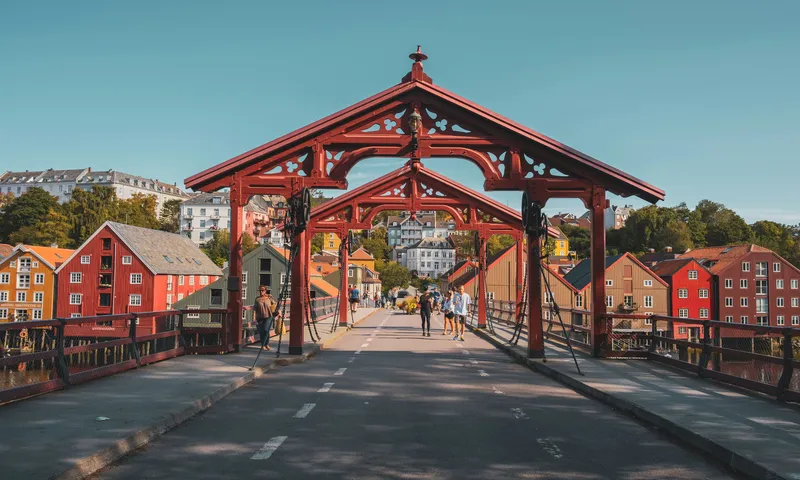
The first time I walked Bergen properly, I made the mistake almost everyone makes. I went straight from my hotel to the fish market, took the funicular up Fløyen at midday with four hundred other people, came back down, and thought I had seen the city. What I had seen was the postcard. The Bergen that people who live here move through every day sits about three streets behind it, up a set of stone steps most visitors walk past without looking. This route fixes that, and you can do the whole thing on foot in an afternoon.
Quick Guide: Walking Bergen
- Primary recommendation: Start at Torgallmenningen and walk the back passages of Bryggen before 9am, when the cruise crowds arrive. The wooden alleyways behind the famous facade are the reason Bryggen is UNESCO listed, and almost nobody photographs them.
- Top choice for views: Fjellveien, the gravel path that runs along the hillside above the city. It costs nothing, it is flat once you are on it, and the view is better than the one from most paid platforms.
- Value pick: Nordnes peninsula for anyone travelling slowly. Quiet wooden lanes, a park at the tip, and a 25-metre heated seawater pool at Nordnes Sjøbad where locals swim year-round.
- Best time to walk: Between 8am and 11am, or after 5pm. Cruise passengers flood the harbour between 11am and 4pm in summer.
- The best way to see the city: Take a private, personalised walking experience with Lokafy in Bergen and discover the alleys, cafés, and hillside paths with a local who lives there.
Why Bergen Is a Walking City
Bergen's centre is small in a way that surprises people. The distance from the train station to the far tip of the Nordnes peninsula is about 25 minutes on foot, and everything in this guide sits inside that stretch. There is a light rail (Bybanen) and a good bus network, but you will barely need either.
What makes walking here different from walking in Oslo or Copenhagen is the vertical element. Bergen is built into the sides of seven mountains, so the city keeps tilting. Streets end in staircases. A lane that looks like a dead end on the map turns out to be 60 stone steps leading to a row of white wooden houses with a view over the fjord. Half the pleasure of a Bergen walking tour comes from following those steps upward when you have no idea what is at the top.
Two practical things before you start. Wear shoes with grip, because the older lanes are cobbled and slick when wet. And accept that it will probably rain. Bergen is the rainiest city in Norway and the locals treat drizzle as weather, not as a reason to stay in.

The Route, Stop by Stop
The full loop below runs about 5 kilometres and takes three to four hours at a relaxed pace with stops. It starts and ends in the centre.
1. Torgallmenningen and Byparken
Start at Torgallmenningen, the wide pedestrian square that functions as Bergen's living room. Locals meet at the Seafarers' Monument here the way Londoners meet under the clock at Waterloo. Walk east to Byparken, the small park with the ornate 1888 bandstand and the pond, and get your bearings: mountains behind you, harbour ahead.
2. Fisketorget, the Fish Market
Five minutes north brings you to Torget and the fish market, which has been trading on this spot since the 1200s. The outdoor stalls run from 1 May to 30 September, with core hours from 10:00 to 18:00.
Here is the local view, delivered gently: look, photograph, do not sit down and order the seafood platter. The outdoor stalls charge tourist prices. Walk through the doors into Mathallen, the glass-fronted indoor hall that opened in 2012, where the same seafood is sold at counters that also supply the city's restaurants. Fjellskål and Fish Me both have proper sit-down sections inside, and Mathallen is open all year, which matters if you visit in February.
3. The Back Passages of Bryggen
Everyone photographs the front of Bryggen, the crooked row of ochre and red wooden gables facing the harbour. Then they walk on. The mistake is not going inside.
Duck into any of the narrow passages between the buildings and you enter a warren of wooden galleries, leaning walkways, and interior courtyards that smell of tar and old timber. The buildings you are standing in were rebuilt after the great fire of 1702, on foundations that go back to the Hanseatic merchants of the medieval trading post. The floors slope. The corridors are dark. This is the part that earned Bryggen its UNESCO World Heritage status, and at 8:30 in the morning you will often have it entirely to yourself.
When you come out the far end, stop at Baker Brun on Bryggen for a skillingsbolle, Bergen's cinnamon bun, which the city has been eating for centuries and takes fairly seriously.
4. Bergenhus Fortress
Keep walking north along the water and the wooden houses give way to stone. Bergenhus is one of Norway's oldest fortifications and it is still in partial military use, but the grounds are open and free to walk through. Håkon's Hall was built between 1247 and 1261, when Bergen was Norway's capital and this was the royal seat. The Rosenkrantz Tower next to it went up in the 1560s as a combined residence and defensive tower.
You can pay to go inside both. If your time is limited, walking the grounds and looking out at the harbour from the ramparts gives you most of what you came for.
5. Sandviken and the White Wooden Houses
North of the fortress the road curves into Sandviken, and this is where the walk starts to feel like someone's neighbourhood rather than an attraction. Skuteviken and Sandviken are dense with 18th and 19th century wooden houses in white, ochre and dusty red, stacked up the hillside on lanes too narrow for cars.
If you have energy and good calves, Stoltzekleiven starts here: roughly 900 stone steps straight up Sandviksfjellet. It is a local fitness institution, and on any dry evening you will pass people in running gear treating it as a workout. The climb takes most people 30 to 45 minutes and the view at the top is enormous.
6. Fjellveien
Fjellveien is the answer to the question every visitor asks without knowing it: where do people in Bergen go for a walk?
It is a wide gravel road running along the mountainside above the city, roughly level once you have climbed up to it, lined with benches placed at exactly the spots where the view opens out. Prams, dogs, teenagers, retired couples. On a clear evening it is one of the nicer 45 minutes you can spend in Norway, and it costs nothing.
You can reach it on foot from Sandviken, or ride the Fløibanen funicular one stop to the Fjellveien mid-station, which costs NOK 90 return for an adult and skips the steepest section.
7. Fløyen
From Fjellveien, paths lead up to Fløyen at 320 metres. Walking up from the city takes 45 minutes to an hour on a well-marked path; the funicular takes six minutes.
Prices as of August 2026: an adult return is NOK 200 bought through the app, website, or a ticket machine, and NOK 220 at the ticket counter. One way is NOK 105 online. The funicular runs from 07:30 until midnight. Your ticket is valid from the day before your chosen date until three days after, which gives useful flexibility if the weather turns.
The move locals recommend is to buy a one-way ticket. Ride up, have a coffee at the top, then walk down through the woods and the older residential streets. It takes about 45 minutes, it is downhill, and you finish at the top of Bryggen instead of in the queue for the return carriage.
8. Skostredet, Marken and Back to Nordnes
Coming down into the centre, cut through Skostredet, the short street that holds most of Bergen's tattoo studios, record shops, second-hand clothing and small bars. Nearby Marken, a narrow pedestrian lane running towards the train station, has a similar independent feel.
Finish by walking west out onto the Nordnes peninsula. The lanes here are residential and quiet, and the peninsula ends in Nordnes Park, with the aquarium next door. Nordnes Sjøbad sits at the tip: a 25-metre saltwater pool heated to 30°C, plus saunas, a diving tower, and steps straight into the fjord. The summer season runs June to September and entry is around NOK 130. Swimming in a heated pool with the fjord and the mountains in front of you is, for many Bergensers, the definition of a good day off.
How Long the Walk Takes
- Full loop: 5 kilometres, three to four hours with stops, plus another hour if you climb Fløyen on foot.
- Short version (90 minutes): Torgallmenningen, fish market, Bryggen passages, Bergenhus, back along the harbour.
- Cruise passenger version (three hours): The short version, plus the funicular up and the walk down. The Fløibanen base station is a five-minute walk from the fish market.
- Slow version (full day): The full loop with a long lunch at Mathallen and a swim at Nordnes.
Where to Eat Along the Route
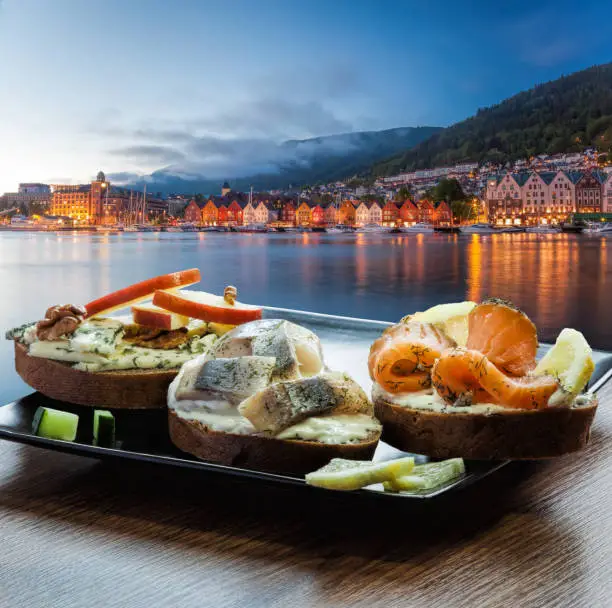
Bergen is expensive, so knowing where to stop matters more than usual.
Søstrene Hagelin on Strandgaten, a minute from the tourist information office, has been making fish cakes from fresh haddock to the same 1929 recipes for nearly a century. Order fiskekaker or the fish soup, eat standing at the counter, and pay a fraction of restaurant prices.
Pingvinen on Vaskerelven serves traditional West Norwegian home cooking: meatballs, fish gratin, plukkfisk, and raspeballer (potato dumplings) on Thursdays, which is a Western Norway institution rather than a gimmick.
Trekroneren, the small sausage stand on Kong Oscars gate, does reindeer sausage with lingonberry and crispy onion for a few hundred kroner less than a sit-down dinner. It stays open late.
Mathallen at the fish market is the safest bet for seafood without the harbour-stall markup.
Costs and Tickets in 2026
- Fløibanen funicular: adult return NOK 200 online or in the app, NOK 220 at the counter, one way NOK 105 online. Mid-station return NOK 90.
- Ulriken cable car (if you want the higher mountain at 643 metres): adult return NOK 435, one way NOK 255. The Ulriken Express bus from Torgallmenningen 1A runs roughly every 30 minutes between 09:00 and 18:30 and costs NOK 150 return.
- Bus and light rail (Skyss): a single adult ticket in zone A is NOK 51 and is valid for 60 minutes. Bybanen line 1 runs between the airport and the centre.
- Bergen Card: NOK 400 for 24 hours, NOK 500 for 48 hours, NOK 600 for 72 hours. It includes light rail and buses and gives 50% off the Fløibanen return, which brings that ticket to NOK 100 in summer.
- Nordnes Sjøbad: around NOK 130 in summer.
Walk Bergen With Someone Who Lives There

A route on a page gets you to the right places. What it cannot do is tell you which staircase behind Sandviken has the best view at 7pm in July, why the neighbourhood argues about the wooden houses, or where the person walking beside you buys their coffee.
That is the gap Lokafy fills. You are paired with a Bergen local who walks the city with you at your pace, adjusts the route to what you are curious about, and answers the questions a sign at Bryggen never will. It is a private, personalised walking experience rather than a group following a raised umbrella, and the fee goes to the person showing you around.
If you have one afternoon in Bergen, this is the version of it worth having. Book a walk with a local in Bergen.
Frequently Asked Questions
Is Bergen walkable?
Yes. Bergen's city centre is compact enough to cross on foot in about 25 minutes, and every major sight (Bryggen, the fish market, Bergenhus Fortress, the Fløibanen base station, Nordnes) sits within that area. The complication is elevation rather than distance, since the city climbs the sides of seven mountains and many streets end in staircases. Wear shoes with grip.
How long does a Bergen walking tour take?
A full self-guided loop covering Bryggen, Bergenhus, Sandviken, Fjellveien and Nordnes runs about 5 kilometres and takes three to four hours with stops. A short version covering the harbour and Bryggen takes 90 minutes. Add an hour if you walk up Fløyen instead of taking the funicular.
What is the best walking route in Bergen?
Start at Torgallmenningen, walk to the fish market and through the back passages of Bryggen, continue north to Bergenhus Fortress and the wooden houses of Sandviken, climb to Fjellveien for the view, then descend through Skostredet and finish on the Nordnes peninsula. This route covers the UNESCO area and the residential neighbourhoods most visitors miss.
Should I walk up Fløyen or take the funicular?
Buy a one-way funicular ticket up (NOK 105 for an adult online in summer 2026) and walk down. The descent takes about 45 minutes on a marked path through woodland and residential streets, it avoids the queue for the return carriage, and it brings you back into the city near Bryggen.
Can you see Bergen in one day on foot?
Yes. One full day is enough to walk the harbour, Bryggen, the fortress, Sandviken, Fjellveien and Fløyen, with time for a meal at Mathallen. Two days lets you add Nordnes Sjøbad, the Ulriken cable car, or a fjord trip.
When is the best time of day to walk Bergen?
Between 8am and 11am, or after 5pm. Cruise ships dock in the morning and their passengers fill the harbour and Bryggen from roughly 11am to 4pm in summer. Early morning at Bryggen is close to empty.
Do I need to book a walking tour in Bergen in advance?
For a private experience with a local, book a few days ahead, especially between June and August when cruise arrivals peak. A personalised walk can be arranged for a specific morning or evening, which is the practical way to avoid the middle-of-the-day crowds.
What should I wear for walking in Bergen?
A waterproof jacket, layers, and shoes with grip. Bergen is the rainiest city in Norway and rain is common even in summer. Umbrellas struggle in the wind coming off the fjord, so a hood is more useful.
Enjoyed this article?