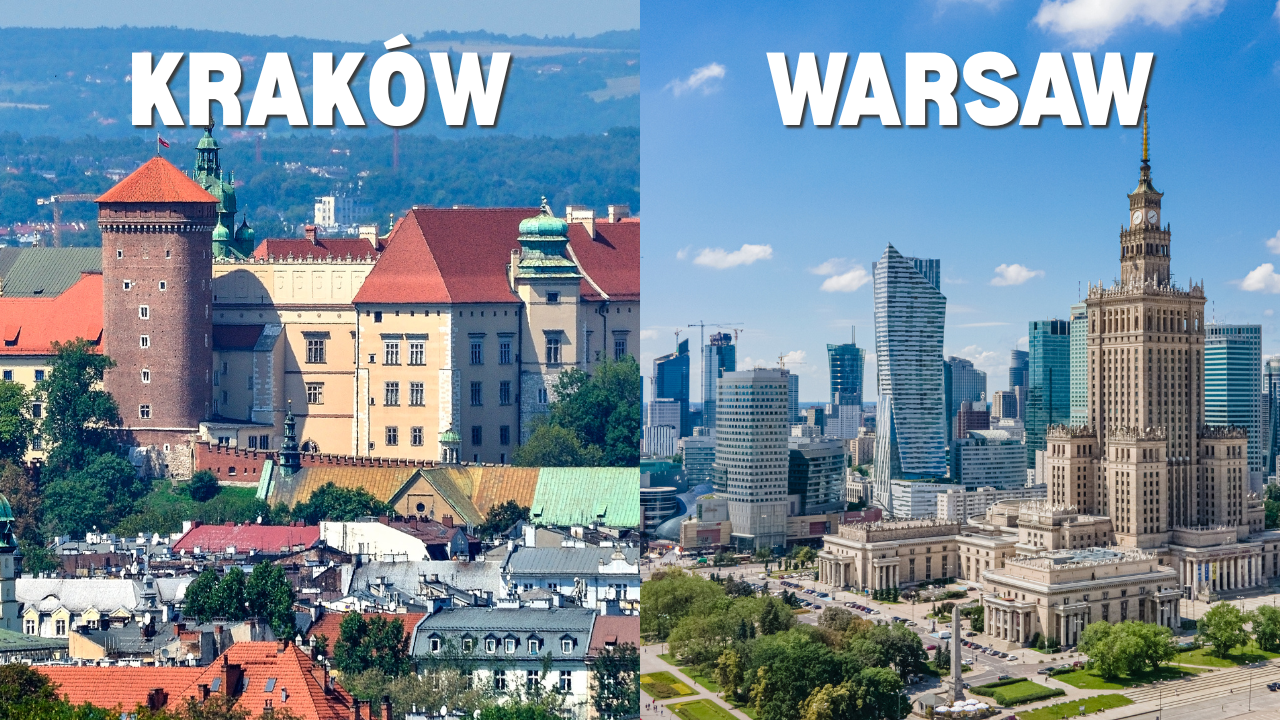
The first time I tried to settle this question I asked five Poles and got five different answers, most of them delivered with the kind of energy usually reserved for football. Krakow people think Warsaw is a business park with a nice river. Warsaw people think Krakow is a beautiful museum that closed for repairs around 1600 and never reopened. Both are wrong, and both are onto something. If you have four or five days in Poland and you can only do one properly, the choice matters more than the internet suggests, because these two cities want completely different things from you.
Quick Guide: Krakow vs Warsaw
- Primary recommendation: First trip to Poland, four days or fewer? Choose Krakow. The medieval centre survived the war intact, everything worthwhile sits inside a walkable ring, and the Auschwitz-Birkenau Memorial is 90 minutes away.
- Top choice for history that explains modern Poland: Warsaw. Start at the Warsaw Rising Museum, then POLIN, then walk the rebuilt Old Town and read the plaques.
- Value pick: Krakow for accommodation and drinks, particularly midweek. Warsaw eats better at the top end and has the better summer riverfront, which costs nothing at all.
- Best food moment in each: A zapiekanka from the Okrąglak kiosk on Plac Nowy in Krakow.
- Do both: The Pendolino runs Krakow to Warsaw in 2 hours 20 minutes. Book ahead and it costs about 49 zł. Turn up on the day and it can cost 169 zł.
- The best way to see either city: Take a private, personalized walking experience with Lokafy and let someone who lives there show you their neighbourhood instead of the postcard version.
The short version of the argument
Krakow is the country's memory. Warsaw is the country's present tense.
Krakow escaped the systematic destruction that flattened the capital, so its Old Town, Wawel Hill and the Jewish quarter of Kazimierz are the original stones. You walk through 700 years of continuous city. It is small, roughly 800,000 people, and dense enough that you can cross the historic core in twenty minutes.
Warsaw lost around 85% of its buildings in the Second World War and rebuilt itself twice over: once from rubble in the 1950s, once again from the 1990s onwards, when the money and the towers arrived. It has 1.8 million people, two metro lines, the tallest building in the European Union and a Vistula riverfront that feels like a different country in July. Warsaw does not hand you beauty on arrival. It makes you go and find it, which is the point.
Krakow: what it gets right

Rynek Główny is the largest medieval market square in Europe at nearly 3.8 hectares, and the hourly bugle call from the tower of St Mary's Basilica still breaks off mid-note, as it has for centuries. It is the most touristed patch of ground in Poland, and the restaurants ringing it charge accordingly. Eat here once for the view, then leave.
Kazimierz is where the city loosens up. The old Jewish quarter has synagogues, a Saturday flea market on Plac Nowy, and the Okrąglak, the round brick kiosk in the middle of the square that sells zapiekanki late into the night. A zapiekanka is half a baguette under melted cheese and mushrooms, and locals will tell you it tastes better after midnight, which is scientifically unprovable and completely true.
Podgórze, across the Bernatek footbridge, is the district most visitors skip. It holds Schindler's Factory, the MOCAK contemporary art museum next door, and the Ghetto Heroes Square with its 70 empty bronze chairs. Quieter cafés, lower prices, better light in the afternoon.
Nowa Huta is the surprise. Built in the 1950s as a socialist model town around a steelworks, it has boulevards wider than anything in the Old Town and got Historic Monument of Poland status in 2023. Tram 4 or 22 takes you there in about twenty-five minutes.
Zakrzówek, a flooded limestone quarry ten minutes south of the centre by tram, is where the city swims. Five lifeguarded floating pools sit inside turquoise water surrounded by white cliffs. Entry is free but capacity is capped, so weekend queues get long. The 2026 pool season ran from 19 June to 7 September, lifeguards on duty 10:00 to 18:00, closed Mondays for maintenance.
Warsaw: what it gets right

The Warsaw Rising Museum is the single most affecting museum in the country, and the reason so many visitors change their minds about the city halfway through day one. It covers the 1944 uprising against German occupation and the destruction that followed. POLIN, the Museum of the History of Polish Jews, covers a thousand years of Jewish life in Poland and won European Museum of the Year in 2016. Neither is a quick visit. Give each of them three hours.
The skyline changed in the last two years. The Museum of Modern Art opened its permanent home on Plac Defilad in October 2024, a long white building facing down the Stalin-era Palace of Culture across the square, and TIME put it on its World's Greatest Places list in 2025. Meanwhile the Highline observation deck opened on the 53rd floor of Varso Tower in September 2025, the highest public viewpoint in the EU, with a garden terrace on the 49th. The old Palace of Culture deck on the 30th floor, at 114 metres, is open daily 10:00 to 20:00 and gives you the one view of Warsaw that includes the Palace of Culture, which is the joke locals have been making since 1955.
Praga, on the east bank, kept its pre-war brick because the German army stopped there. Ząbkowska Street, the Koneser vodka distillery complex, and courtyard shrines built by residents during the occupation. One correction worth having before you go: the Neon Museum, for years the reason people crossed the river, moved out of the Soho Factory in August 2025 and now lives on the 4th floor of the Palace of Culture. Plenty of guides have not updated. Enter from Marszałkowska, take the side lifts from level -1.
Then there is the river. From June to September the Vistula beaches on the Praga side are where the city goes after work. Poniatówka, under the Poniatowski bridge, has sand, fire pits, beach bars and volleyball, and free municipal ferries cross to the left-bank boulevards through the summer. Metro line M2 to Stadion Narodowy puts you there in minutes. No entry fee, no booking, no queue.
Where people who live there eat

Both cities run on milk bars, the state-subsidised canteens that survived communism and are still cheap enough to feel like a mistake. In Warsaw, Bar Prasowy on Marszałkowska is the well-known one, Bar Ząbkowski in Praga is the local one, and Bar Mleczny Rusałka on the Praga edge has no English menu at all, which is either a barrier or the entire appeal. In Krakow, Bar Mleczny Pod Temidą on Grodzka sits inside the tourist zone and still charges milk bar prices, and Kuchnia u Doroty on Augustiańska in Kazimierz is the one Kazimierz residents name first.
For markets, Krakow has Stary Kleparz for produce every morning and Hala Targowa on Grzegórzecka, which is a food market during the week and turns into the city's best flea market on Sundays from around 6am. Get there before 9am if you want the good stock.
Warsaw's food halls are the modern version: Hala Koszyki, Browary Warszawskie and Fabryka Norblina all work. Skip the advice you will find in older articles about Hala Gwardii. It has been closed since June 2023, the renovation contract was signed with the city, and it is not due to reopen until the first half of 2027. Its twin building next door, Hala Mirowska, still trades, and the open-air stalls between the two halls are worth an hour on a Saturday morning.
Costs, crowds and the honest trade-offs
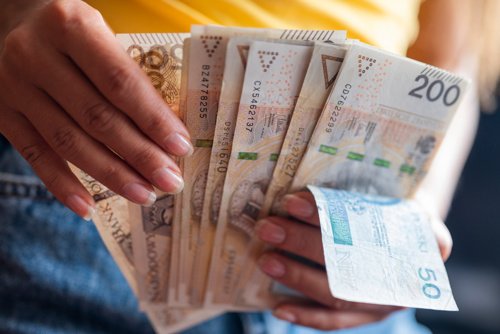
Day to day, the two cities cost almost the same. A meal at an inexpensive restaurant lands around 45 zł in either, a pint of Polish draught between 18 and 20 zł. The difference shows up in accommodation, where central Warsaw runs higher on weeknights because of business travel, and central Krakow spikes on weekends.
The bigger difference is pressure. Krakow drew close to 15 million visitors in 2024 according to city figures, roughly 12.4 million domestic and 2.3 million from abroad, in a city of 800,000. The council has been asking the government for the legal power to charge a tourist tax since 2017 and still does not have it, so there is no per-night fee to budget for. What you will feel instead is the crowding, plus the weekend stag traffic the city has spent years trying to manage, including a night mayor and a ban on late-night alcohol sales in shops. Visit Krakow on a Tuesday in May and it is a dream. Visit on a Saturday in July and the Old Town moves at shuffle speed.
Warsaw absorbs its visitors. The city is big enough that you can spend a week and never queue for anything except the Highline lift.
Getting between them, and the day trips that decide it

The Express InterCity Premium takes 2 hours 20 minutes between Kraków Główny and Warszawa Centralna, running through the day. Advance Super Promo fares start around 49 zł and walk-up fares reach 169 zł, so book at intercity.pl as soon as your dates are fixed. Standard InterCity services take closer to three hours and cost less.
Krakow wins on day trips, and it is not close. The Auschwitz-Birkenau Memorial is about 90 minutes west. One rule has changed and it catches people out: since 1 March 2026, all entry cards must be booked online at visit.auschwitz.org, and there are no tickets sold at the gate at all. Entry to the grounds is free, the fee is for the educator-guided tour. Free self-guided entry cards are released seven days before the date and go quickly; guided tours can be booked up to three months ahead. Bags larger than 30 x 20 x 10 cm are not allowed inside. Book the entry first and build the day around it.
The Wieliczka Salt Mine is thirty minutes out and sits on the same suburban rail line that serves Krakow's airport. Warsaw's equivalents, Wilanów Palace and the Chopin recitals in Łazienki Park on summer Sundays, are pleasant rather than essential.
Arrivals are easy on both ends. Krakow's airport train reaches Kraków Główny in about twenty minutes for under 20 zł. Warsaw Chopin connects to the centre by train in roughly the same time on a standard city ticket.
How to split your time
Three or four days total: Krakow only. Two days in the city, one for Auschwitz-Birkenau, half a day for Zakrzówek or Nowa Huta.
Five to seven days: Both. Fly into Krakow, give it three nights, take a late-morning train, give Warsaw two or three nights, fly home from Chopin. Doing it in this direction means you finish on the bigger food scene and the easier airport.
A weekend, and you have already seen Krakow: Warsaw, and stay on the Praga side or in Powiśle rather than the Old Town.
Returning to Poland: Warsaw, then use it as a base. Łódź, Lublin and Gdańsk are all reachable by direct train, and none of them are on the standard first-timer route.
When to go
May, June and September are the sweet spot in both cities: long days, warm evenings, manageable crowds. July and August bring Warsaw's river season to full swing, which is the best argument for the capital in summer, and bring Krakow's worst crowding. December is a genuine reason to pick Krakow, where the Christmas market fills the main square. January and February are cold and grey, and also the cheapest months to fly, so if museums are your priority, it is a fair trade.
See either city with someone who lives there

The gap between a good trip and a forgettable one in Poland is usually the gap between the Old Town circuit and the neighbourhood behind it. A local knows which milk bar still has the queue at 1pm, which tram gets you to Nowa Huta, and which stretch of the Vistula is worth walking at sunset.
Take a private, personalized walking experience with Lokafy in Krakow or Lokafy in Warsaw, matched with a local who shows you their own city on your own schedule. If you are leaning towards Krakow, our Krakow walking tour guide maps out the route on foot first.
Frequently asked questions
Is Krakow or Warsaw better for a first visit to Poland? Krakow, for most first-time visitors. Its medieval centre survived the Second World War, the main sights sit within a twenty-minute walk of each other, and the Auschwitz-Birkenau Memorial and the Wieliczka Salt Mine are both easy day trips. Warsaw rewards a second visit or a longer stay.
How many days do you need in Krakow and Warsaw? Three days in Krakow, including a day for Auschwitz-Birkenau, and two to three days in Warsaw. Five to seven days total covers both without rushing. If you only have three or four days, spend them all in Krakow.
How long is the train from Warsaw to Krakow? The fastest Express InterCity Premium service takes 2 hours 20 minutes between Warszawa Centralna and Kraków Główny. Standard InterCity trains take around three hours. Advance fares start near 49 zł, rising to about 169 zł for last-minute premium tickets.
Is Warsaw more expensive than Krakow? Only slightly. Restaurant and grocery prices are within a few percent of each other, and a pint costs 18 to 20 zł in both. Accommodation is where the gap shows: central Warsaw runs higher midweek, while Krakow prices climb at weekends.
Do I need to book Auschwitz-Birkenau in advance? Yes. Since 1 March 2026 all entry cards are issued online only at visit.auschwitz.org, with no tickets sold on site. Entry to the grounds is free but the card is compulsory. Free self-guided cards are released seven days ahead; guided tours open three months ahead.
Is Krakow too crowded to enjoy? It depends entirely on timing. Krakow received close to 15 million visitors in 2024, and the Old Town is uncomfortable on summer weekends. Weekdays in May, June or September are a different city, and neighbourhoods like Podgórze and Nowa Huta stay quiet year-round.
Does Poland charge a tourist tax? No. Polish law does not currently allow cities to levy one, and Krakow has been lobbying the government for the power since 2017 without success. There is no per-night visitor fee in either city.
Do I need ETIAS to visit Poland in 2026? Not yet. ETIAS is not operational and the launch is now expected in 2027. The Entry/Exit System has been running at all Schengen external borders since 10 April 2026, so visa-exempt travellers give fingerprints and a facial scan on first entry. Allow extra time at passport control at peak periods.
Which city has better food? Warsaw at the top end, with a deeper modern restaurant scene and better food halls. Krakow is stronger for cheap traditional eating, especially in Kazimierz and Podgórze. Both cities still run subsidised milk bars where a full lunch costs under 40 zł.
Enjoyed this article?