San Francisco is one of the most beautiful cities in the US, with dreamy views and a charming atmosphere that will make you feel at home as soon as you arrive. Its Golden Gate Bridge, steep streets, cable cars and wonderful waterfront are some of the few things that make everyone fall in love with this city. All of these things and much more is why San Francisco is such a vibrant, colorful and liberating place.

Even if there are countless things that make San Francisco one of the greatest cities in the world, today we’re going to focus exclusively on its creative facet. For decades, street art has taken over the streets and interiors of the city, becoming crucial for expressing the political, cultural and economic tensions of San Francisco, as well as the needs and dreams of the population. Today, there are over 1,000 murals scattered across the city, each one of them telling a different story about how people have built the San Francisco that we all know and love nowadays. Keep reading to understand a little bit better why street art has become so important in the city, as well as identify the districts and neighborhoods famous for their colorful and insightful murals.
Street Art in Mission District:
Mission District is definitely the perfect place to begin if you want to explore San Francisco’s street art, because there are more than 400 murals throughout the neighborhood. For decades, Mission has been the preferred district of Mexican and Central American immigrants to arrive and build a new home. Thus, no matter where you go in the neighborhood, you’ll find Latin culture thriving through its music, gastronomy and art. Unfortunately, as the city has raised its status as a global tech hub, Mission has seen the repercussions in the form of gentrification, so high-end boutiques, pricey restaurants and vanguardist coffee shops have become the norm. However, the district’s community has fought back, trying to safeguard their homes and keeping their culture alive. And that’s just what is expressed in the murals: the past and current immigrant experience, the multicultural backgrounds of a diverse group of residents, the political tensions that have arised with San Francisco’s tech status, among others. Exploring Mission’s street art is truly the best way to understand how this community feels, how they relate to their city and what changes they want to see.

Throughout Mission District, you’ll find over 400 murals showcasing the most colorful and creative side of San Francisco.
Balmy Alley:
Since we talked so much about the countless murals scattered across Mission District, don’t think that we’re done with this neighborhood just because we’re going over to Balmy Alley. In reality, it is located within Mission, between 24th and 25th Street, near Garfield Square, and it might be a pretty small alley, but it has quite a lot of stories to tell. As such, Balmy Alley is one of the most painted and celebrated corners of Mission District, and it is mostly due to the influence of Chicano artists. For at least fifty years, these artists have kept the tradition of muralismo (muralism) alive in Balmy, creating works of art remembering essential figures such as El Salvador’s activist Archbishop Óscar Romero or Frida Kahlo, as well as immortalizing the experiences of everyday people. By sustaining and elevating this artistic movement with roots in pre-Hispanic Central American cultures, the artists that have worked in Balmy Alley have been able to represent and commemorate their roots, ancestors and their history.

This corner of Mission District is the perfect place to appreciate some of the best examples of muralismo made by Chicano artists, among others.
Clarion Alley:
Similarly to Balmy Alley, the place located between Mission Street and Valencia Street, known as Clarion Alley, has been key in the development of muralismo by the Chicano movement. For over 30 years, Clarion Alley has been the designated space to express ideas on Chicano identity and the political struggles of Central America during the 80s, as well as explore the ways in which the Latino and American culture have been intertwined for decades. Clearly, the streets, building facades and walls of this part of Mission District have become canvases that serve the community in the exploration of their stories and their identities. Now, this didn’t happen spontaneously, because by the early 90s, artists such as Aaron Noble, Sebastiana Pastor, Mary Gail Snyder, and Aracely Soriano, among others, created the Clarion Alley Mural Project (CAMP), to create a safe space for their art just as the one that was developed in Balmy Alley before.
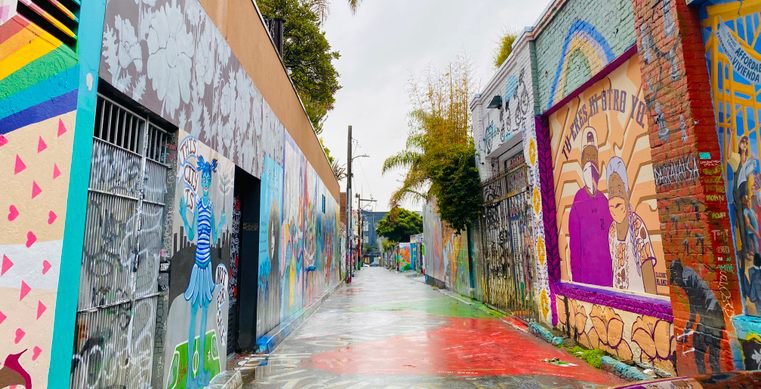
Clarion Alley developed as a muralismo hub after Balmy Alley, but it has allowed the expansion of this type of safe spaces for Chicano artists.
Rincon Center:
We’ve seen Mission District closely, paying attention to its streets and alleys, which work like an open-air art gallery. Now, we would like to move somewhere else that on the outside might not seem as creative or colorful as Mission District, but that on the inside is filled with incredible historic murals ready to be admired. We’re talking about Rincon Center, a complex that was first built in the 40s as one of the main post offices in the city, but that later evolved to shops, restaurants, offices and even apartments. Today, the center catches our attention for its museum-like atmosphere. Inside the Rincon Center, you’ll find 27 murals made by Anton Refregier that tell the history of the city of San Francisco. Although the artist was commissioned, his work proved to be highly controversial and several of the murals had to go through revisions before the murals could be deemed completed. As it usually happens when retelling history, not everyone agreed with Refregier 's of how San Francisco came to be, but nonetheless, today we get a 27-part history of the city. Each mural comes with a short description, which will allow you to better understand what the artist tried to convey, as well as identify the moment of history that’s being portrayed.

The 27 murals made by Anton Refregier for the Rincon Center have proven controversial, although they are also a symbol of the history of San Francisco.
After all that we’ve talked about, there’s no doubt that San Francisco has such a strong creative force that it has become a crucial part of its essence, and now no one can picture the city without its murals and street art that serve as a platform to protest, express and build community. As you’ve seen, Mission District is at the heart of San Francisco’s street art scene, but no matter where you go in the city, there’ll always be colorful walls or alleys relaying messages from artists and communities. It is time for you to finish discovering the wonderful artistic facet of San Francisco.
Enjoyed this article?