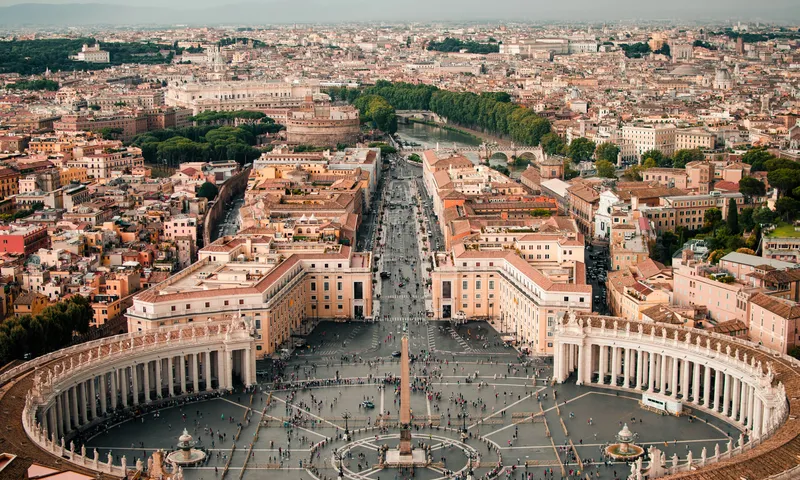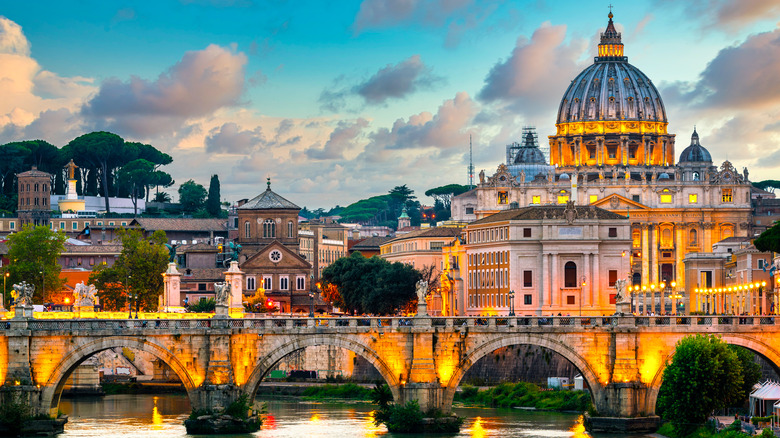
Rome is not only one of the most special and popular cities in the world, but it is also the living proof of the Roman Empire, one of history’s greatest civilizations. As such, the Italian capital has beautifully combined modernity and tradition to create a breathtaking picture. Of course, Rome is not the only place where you can find ancient Roman ruins, as there are traces scattered across Europe, but this city is certainly where you’ll find the most magnificent ones. Art, history and culture run through Rome’s veins, and if you really want to learn more about Western civilization, traveling to this city is a must. Locals might feel like waking up next to the Colosseum or the Pantheon is normal, but for those visiting, it can be a life-changing experience, because the steps you take and ruins you see, are proof of an Empire whose influence we can see even today. There’s a reason why Rome is called “The Eternal City”, and after today’s blog, you’ll understand it thoroughly.
Colosseum:
If we’re going to talk about Roman ruins in the city, there’s no other way to begin than by talking about the Colosseum, the most mesmerizing ancient monument in Rome. It is one of the most popular attractions in all of Italy, and each year, at least seven million people visit it. Regardless of the two thousand years that have passed since it was first erected, the Colosseum is still as important as when it was used as the fighting ground for gladiators. From the moment the amphitheater was completed in 80 CE, it became a symbol of the immense power of the Roman Empire and it was used to celebrate important anniversaries, military services and spectacles for its citizens. Once the empire fell, the Colosseum fell into oblivion too, and a lot of time had to pass before it came to life again as a testament of Italy’s and Western civilization’s history.
There are several ways in which you can enjoy the Colosseum, discovering its precious details and uncovering its incredible story. For example, from the outside you’ll get a good look into the massive outer walls of 159 ft, as well as its three levels of arches. Each one of them is framed by columns topped by capitals of the Ionic, Doric and Corinthian orders. Although they are long gone, you can still imagine how marble statues filled the niches on the 2nd and 3rd stories, creating intricate details that made the Colosseum even more magnificent. On the inside, you’ll be able to go up to the first and second tiers, to have an excellent view on the arena floor, and on the second floor, there’s a balcony from where you can watch the Arco di Constantino. Regardless of the angle from where you see everything, there’s no doubt that the Colosseum is one of the greatest structures built in history.
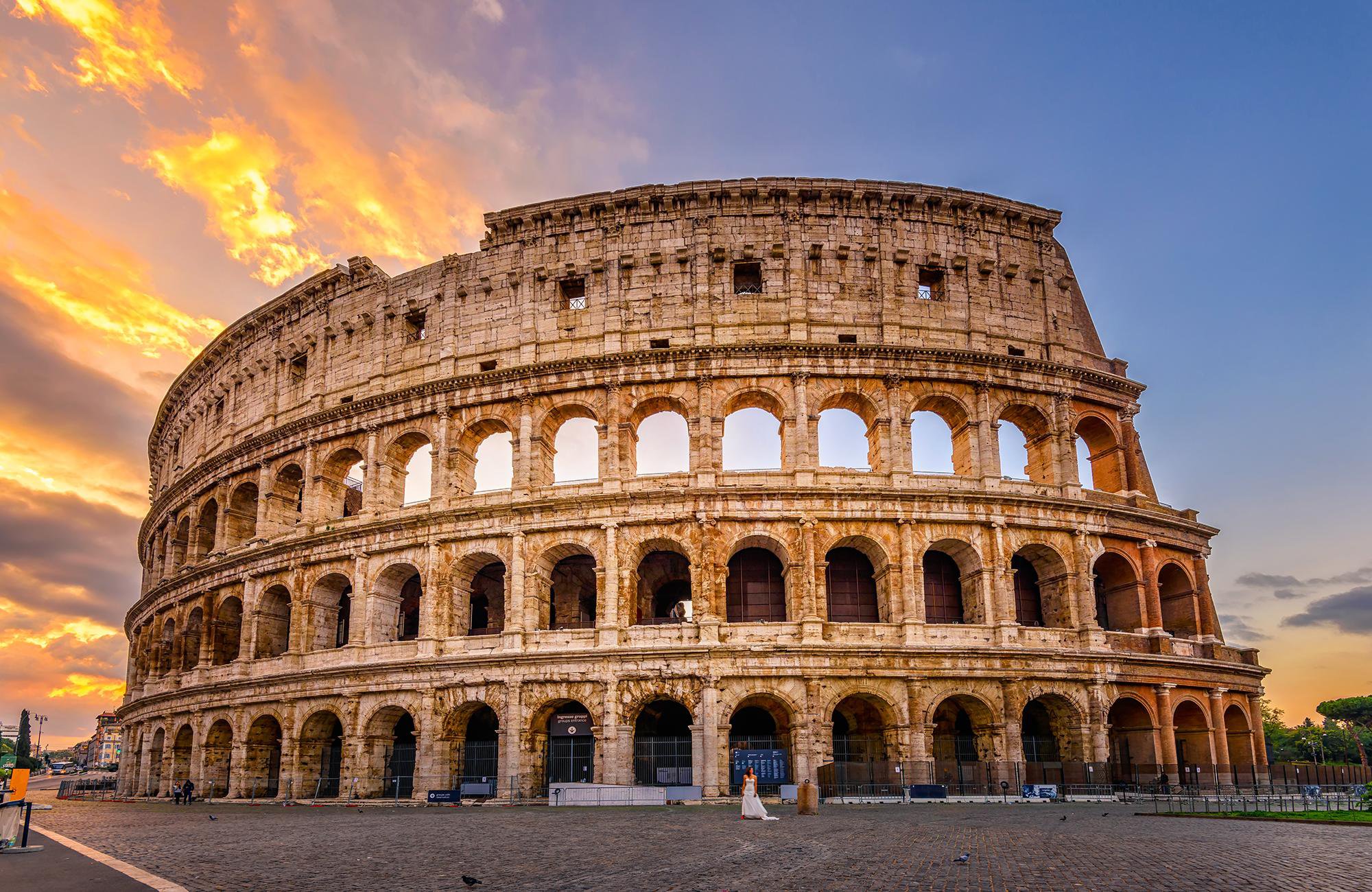
The Colosseum is probably the most popular Roman ruin in the world, and for 2000 it has been proof of the Roman Empire’s power.
Pantheon:
Rome’s Pantheon is a 2000-year-old temple that’s regarded as the best preserved of the city’s ancient monuments. It is located in the heart of Rome, and since approximately 125 CE, it has amazed everyone as an architectural marvel. Once you put a foot inside, you won’t believe what you see with a massive dome that was the world’s largest until the 15th century. Additionally to its size, the Pantheon’s dome is impressive because it has an oculus from where the light enters the building and bathes the royal tombs with the sun’s golden light. In the beginning, the Pantheon was a temple dedicated to the seven classical gods, but in 609 CE, it became a Christian church known as the Basilica di Santa Maria ad Martyres. Today, it still is a basilica, so when you enter, you have to bear in mind that you’re coming into a spiritual and religious realm, and you’ll have to act accordingly. Just as the Colosseum is proof of the Roman Empire’s power, the Pantheon is the perfect example of its brilliant architecture, which has stood the test of time.
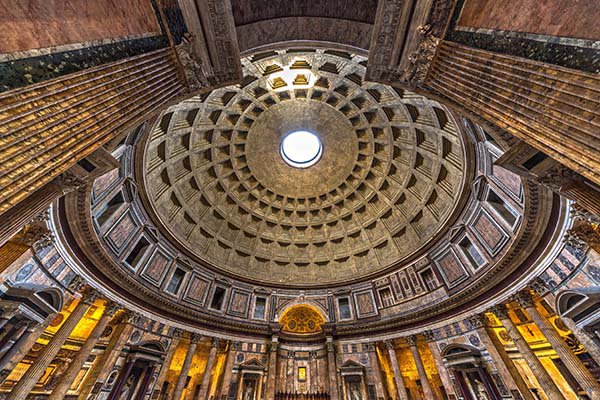
The Pantheon’s dome was the world largest until the 15th century, but even after losing its title, it is the perfect showcase of Roman architectural brilliance.
Largo di Torre Argentina:
The Colosseum and Pantheon are so iconic that even if you’ve never been to Rome, you probably recognize them or at least have a vague idea of them. But, if you don’t know the place we’re going to talk about next, we won’t blame you, because it actually only opened to the public in June of this year. The Roman remains of the Acra Sacra di Largo Argentina have been visible for quite some time from Largo Argentina, a busy square near Piazza Navona. However, what’s new is that people can visit it, descend around 20 feet below Rome’s street level and for a brief moment, walk through the paths of the ancient Roman empire. In this site, you’ll find the remains of four temples from the Roman Republican era, which were built between the 2nd and 4th centuries BC and were dedicated to different deities.
You might be wondering what makes this place remarkable; no one will dispute the Pantheon’s or Colosseum’s magnificence, but if these ruins took so long to open to the public, are they worthy? The answer is that regardless of the remains, whether they’re massive or small, the history that they contained is not easily forgotten. Here, at Largo di Torre Argentina, is where on March 15, 44 BCE, the assassination of Julius Caesar reportedly happened, putting an end to the Republican era of ancient Rome, and signaling the beginning of the Roman Empire, funded by emperor Augustus.

The ruins at Largo di Torre Argentina might not be as magnificent as the Colosseum, but they hold a key part of Roman history: the assassination of Julius Caesar.
Roman Catacombs:
Roman ruins can be deceitful, because at first glance we may think that what can be seen above the surface is all that there is, but the reality is very different. Down below Rome there’s a network of tunnels, passages and narrow alleys that make up the Catacombs, where early Christians were buried and lots of stories about the Eternal City are waiting to be unearthed. Once you start exploring the catacombs, you’ll be able to see the different forms of art that embellish the site, and through frescoes and sculptures, you’ll get clues about these first Christians’ spirituality and devotion, especially within a period of transition between Paganism and Christianity.
Of course, there are several different catacombs that were progressively built over the years, but for example, the Catacombs of Rome are some of the world’s oldest burial tunnels, and, for example, its sculpture of the Virgin Mary is her oldest known depiction. Another pretty popular site is the Catacombs of St Callixtus, the largest and busiest of its kind. This network was founded in the 2nd century and it was named after Pope Calixtus I, when it became the official cemetery of the Roman Church that had appeared recently. Since its creation, these catacombs have been the burial site of 16 popes, dozens of martyrs and thousands of Christians.

The Catacombs in Rome may not be for the faint of heart, but they surely are an incredible way to understand the evolution of Christianity in the city.
Indeed, Rome is one of the world’s oldest cities, and as the epicenter of some of the most important periods in the Western civilization’s history, there’s quite a lot to see. Regardless of how many pages we wrote or how many sites we mentioned, we’d still be leaving something out. Today, we just mentioned some of the highlights of the numerous Roman ruins scattered across Rome, and tried to show you some of the most essential, the newest and even scariest (depending on who you ask). At the end of the day, we just hope that with this short introduction, you found the inspiration needed to book the next flight and enjoy your summer vacations reconstructing Rome’s history.
Enjoyed this article?