Bergen has a way of making people emotional about it. Not in a dramatic, overwhelming way, more quietly than that. You walk past the colorful wooden houses of Bryggen, you eat shrimp from a paper cup by the harbor, you take the funicular up to the top of Fløyen and look out over the city and the fjord, and something in you settles. You understand, standing there, why people who visit Bergen end up coming back.
I think what makes Bergen special, genuinely special, not just tourist-brochure special, is that it's completely itself. It doesn't try to be Oslo. It doesn't perform for visitors. It rains here more than almost anywhere else in Europe (averaging 240 rainy days a year), and Bergen is entirely unbothered by this fact. The city has its mountains and its harbor and its centuries of history as a trading port, and it wears all of it with a quiet confidence that's very appealing.
For cruise passengers, Bergen is one of the absolute best stops on any Norwegian cruise itinerary. It's compact enough to cover the highlights in a few hours, deep enough to fill a full day without scraping the bottom, and genuinely beautiful in a way that photographs don't fully capture. Here's how to make the most of your Bergen cruise port stop, from someone who actually knows the city.
Understanding Bergen Cruise Terminals: Where Your Ship Docks
The Two Main Bergen Cruise Port Locations
Bergen cruise ships dock at either Skolten (Vågen Harbour) or Jekteviken/Dokken terminals, and which one you get matters more than you might think.
Skolten Cruise Terminal (Skoltegrunnskaien): This is the one to hope for. Located right in the harbor at Skoltegrunnskaien 1, it's a glorious 5-10 minute walk from Bryggen, right in the thick of everything. You step off the ship and you're basically already in the medieval heart of Bergen. The Bergenhus Fortress is immediately visible, Bryggen's wooden houses are just ahead, and the fish market is within easy walking distance. This terminal has three berths: Skolten, Bontelabo, and Festningskaien.
Dokken/Jekteviken Cruise Terminal: Further out, about 2.5 kilometers from the city center in Bergen's industrial area. From here, it's about 15-20 minutes on foot (not particularly scenic) or a short complimentary shuttle bus ride that cruise lines typically provide to downtown. Smaller ships, particularly Hurtigruten vessels, sometimes dock at Jekteviksterminalen 2, which is actually closer to the city center.
How to know which terminal: Check your cruise itinerary or ask at guest services the day before your Bergen stop. Your ship's daily program will specify the terminal and provide a map.
Bergen Cruise Port Facilities
Both terminals offer basic amenities:
- Free WiFi (though sometimes spotty)
- Tourist information desks with maps and brochures
- Taxi stands
- Public transportation access
- Currency exchange (though ATMs in town offer better rates)
- Shops selling Norwegian souvenirs, sweaters, and trolls (expect cruise port pricing)
Important sustainability note: As of 2026, Bergen limits cruise ships to 4 vessels and maximum 8,000 passengers per day. All cruise ships must be able to use shore power. This commitment to sustainability means cleaner air in port, but it also means Bergen can feel busy on days when multiple large ships are docked.
Getting from Bergen Cruise Port to City Center

From Skolten Terminal:
- Walk: 5-10 minutes to Bryggen (600-900 meters). Just follow the waterfront north. It's scenic, flat, and impossible to get lost.
- Taxi: Available but honestly unnecessary unless you have mobility issues
- Hop-on-Hop-off bus: Stops right at the terminal if you prefer guided commentary
From Dokken Terminal:
- Complimentary shuttle bus: Provided by your cruise line, runs frequently to city center (about 5-8 minutes)
- Walk: Possible but 20-25 minutes through less interesting industrial areas, not recommended
- Taxi: Around 150-200 NOK to city center if you miss the shuttle
Local tip: If you're at Skolten, skip the taxis and paid transportation entirely. The walk along Bergen's waterfront to Bryggen is half the experience. You'll see the harbor come to life, fishing boats, local kayakers, and get your first proper look at the city's character.
One Critical Thing Before You Step Off the Ship
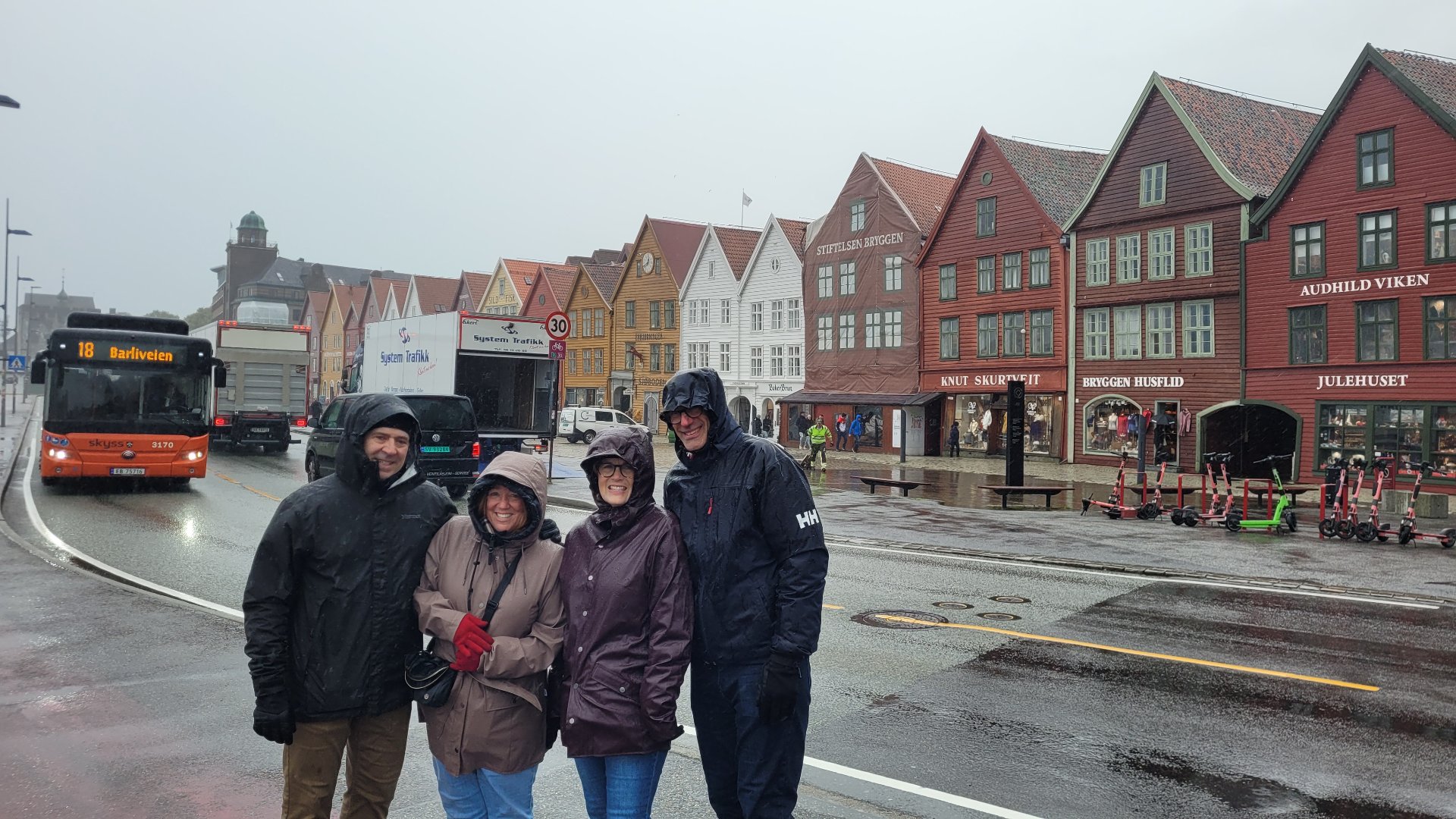
Bergen's weather does what it wants. The city averages around 240 rainy days a year, which is not a typo. Pack a waterproof layer regardless of the forecast, because the forecast is more of a suggestion than a commitment. A good waterproof jacket doesn't ruin a day in Bergen. Getting soaked at the fish market absolutely does.
Even on days that start sunny, rain can roll in from the North Sea within an hour. Locals dress in layers and always carry rain gear. You should too.
How Much Time Do You Have? Bergen Shore Excursion Planning by Port Hours

3-4 Hours (Short Port Stop)
This is tight but totally doable if you focus:
- Bryggen's colorful facades and hidden alleyways (45 minutes): Don't just photograph the front, walk through the passages
- Fish market for shrimp and atmosphere (30 minutes): Fresh seafood eaten standing up by the water
- Fløibanen funicular to Mount Fløyen (1 hour including travel time): Views that justify the entire cruise
- Quick walk back to ship via Bergenhus Fortress
You'll feel Bergen properly, even if you're moving briskly. This hits the absolute essentials.
5-7 Hours (Standard Port Stop)
Add breathing room and depth:
- All of the above, but slower and with more wandering
- Proper lunch at a local restaurant like Pingvinen (traditional Norwegian) or Colonialen (modern Nordic)
- Extra time in Bryggen's artisan workshops: ceramics studios, small galleries, craftspeople at work
- Visit Bergenhus Fortress and Håkonshallen (Bergen's medieval royal residence)
- Coffee in a neighborhood café away from tourist streets
- Maybe Nordnes Peninsula if the weather's good and you want to see where locals actually live
This is the sweet spot for most cruise passengers. Enough time to experience Bergen without rushing, but structured enough that you won't feel lost.
8+ Hours (Long Port Stop or Overnight)
Now you can really experience Bergen beyond the standard cruise port routine:
- Morning: Troldhaugen (Edvard Grieg's lakeside villa and studio, about 25-30 minutes from center)
- Midday: Bryggen, fish market, Mount Fløyen
- Afternoon: Either a short fjord excursion (Mostraumen or a brief Sognefjord trip) OR deeper neighborhood exploration in areas like Nordnes, Sandviken, or Møhlenpris
- Evening: Proper dinner at a restaurant locals actually go to, maybe live music if your timing works
If you're extending your Bergen visit beyond the cruise, check out our 24 Hours in Bergen guide for a complete itinerary that digs deeper into neighborhoods, food culture, and experiences that require more time.
Bryggen: More Than Just a Postcard (And How to Actually Experience It)
Bryggen is the image everyone has when they think of Bergen. A row of colorful wooden buildings along the harbor, perfectly reflected in the water. And yes, it looks exactly like that. Better, actually, especially when the afternoon light hits the facades just right and the whole thing glows.
But most people stop at the facades, take the Instagram photo, and move on. That's the mistake.
The Hidden Bryggen: Where the Magic Actually Happens
Walk past the front buildings and into the narrow alleyways behind them. That's where Bryggen becomes something else entirely. A network of tiny passages and crooked staircases, artisan workshops with their doors open, a ceramics studio where you can watch the potter at work, a small gallery showing contemporary Norwegian art, a café tucked into a building that's been standing since the 18th century.
It's dim and slightly crooked and smells faintly of old wood, and it's one of the most atmospheric places I've been in Norway. The wooden walkways are worn smooth from centuries of footsteps. The buildings lean into each other. You can touch walls that Hanseatic merchants touched 500 years ago.
The History That Makes Bryggen Special
Bryggen has burned down multiple times over the centuries. The most recent major fire was in 1702. And every single time, the city rebuilt it in the same place, the same layout, the same character. Because this is what Bergen looks like. This is Bergen's identity, built from wood and stubbornness and a refusal to let the past disappear.
It was recognized as a UNESCO World Heritage Site in 1979, and if you spend time in those alleyways, you understand exactly why. This isn't a reconstructed historical theme park. These are working buildings, some dating to the 1700s, still used by artisans, artists, and small businesses today.
How to Actually Experience Bryggen (Not Just See It)
Give this at least 45 minutes. More if you can.
- Walk through, not just past: Enter the alleyways between buildings. They're public passages, not private property. Explore.
- Visit the workshops: Many artisans welcome visitors. Watch glassblowing, pottery, jewelry-making. Ask questions. Norwegians appreciate genuine interest.
- Find the Bryggen Museum: Underground archaeology showing layers of medieval Bergen. Fascinating if you have time.
- Notice the lean: Buildings tilt because they're built on old wooden pilings that have shifted over centuries. This isn't neglect, it's authenticity.
With a local host: They'll show you the alleyways most tourists miss, explain the Hanseatic League's history here, point out architectural details you'd otherwise walk past, and time your visit to avoid cruise ship crowds converging all at once. That local knowledge makes the difference between a photo stop and actually understanding what made Bergen one of medieval Europe's most important trading cities.
Bergen Fish Market: What to Eat and When to Go
Right on the waterfront at Torget, Bergen's Fish Market (Fisketorget) is one of the oldest markets in Norway and one of the most visited. In summer (May through September), the stalls spill outdoors along the harbor in a colorful, lively scene. In winter, it moves inside the permanent market hall and loses none of its atmosphere.
What to Order at the Fish Market
Fresh shrimp (reker): This is non-negotiable. Sold by the cup (small, medium, large), eaten standing up with mayonnaise, lemon, and crusty bread. It's one of those experiences that sounds so simple it's hard to understand why it's so good until you're actually doing it. Standing by the water in Bergen with perfectly fresh North Atlantic shrimp in your hand, the harbor in front of you, seagulls wheeling overhead. It just works.
Expect to pay: 150-200 NOK for a generous cup. Yes, Norway is expensive. Yes, it's worth it.
Also worth trying:
- Salmon (grilled, smoked, or as sushi): Norwegian salmon is exceptional, and here it's as fresh as it gets
- Fish cakes (fiskekaker): Warming, traditional, and very Norwegian. Like a refined fish patty served with potatoes and vegetables
- King crab: If you want to splurge, Bergen's king crab is massive and delicious
- Brown cheese (brunost): If you want to understand what Norwegians actually eat at home. It tastes like sweet caramel fudge and is divisive in the best way. You'll either love it immediately or look confused. Either reaction is valid.
When to Visit the Fish Market
The market gets busy. Really busy. In peak summer cruise season (June-August), it can feel like a theme park between 10am and 2pm when multiple cruise ships are in port.
Best times:
- Early morning (8-9am): Locals shopping for the day, fewer tourists, fresher selection
- Late afternoon (4-5pm): Crowds thin out, vendors sometimes offer deals on remaining stock
- Off-season (September-April): More authentic, less crowded, though some outdoor stalls close
With a local host: They know exactly when to hit the market based on your ship's schedule and how many other vessels are in port that day. They also know which stalls offer the best quality versus which ones are purely tourist-oriented. That knowledge saves you from overpaying for mediocre seafood.
Fløibanen Funicular and Mount Fløyen: The View That Defines Bergen
The Fløibanen funicular takes you from the city center to the top of Mount Fløyen (320 meters above sea level) in exactly eight minutes. Eight minutes. And at the top, you get one of the best views in Norway: Bergen spread out below you, the fjord stretching toward the horizon, mountains filling the rest of the frame in every direction.
On a clear day, it's the kind of view that makes you go quiet for a minute. You just stand there and look. The city looks like a toy town from up here. The harbor sparkles. The islands scattered across the fjord seem to float. You understand, viscerally, why Bergen became one of the world's great maritime cities. The geography just makes sense from this height.
What to Do at the Top of Fløyen

The viewing platform: Obviously. Take your photos, breathe the mountain air, look out over Bergen. On really clear days, you can see all the way to the outer islands and the open North Sea beyond.
Walking trails: If you have extra time and energy, hiking trails radiate from the top into Bergen's surrounding forests. They're well-marked, relatively easy, and give you a completely different perspective on the city. Even a 15-minute walk into the woods reveals why Norwegians have such a strong connection to nature.
The café: Serves waffles with jam and sour cream (a Norwegian classic) that I think about more than I probably should. Also coffee, soft drinks, and light meals. The waffles are genuinely good. Get the waffles.
Playground and goats: If you're traveling with kids, there's a playground and small petting zoo with goats at the top. Norwegian families come up here on weekends.
The Funicular Queue Problem (And How to Solve It)
Here's the thing nobody tells you: the funicular gets busy in peak summer. Very busy. Queues can stretch to 45 minutes or even an hour on popular days when multiple cruise ships are in port and everyone has the same idea at the same time.
Strategies to avoid the wait:
- Go early: First funicular leaves around 7:30am. By 8am you're at the top with almost nobody else
- Go late: After 4pm, crowds thin significantly
- Weekdays over weekends: If your cruise timing allows, weekdays are calmer
- Check the live queue camera: Bergen has a webcam showing the funicular queue in real-time (search "Fløibanen live queue")
With a local host: They'll know how to time your visit to avoid the worst wait, which on a cruise timeline where every hour matters, is genuinely valuable. They might suggest walking up instead (30-40 minutes, moderate incline, but you skip the queue entirely and the path is beautiful). Or they'll know alternative viewpoints if the Fløyen queue is prohibitive.
Cost: Round-trip ticket is around 115 NOK for adults. You can also buy one-way tickets if you want to hike down (or up).
Troldhaugen: Edvard Grieg's Home by the Lake
About 8 kilometers south of Bergen's city center sits Troldhaugen, the former home of Edvard Grieg, Norway's most celebrated composer. You know his music even if you don't know you know it: the opening of Piano Concerto in A minor, or "In the Hall of the Mountain King" from Peer Gynt. That's Grieg.
Why Troldhaugen Is Worth Your Port Time (If You Have 5+ Hours)
The villa itself, built in 1885, is beautifully preserved exactly as it was when Grieg lived and worked here. The rooms are filled with personal belongings, original furniture, photographs, and the actual piano he composed on. It's intimate in a way that large historical sites rarely achieve. You feel like you're visiting someone's home, because you are.
But the real magic is out back: a tiny wooden cabin sitting by Nordås Lake where Grieg wrote during the summers. It's almost comically small for what came out of it. Just a desk, a chair, a window overlooking the water. That's where some of Norway's most famous music was created.
The Troldhaugen Experience
- The villa tour (30-40 minutes): Guided tours in English explain Grieg's life, his relationship with his wife Nina (also a talented musician), and his impact on Norwegian national identity during the country's independence movement
- The lakeside walk (15 minutes): Gardens lead down to the water where Grieg's cabin sits. It's peaceful and beautiful.
- Grieg's burial site: He and Nina are buried in a rock wall facing the lake, as he requested
- The concert hall (Troldsalen): A modern purpose-built space on the grounds where chamber concerts are held regularly, often featuring Grieg's work. If your cruise schedule happens to coincide with a concert (they're usually lunchtime or afternoon), it's absolutely worth rearranging your day around. Hearing Grieg performed at Grieg's home is special.
Getting to Troldhaugen from the Cruise Port
By bus: Take the Bybanen light rail from city center to Hop station, then bus 850 toward Fana. Total journey about 35-40 minutes. Buses run regularly.
By taxi: About 20 minutes, 200-300 NOK from downtown.
With a private tour: Your local can arrange transportation, time it perfectly with your ship schedule, and explain the cultural and historical context that makes Grieg's music inseparable from Norwegian identity.
Realistic assessment: Troldhaugen requires about 2.5-3 hours total (travel + visit). Only do this if you have 6+ hours in port and you're genuinely interested in classical music, Norwegian history, or beautiful old houses by lakes. If your port time is shorter, prioritize central Bergen.
Nordnes: The Neighborhood Most Cruise Passengers Never Find
Nordnes is a quiet peninsula west of Bryggen that most cruise passengers never reach, which is exactly why I'm telling you about it.
It's not dramatically beautiful or filled with monuments. It's just a real Bergen neighborhood. Wooden houses painted in muted colors, narrow residential streets, a small park (Nordnestangen) at the tip of the peninsula with water views on three sides. The Bergen Aquarium (which has been there since 1864) sits here. You'll see locals walking dogs, kids riding bikes, people sitting on benches reading. Boats bob in the water.
Why Nordnes Matters for Cruise Passengers
Because sometimes the most memorable travel moments happen when you stop trying to see attractions and just watch how people actually live. Nordnes gives you that. It's Bergen without performing for anyone.
If you have time after Bryggen and the fish market, and you want to see where Bergen actually lives rather than where it poses for photos, head this way. It's a 10-15 minute walk from Bryggen, completely flat, and you'll probably be the only cruise passenger there.
The walk: Head west from Bryggen along the waterfront, past the KODE art museums, and onto the Nordnes peninsula. The park at the tip offers a completely different perspective on Bergen's harbor and the mountains beyond.
Where to Eat in Bergen: Beyond the Fish Market

Bergen's food scene has grown significantly over the past decade. The city now has a genuinely exciting restaurant culture, and beyond the fish market, there are places worth seeking out.
Traditional Norwegian Food
Pingvinen: Located on Vaskerelven, this is a traditional Norwegian diner that's been feeding locals since 1961. Meatballs, fish cakes, game dishes, cloudberry cream for dessert. It's cozy, unpretentious, and the kind of place a Bergen resident will take you to without you having to ask. This is what Norwegian home cooking actually tastes like: hearty, unfussy, based on ingredients that survive Arctic winters.
Expect to pay 200-300 NOK for a main course. Reservations recommended if you have the time to plan ahead.
Bryggeloftet & Stuene: Right in Bryggen, which usually screams "tourist trap," but locals actually eat here. Traditional dishes done well, historic atmosphere in an 18th-century building, and surprisingly reasonable prices for the location.
Modern Nordic Cuisine
Colonialen: Multiple locations around Bergen, this spot does excellent open-faced sandwiches (smørbrød) and modern takes on local produce. Good for a quality, slightly quicker lunch. The Litteraturhuset location near city center is convenient for cruise passengers.
Lysverket: If you want to experience New Nordic cuisine at its finest and you have the time and budget, this restaurant inside the KODE 4 museum showcases the best of Norwegian ingredients with creative preparations. Tasting menus start around 1,200 NOK.
Coffee Culture in Bergen
Bergen's specialty coffee scene is strong, and the spots worth going to are rarely on main tourist streets. Locals are particular about their coffee (this is Norway), and several roasters and cafés have emerged that rival anywhere in Europe.
Your local host will have opinions about this. Trust them. Coffee culture is hyperlocal, shops open and close, quality changes. A local knows which place has the best kanelboller (cinnamon buns) this month, which roaster just opened, and which café has the view nobody knows about. Read more about where locals eat in Bergen.
Bergen as Gateway to the Fjords: What's Possible on a Cruise Stop
Bergen takes its tagline "Gateway to the Fjords" seriously, and it earns it.
The Hardangerfjord, the Sognefjord (the longest fjord in Norway, stretching 205 kilometers inland), and the Nærøyfjord (UNESCO World Heritage listed and one of the narrowest fjords in the world) are all accessible from Bergen. Standing at the edge of any of these, the water impossibly blue, the walls of rock rising vertically on both sides hundreds of meters high, the silence broken only by distant waterfalls, is the kind of experience that reframes what you thought you understood about landscape.
Fjord Excursions from Bergen Cruise Port
The reality check: Most fjord experiences require a full day. You're talking about 6-10 hours for a proper fjord trip to Sognefjord or Hardangerfjord. If your ship is in Bergen for only 6-8 hours, a full fjord excursion isn't realistic.
What IS possible:
- Mostraumen fjord cruise (3 hours): A shorter option that gives you a taste of Norwegian fjords without the full commitment. Narrow sounds, waterfalls, dramatic scenery. Works for 5-6 hour port stops.
- Bergen to Flåm day trip (12 hours): Only if you have an overnight in Bergen or an exceptionally long port stop. The famous train journey through mountains and fjords, but it requires most of a day.
Your local host can help figure out what's realistic given your exact port time and ship departure, and whether combining a city experience with a fjord excursion makes sense for your schedule. They know which operators are reliable, which trips deliver what they promise, and what's tourist theater versus actual fjord experience.
Alternative: If your Norwegian cruise continues to other ports, you might have better fjord opportunities elsewhere. Check our guides to other Norwegian cruise ports like Stavanger, Oslo, and Trondheim to see what each stop offers.
Exploring Bergen with a Local Host: Why It Makes a Difference

Bergen rewards local knowledge more than most cities. The alleyways of Bryggen that look like dead ends but aren't. The café tucked into a courtyard with no street-level signage. The exact spot on Fløyen where the view is best, away from the crowd gathered at the obvious lookout. The story behind the fires and why the city kept rebuilding in the same way. Which fish market stalls are tourist traps and which ones locals actually use.
These are the things that make the difference between seeing a city and understanding it.
What Makes Private Bergen Tours Different
All Bergen tours with Lokafy are fully private: no shared groups, no fixed itinerary you don't care about, no strangers. You (and your travel companions), your local host, and a day shaped around what you're actually curious about. Tours run anywhere from 2 to 8 hours, starting when you step off your ship, and are available in English, German, French, Spanish, Portuguese, and Italian.
Your local host:
- Knows your ship's departure time and has already factored it in (no stress about missing the boat)
- Adjusts the pace based on your energy and interests (want to linger in Bryggen's workshops? They're fine with that)
- Times visits to avoid the worst cruise ship crowds (they know when 4,000 passengers from three ships all descend on the fish market)
- Explains Norwegian culture and history in a way that makes sense (not textbook facts, but stories)
- Recommends restaurants for your evening if you're staying overnight
- Answers the questions you don't even know you have yet
Book a Private Walking Tour with a Bergen Local Host and experience the city through someone's eyes who actually lives here.
Discover Bergen with a Local
Want to know what exploring Bergen with a local actually feels like? Read stories from travelers who've done exactly that: Meet Our Bergen Local Hosts
Sample Bergen Shore Excursion: Six Hours in Bergen
Here's a realistic shape for a mid-length port stop. Your local will adjust based on your interests, walking pace, and the weather:
9:00 AM — Meet your local host near the cruise port (they know which terminal you're at)
9:15 AM — Walk to Bryggen. Not just the facades—spend proper time in the alleyways, artisan workshops, explaining Hanseatic history
10:30 AM — Fish market. Fresh shrimp, something warming if you want it, watch the vendors work, talk about Norwegian seafood culture
11:15 AM — Fløibanen funicular up to Mount Fløyen (timed to avoid the worst queue). Views, waffles at the top if you want them, maybe a short forest walk
12:45 PM — Back down, walk through Torgallmenningen (Bergen's main square) and smaller streets
1:30 PM — Lunch at Pingvinen or wherever your local recommends based on your food preferences
3:00 PM — Coffee in a neighborhood spot, time to wander residential areas or shop for Norwegian design
3:45 PM — Head back toward port, maybe via Bergenhus Fortress or a different route depending on timing
If you have longer, add Troldhaugen before the funicular, or swap the afternoon walk for a Mostraumen fjord cruise. If you have less time, your local will know what to cut while still giving you an authentic Bergen experience.
Not sure how to structure your port time? That's literally what local hosts are for. Tell them your interests (food? history? views? just wandering?) and how much time you have, and they'll shape something that works.
Common Bergen Cruise Port Questions
How far is the Bergen cruise port from the city center?
Skolten terminal: About 5 minutes walk from Bryggen (600-900 meters). You can see the colorful buildings from the ship.
Jekteviken/Dokken terminal: About 15-20 minutes on foot or 5-8 minutes by complimentary shuttle bus to city center.
What is Bergen most famous for?
Bryggen (the UNESCO-listed wharf buildings), being the gateway to Norway's dramatic fjords, composer Edvard Grieg, and rain. Specifically: a lot of rain. Bergen receives about 2,250mm of precipitation annually, making it one of Europe's wettest cities.
Is Bergen worth visiting on a cruise stop?
Without question. It's one of the most characterful cities in Scandinavia, very manageable even in a short port stop, and offers a perfect mix of history, nature, and authentic Norwegian culture. The compact city center means you can experience a lot in just a few hours.
What's the best thing to do in Bergen with only a few hours?
If you only have 3-4 hours: Bryggen's alleyways (not just the facades), fresh shrimp at the fish market, and Fløibanen up to Fløyen for the view. Those three experiences cover the heart of what makes Bergen special.
Do I need to book the Fløibanen funicular in advance?
Not strictly required, but queues can stretch to 45+ minutes in peak summer (June-August) when multiple cruise ships are in port. Going early morning (before 9am) or late afternoon (after 4pm) helps significantly. Timing it with a local who knows the patterns can save you considerable waiting time.
What should I wear in Bergen?
A waterproof jacket. Always. Regardless of the forecast. Even if it's sunny when you leave the ship. Bergen's weather changes fast, and rain can appear from nowhere. Layering is also smart—the city can be warm or cool, often in the same day. Comfortable walking shoes with good grip (those wooden walkways in Bryggen get slippery when wet).
Can I use credit cards in Bergen?
Yes, extensively. Norway is largely cashless. Credit and debit cards (Visa, Mastercard) are accepted almost everywhere, including small cafés and market stalls. However, having a small amount of Norwegian kroner (NOK) in cash isn't a bad idea for the occasional place that's cash-only or if card systems go down.
How do I book a private local tour in Bergen from my cruise ship?
Visit Lokafy, search for Bergen, browse local host profiles to find someone whose interests and style match yours, and book a private tour that fits your cruise schedule. Your local will reach out before your arrival to understand what you want to see and confirm pickup details at your terminal.
Book Your Bergen Private Tour→
Is Bergen expensive?
Yes. Norway is consistently one of Europe's most expensive countries. A casual lunch might cost 200-300 NOK (€20-30), coffee 50-70 NOK (€5-7), a beer 100+ NOK (€10+). The fish market shrimp that locals rave about runs 150-200 NOK per cup. Budget accordingly. That said, the quality usually justifies the price, and experiences like walking through Bryggen or hiking on Fløyen are free.
Planning Your Scandinavian Cruise: Other Norwegian Ports
If Bergen is one stop on a larger Scandinavian cruise, you might also be visiting other Norwegian cities. Each offers something different:
Oslo Cruise Port Guide: Norway's capital blends museums (Viking Ship Museum, Munch Museum), royal palaces, and modern waterfronts. Very different energy from Bergen—more urban, more contemporary.
Stavanger Cruise Port Guide: Known for Preikestolen (Pulpit Rock) and being the gateway to Lysefjord. If you're seeking dramatic nature and want the famous cliff-edge photo, Stavanger delivers.
Trondheim Cruise Port Guide: Norway's historic third city with Nidaros Cathedral and colorful wooden wharves that rival Bergen's. Less touristy, more off the beaten path.
Each port offers opportunities to explore with local hosts who know their cities intimately. Browse all our Norwegian cruise port guides to plan your entire Scandinavian itinerary.
Extending Your Bergen Visit
If you're considering staying in Bergen before or after your cruise (highly recommended if you have the flexibility), our 24 Hours in Bergen guide provides a complete day-by-day itinerary covering neighborhoods, restaurants, hiking trails, and experiences that cruise passengers rarely have time for.
Why Bergen Stays With You

Bergen doesn't apologize for the rain or the prices or the hills. It's completely itself, and that's exactly why people fall for it.
Go ashore. Get a little wet. Eat shrimp by the harbor standing up like locals do. Walk through Bryggen's crooked alleyways and touch 300-year-old wooden walls. Take the funicular up Fløyen and just look—really look—at how the mountains and fjords and city fit together.
You'll understand why everyone keeps coming back.
Ready to experience Bergen with local insight?
Book a Private Bergen Shore Excursion starting from your cruise terminal
RMeeeat Bderge n Locmal host profiles and fi Coffee culture is hyperlocal, shops open and close, quality changes. A local knows which place has the best kanelboller (cinnamon buns) this month, which roaster just opened, and which café has the view nobody knows about.Read mo.Read m.Read .Read.Rea.Re.R
Talk to someone who actually lives here and let them show you the Bergen that exists beyond the cruise ship crowds.
Enjoyed this article?