Cartagena has always been the jewel of Colombian tourism. It is impossible not to fall in love with its antique architecture, colorful facades, exquisite food and refreshing beaches. Fortunately, as more and more international tourists have arrived at La Heróica, its charms have become more visible and currently, there isn’t a day in which you don’t find people from all over the world enjoying everything that Cartagena has to offer. Its colonial fortress and castle, as well as the Old Town guarded by centuries-old stone walls will take you back to another period, and right then and there, you’ll understand just how important this city was for the Spanish rulers, and how its role in the Caribbean coast has changed throughout the centuries.
Today, we’re going to think about how to spend one day at Cartagena and make the most of it. Of course, there’ll be certain things missing, and you’ll need a couple more days to relax on the beach and head over to one of the islands nearby, but undoubtedly, one day is enough to discover the true heart and soul of Cartagena. 24 hours are plenty of time to learn about history, eat the most delicious food in the world, explore alleys and squares filled with laughter, hope and stories, take breathtaking photos and at night, dance your way through the city’s vibrant nightlife.
Exploring the Ciudad Amurallada:
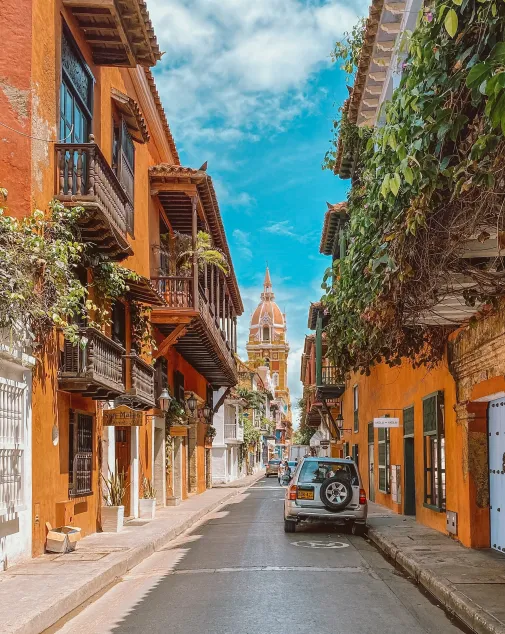
Obviously, your day has to start off strong! So, you’re going to begin your adventure diving into Cartagena’s past in the old city. The inner walled town consists of the historical districts of El Centro and San Diego, which hold some of the most impressive examples of preserved colonial architecture of the region. There are plenty of churches, monasteries, plazas and mansions that hold Cartagena’s secrets and are key parts of its past. Even though we will not mention every single thing that you can explore here, we’ll go over the most important buildings, and as for the rest, while you make your way through the old city, you’ll get a glimpse of them and if they catch your attention, you’re only one step away from discovering what they are all about.
An unmissable sight is the Convento & Iglesia de San Pedro Claver. As you can guess, religion has been an essential part of its history, especially Catholicism. In the 17th century, the Jesuits founded the Convento San Ignacio de Loyola, and later on they changed its name to honor San Pedro Claver, a Jesuit who fought and cared for the slaves who came from Africa. Getting to know his story is a great way to learn more and understand how slavery impacted Cartagena. The convent is a three-story building with beautiful gardens and courtyards and it serves as an open museum exhibiting religious art and pre-Columbian ceramics, as well as more contemporary Afro-Caribbean paintings and sculptures. On the other hand, the Iglesia de San Pedro Claver is an architectural treasure that’s also worth the visit. On the same religious note, another of Cartagena’s landmarks is its Cathedral, with its yellow tower and terracotta dome, intricate designs in its interior and mystique atmosphere. One could say that you haven’t been to Cartagena without visiting its Cathedral!

The Convento San Pedro Claver is a great example of just how important Catholicism has been in the history of Cartagena.
Additionally, a tour around the Ciudad Amurallada would not be complete without exploring the Palace of the Inquisition. Today, it seems like a wonderful colonial building, but its beautiful facade masks the fact that it was built by the Spanish as a place of torture and it served as the Inquisition’s headquarters to free Cartagena from heresy. The Palace was finished in 1776 and it still stands as an example of late-colonial architecture, with long balconies and a baroque stone gateway. If you’re not very interested in understanding how the Inquisition worked or discovering the different torture instruments used, don’t worry, there’s a lot more than that in the Palace’s museum. It also houses pre-Columbian pottery, a collection of old maps from the colonial era, and takes on a journey across Cartagena’s history through different elements such as paintings, furniture and church bells.

Don’t let its beautiful facade fool you, the Palace of the Inquisition holds secrets from Cartagena’s dark past.
Cartagena Inside Out:
Although the old city is Cartagena’s main attraction, that doesn’t mean that outside its walls there’s nothing left to see. On the contrary, part of what makes the city such an incredible destination are right there, outside of the inner walled town. To recap, you have spent your morning discovering a huge part of Cartagena’s past and its outstanding colonial architecture. You’ve walked so much under the hot sun of the city that it is time to pause for a bit, have lunch and recharge batteries to continue, don’t you think? Well, fortunately for you, there’s a short walk between the old city and your next destination. You know that you’re exiting the inner walled town because you’ll come across the Puerta del Reloj (or Clock Tower) which sits at the original entrance to the fortified city and literally is a 17th-century clock tower that reminds you that you’re about to enter (or exit) another time.
As you leave the Clock Tower behind, you’ll go into Getsemaní, a neighborhood that isn’t as sophisticated as what you just saw, but that has a special and very unique charm to it. In the last few years, it has become a focal point of Cartagena’s gentrification, so its traditional houses have become hotels, restaurants and bars. Thus, you won’t have any trouble finding a great spot to have lunch. You have two options: eat in one of the luxurious and modern restaurants of the neighborhood, or look into a traditional restaurant where there’s a special menu for each day (they are way cheaper and also delicious). After an incredible meal, you can roam freely through Getsemaní, uncovering the boutiques and street art that make it even more attractive for visitors.

Getsemaní is a colorful and very unique neighborhood of Cartagena.
Undoubtedly, we could not talk about Cartagena without mentioning the Castillo de San Felipe, because it is basically what makes the city what it is; it is the most vital part of its DNA. This castle is the greatest fortress that the Spaniards built in any of their colonies, and as such, it is a crucial part of the city’s landscape. With such a massive construction, it may come as a surprise that the original building was pretty small, but there was an enlargement project in 1762 that resulted in the powerful bastion that we see nowadays. There is a complex system of tunnels that served the distribution of provisions and facilitated evacuations, which has been preserved and can be visited, so we highly recommend that you take the time to explore all of the fascinating history of the Castillo de San Felipe.
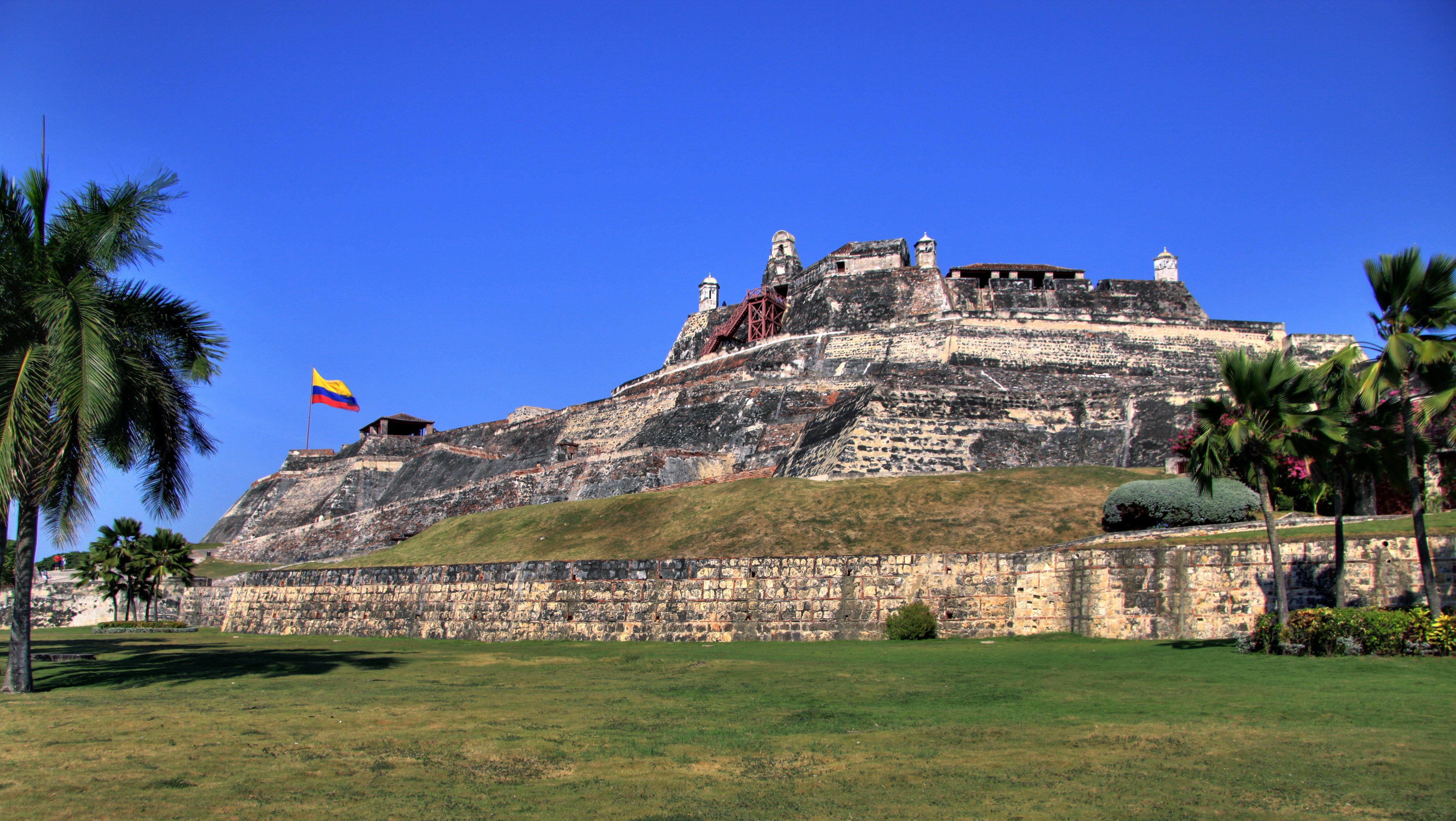
The glorious Castillo de San Felipe is probably Cartagena’s most iconic landmark.
It’s been a pretty hectic day so, for the night, we think that the best idea is to simply
enjoy Cartagena’s nightlife and dance until the sun rises again. The walled city is a great place to find incredible nightclubs, salsa clubs or anything in between.
Where the locals eat:
We didn’t want to end our tour around Cartagena without diving deeper into which are the best places to eat in the city. We know that regardless of the time of the day, fresh fruit or a typical dish is always welcome. Well, throughout the day you should be very attentive to the street cart vendors with mangoes, avocados, bananas and other fruits that you have no idea what they are because they only exist in Colombia. Normally, they sell the whole fruit or a cup of it so that you can have something a bit refreshing. Also, aside from the small local restaurants that we mentioned earlier, if you want to taste the most authentic food of the Caribbean, you should head over to one of the main marketplaces (plazas de mercado) of the city. The Bazurto Market is an exotic place for anyone who’s not familiar with this kind of market. There are unknown fruits and vegetables, new flavors and scents and lots of noise. You can have little bites of typical dishes or try a whole meal. These mercados are where locals normally buy the products for their everyday lives.
Obviously, we couldn’t forget sugar-lovers because honestly, Cartagena is a city made for them! For anyone craving some sweets, there’s a whole place dedicated solely to them. The market is called the Portal de los Dulces and it is located at the entrance of the walled city. In there, you’ll find all kinds of Caribbean sweets and preparations, which you won’t come across anywhere else in the whole world. Yes, they are also sold in supermarkets, but the most authentic flavors cannot be found in another place that’s not the Portal. It doesn’t matter at what time of the day you visit the Portal de los Dulces, because day or night, it is the perfect moment to want sweets.

The Portal de los Dulces is heaven for anyone looking for something sweet and local.
That’s all for today! If you’re left feeling like there’s something missing, the only way to fix it is by traveling by yourself and enjoying the wonderful history, gastronomy and scenery of Cartagena. As we said, it is the jewel of the Colombian tourism crown, so don’t expect anything short of extraordinary. What are you waiting for? The adventure is calling for you.
Enjoyed this article?