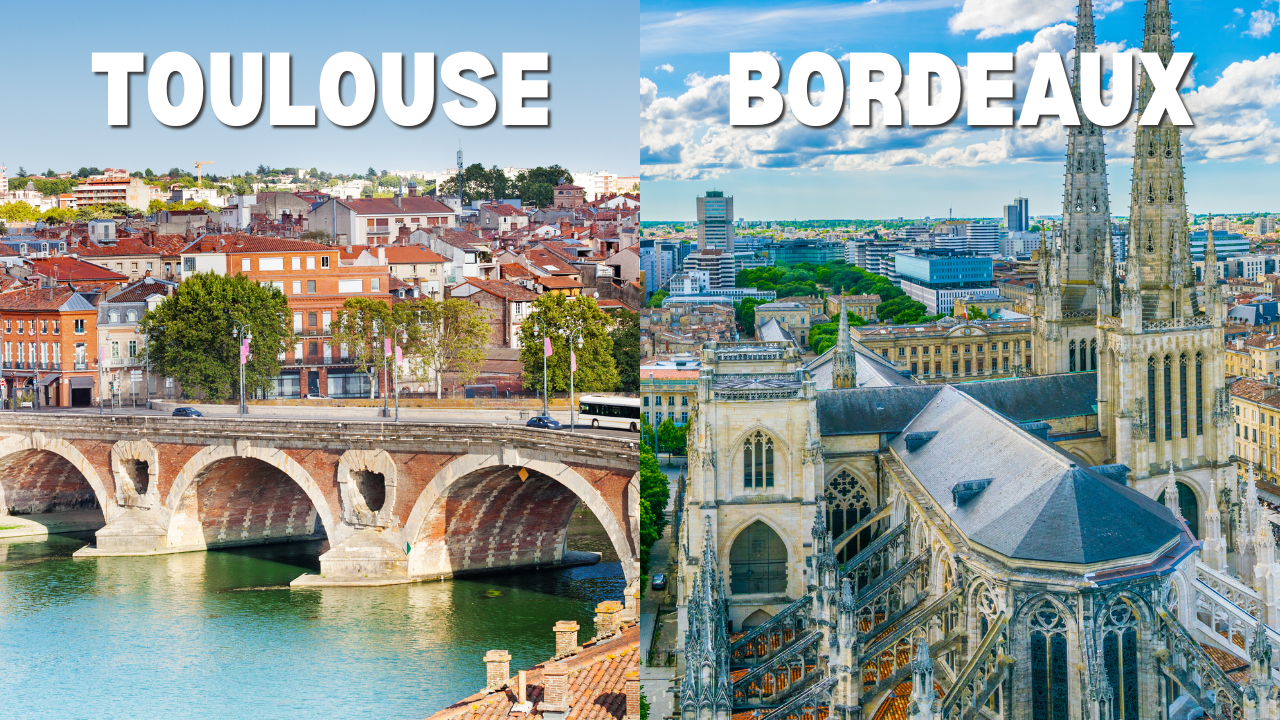
The first time I had to choose between these two, I picked wrong for entirely reasonable reasons. I wanted wine, so I went to Bordeaux, spent three days photographing gorgeous stone facades, and came home with the vague feeling I had visited a very beautiful museum. A year later I gave Toulouse a weekend, ended up eating lunch above a market with butchers shouting at each other downstairs, and understood what I had missed. Both cities are worth your time. They are also almost opposites, and the good news is that picking between them is easy once you know what separates them.
Quick Guide: Toulouse vs Bordeaux
- Primary recommendation: Choose Bordeaux for architecture, wine country and river-city elegance. Choose Toulouse for food, young energy, warmer weather and better value.
- Top choice for wine: Bordeaux.
- Top choice for food: Toulouse.
- Value pick: Toulouse, for travellers who want a bigger, livelier city on a smaller budget. It also gets more sun and stays busy in winter.
- Best for a short stop: Bordeaux. The UNESCO centre is compact and the sights sit close together, so two days covers it comfortably.
- The best way to see either city: Take a private, personalised walking experience with Lokafy in Toulouse or Lokafy in Bordeaux and let someone who lives there show you the streets that never make the guidebooks.
The short version: stone versus brick

Bordeaux is a stone city built on wine money. Its centre is a sweep of pale eighteenth-century limestone facades along a curve of the Garonne, listed by UNESCO as the Port of the Moon, and it looks like money because it was money. Wine merchants shipped from these quays for centuries, and the city was designed to impress the people arriving by boat.
Toulouse is a brick city built on trade, then aviation, then space. Locals call it la Ville Rose because the clay brick turns pink and then orange as the sun drops. It made its first fortune in the 1500s selling pastel, a blue dye pressed from the woad plant, and it now builds most of Europe's aircraft. The centre is smaller than Bordeaux's, flatter, and considerably more chaotic in the good way.
If you photograph buildings, Bordeaux wins. If you want a city that feels lived in at street level, Toulouse takes it.
Food: Toulouse has the edge, and it is not close
Toulouse eats seriously. The centre of the argument is Marché Victor Hugo, a covered market trading since 1896, open Tuesday to Sunday from around 7am until early afternoon and closed Mondays. Around 80 stallholders work the ground floor. The trick most visitors miss sits one level up: five restaurants (Chez Attila, L'Impériale, Le Louchebem, Le Magret and Au Bon Graillou) that cook the produce sold beneath them, open at lunch only. Get there by 11:45am for a table without waiting.
For cassoulet, the local benchmark is Le Genty Magre on rue Genty-Magre, where chef Romain Brard has been cooking traditional southwest food for over two decades and took the best Toulouse cassoulet title in 2023. It is closed Sunday through Tuesday, and booking is close to mandatory. Le Bibent on Place du Capitole is the grander option, a Belle Époque room that took the jury prize at the 2026 World Cassoulet Championship. Either way, treat cassoulet as a lunch. It is duck confit, Toulouse sausage, pork and white beans baked slowly, and it does not leave much room for an afternoon.
→ Where Locals Eat in Toulouse: A Food Lover's Journey Through the Pink City
Bordeaux's answer is Marché des Capucins in the Saint-Michel quarter, the biggest market in the city, open Tuesday to Friday from 6am to 1pm and until 2pm at weekends, closed Mondays. Sunday morning there is a proper local ritual: oysters from the Arcachon basin with a glass of dry white and a crépinette, standing at a counter, from about 9am. Chez Jean-Mi is the stall everyone names. Prices are cheap, the noise level is high, and nobody is performing for tourists.
The other Bordeaux essential is the canelé, a small fluted cake with a burnt-sugar crust and a custard centre, which locals buy by the bagful rather than the single. Buy a few warm and eat them within the hour, because the crust softens fast.
Result: Bordeaux has one world-class market moment and one iconic pastry. Toulouse has a food culture that runs all week.
Wine, planes and what fills your afternoons
Bordeaux's flagship attraction, La Cité du Vin, sits north of the centre on the right bank of the river at Bacalan. Adult entry is €23, and the ticket includes the audio companion plus a glass of wine on the eighth-floor Belvedere with a 360-degree view over the city. It turned ten in 2026. Take tram line B to the La Cité du Vin stop, or the Bat3 river shuttle from Quinconces, which costs the same as a tram ticket and gives you the best approach to the building.
Nearby, the Bassins des Lumières fills a WWII German submarine base with immersive digital art projected across four concrete basins over 100 metres long, with the images reflecting off the water. It opened in 2020 and rotates exhibitions two or three times a year, so check the current programme before booking.
Toulouse counters with space and aircraft. Cité de l'Espace, on the eastern edge of the city, holds a full-size Ariane 5, a Mir station replica and an Apollo lunar module, with free parking and enough content for a full day. Adult tickets are €29 and children €22.50. On selected summer evening openings, an online-only half-price ticket at €16 gets you in after 7pm, which is the smart move in July and August heat.
The stranger and more memorable option is the Halle de la Machine at Montaudran, built on the old Aéropostale runway where Saint-Exupéry and Mermoz once took off. Its resident giant is Astérion, a 14-metre, 47-tonne mechanical minotaur that walks the runway carrying passengers in a two-storey temple strapped to its back. The ride is ticketed separately from museum entry. Book it in advance.
The neighbourhoods worth your legs
In Bordeaux, walk Chartrons in the morning. It was the wine merchants' quarter, and it still has the covered market on rue Sicard (open daily except Sunday and Monday) plus the antique shops along rue Notre-Dame. On Sunday mornings the quayside market runs along the river and the flea market fills place Canteloup in Saint-Michel.
Saint-Michel itself is the most mixed and most affordable part of the centre, with North African grocers, Vietnamese kitchens and old-school Bordeaux bistros within two streets of each other. One 2026 note: the Marché Royal that normally sets up on place Canteloup on Saturdays has been moved temporarily to quai des Salinières while scaffolding comes down from the Saint-Michel spire.
Cross the Pont de Pierre to La Bastide for Darwin, a former military barracks converted into a skate park, co-working space, organic canteen and street-art site. It is where young Bordeaux spends its weekends and it is free to wander.

In Toulouse, start in the Carmes quarter for narrow streets and small squares, then cross the Garonne to Saint-Cyprien, which has the city's second market and a more neighbourhood feel. End at the Prairie des Filtres or the quays around Pont Neuf at sunset, when half the city sits on the grass with a bottle and the brick opposite goes properly orange. For a view, take the Téléo cable car, opened in 2022, which runs across the river and up to Pech David on a standard transport ticket.
Day trips: this one is a real tiebreaker
From Bordeaux, the wine villages are the draw. Saint-Émilion is roughly 40 minutes by regional train, though there are only a handful of services a day, so check the return before you commit. Arcachon and its oyster ports are under an hour, and the Dune du Pilat, the tallest sand dune in Europe at 106 metres, sits at the mouth of the basin.
Important 2026 update: large wildfires burned through parts of Gironde and the northern Landes from 22 July 2026, destroying around 45,600 hectares of forest. Bordeaux itself was never in the fire zone, and the Dune du Pilat reopened on 1 August. The climb up the dune is open while the surrounding forest paths stay closed, and smoking is banned across the whole site. Visitor numbers across the region dropped by as much as 30 percent afterwards, so late-season crowds are thinner than usual. Check the Grand Site de la Dune du Pilat and Inforoutes Gironde for current access before you travel.
From Toulouse, the medieval walled city of Carcassonne is 42 minutes away on the fastest direct trains, with roughly 22 services a day. Albi, with its enormous red-brick cathedral and the Toulouse-Lautrec museum, takes an hour to an hour and a quarter. Both are UNESCO sites, both are doable before dinner, and regional tickets in Occitanie are cheap enough that the trip costs less than lunch.
Toulouse wins on ease. Bordeaux wins if wine is the point of your trip.
Getting there, and getting around
Paris to Bordeaux by TGV takes about two hours, which is the single biggest reason Bordeaux tourism transformed after 2017. Paris to Toulouse takes over four hours by train, so most visitors fly. A high-speed line between Bordeaux and Toulouse is under construction and expected around 2032, which will cut the trip to roughly an hour.
For now, the two cities are 2 hours 20 minutes apart on the fastest direct trains, with around 17 services a day. That makes a combined trip straightforward.
Bordeaux transport: a single TBM ticket costs €1.80 and covers an hour of travel including transfers across trams, buses, the Bat3 river boats and V3 bikes. A 24-hour pass is €5.20 and a 7-day pass €14.40. Since December 2025 the network runs six tram lines, A to F. The airport is served by both tram A, which reaches Pey-Berland in around 35 to 45 minutes, and the newer line F, which links the airport to Gare Saint-Jean in about 45 minutes.
Toulouse transport: Tisséo raised fares on 1 July 2026, so a single ticket is now €1.90, a day pass €7.20 and a book of ten trips €16. That covers two automatic metro lines, two trams and the Téléo cable car. Tram T2 runs from the airport to Palais de Justice in around 30 minutes, and an express airport shuttle bus serves Matabiau station.
One thing worth knowing before you book a central Toulouse hotel: the city is mid-way through building metro line C, due to open at the end of 2028. Around 76 percent of the tunnelling was finished by mid-2026, and surface works are visible around François-Verdier, Matabiau, Bonnefoy, place de l'Ormeau and Côte Pavée, where avenue Jean Rieux stays diverted until the end of 2028. It is noise and hoardings rather than anything that will ruin a trip, but pick a room away from a work site.

Costs
Toulouse is the cheaper city across the board: hotel rates, restaurant covers and drinks all sit below Bordeaux, which prices itself as a wine destination and fills up during the September harvest. Bordeaux gets expensive fast in spring and early autumn. Toulouse holds steadier through the year because its economy runs on students and aerospace workers rather than visitors.
Public transport costs are near identical, at €1.80 in Bordeaux and €1.90 in Toulouse.
48 hours in each city
Bordeaux, two days. Morning one: Place de la Bourse and the Miroir d'Eau early, before the reflection fills with people, then the Golden Triangle and rue Sainte-Catherine. Lunch in Saint-Pierre. Afternoon: Bat3 shuttle up to Bacalan for La Cité du Vin, then Bassins des Lumières next door. Evening: dinner in Chartrons.
Day two: Marché des Capucins from 9am for oysters and white wine, then wander Saint-Michel and climb the bell tower if it is open. Afternoon: train to Saint-Émilion, or cross to Darwin in La Bastide if you would rather stay in town. Evening: the quays at sunset.
Toulouse, two days. Morning one: Place du Capitole, Couvent des Jacobins for the palm-tree vault, then Basilique Saint-Sernin, the largest surviving Romanesque church in Europe. Lunch upstairs at Marché Victor Hugo. Afternoon: the Carmes backstreets and Fondation Bemberg. Evening: apéro on the quays by Pont Neuf.
Day two: Cité de l'Espace or Halle de la Machine, both on the eastern side of the city and both worth half a day. Afternoon: cross to Saint-Cyprien, then take the Téléo cable car for the view. Evening: cassoulet, booked ahead, followed by a walk along the Canal du Midi, which is also UNESCO-listed and starts a short walk from Matabiau station.
So which one should you visit?
Pick Bordeaux if you want elegant architecture, wine at the source, easy access from Paris, and a compact centre you can cover in two days without hurrying.
Pick Toulouse if you care more about eating well, spending less, hearing the local accent, wanting sun into October, and having Carcassonne and Albi within an hour.
Pick both if you have five days or more. Two nights in Bordeaux, the 2h20 train, three nights in Toulouse, out through Toulouse-Blagnac. It is one of the better short trips in France and almost nobody plans it that way.
See either city with someone who lives there

Both cities hide their best parts one street back from the obvious route. In Bordeaux that might be which stall at the Capucins opens the oysters properly, or which Chartrons courtyard is worth stepping into. In Toulouse it might be the lunch counter your host has used for fifteen years, or the quiet square behind Saint-Sernin that nobody photographs.
Take a private, personalised walking experience with Lokafy in Toulouse or Lokafy in Bordeaux and see the city through a local's eyes. Tours are one-on-one, built around what you want to see, and shaped by someone who lives there rather than a script. No groups, no flags, no fixed route.
Frequently asked questions
Is Toulouse or Bordeaux better to visit? Bordeaux is better for architecture, wine tourism and a short, polished city break. Toulouse is better for food, atmosphere, value and day trips. If you have to choose one and wine is not your priority, Toulouse tends to be the more rewarding stay.
How far is Toulouse from Bordeaux? The two cities are 2 hours 20 minutes apart on the fastest direct trains, with around 17 services a day. A high-speed line is planned for about 2032, which would cut the journey to roughly an hour.
Can you visit Toulouse and Bordeaux in the same trip? Yes, and it is one of the easiest pairings in France. Five days works well: two nights in Bordeaux, the train across, three nights in Toulouse. Fly into Bordeaux-Mérignac and out of Toulouse-Blagnac to avoid backtracking.
Which city is cheaper, Toulouse or Bordeaux? Toulouse. Hotels, restaurants and drinks all cost less, and prices stay steadier through the year. Bordeaux climbs sharply in spring and during the September grape harvest. Transport is almost identical at €1.80 a ride in Bordeaux and €1.90 in Toulouse.
Is Bordeaux worth visiting if you do not drink wine? Yes. The UNESCO-listed centre, the Miroir d'Eau, the Bassins des Lumières in the old submarine base, the Capucins market and the Darwin site in La Bastide all stand on their own. You will still be offered wine constantly, and grape juice is available at La Cité du Vin instead of the tasting glass.
Is Toulouse worth visiting for more than a day? Comfortably. Two full days covers the old town, one major attraction such as Cité de l'Espace or the Halle de la Machine, and both riverbanks. A third day gets you Carcassonne or Albi by train.
Is it safe to visit Bordeaux after the 2026 wildfires? Yes. The fires that began on 22 July 2026 affected forest areas of southern Gironde and the northern Landes, not the city. The Dune du Pilat reopened on 1 August, with the dune climb accessible while surrounding forest paths remain closed and smoking banned across the site. Check the Grand Site de la Dune du Pilat and Inforoutes Gironde for current access before travelling to the coast.
When is the best time to visit? May, June and September suit both cities. Bordeaux is at its busiest and priciest during the September harvest. Toulouse holds warm weather into October and stays lively in winter because of its student population. July and August get hot in Toulouse, which is when the evening ticket at Cité de l'Espace earns its keep.
Enjoyed this article?