The first time I stepped out of Porta Nuova station, I was braced for a grey industrial city with a football team and not much else. An hour later I was sheltering from drizzle under a stone arcade, holding a small glass of coffee, chocolate and cream that the waitress had firmly told me not to stir. Turin is that kind of place. It doesn't shout for attention the way Rome or Florence does, which is exactly why it suits travelling alone: the crowds are thinner, the cafés expect you to linger, and almost everything worth seeing sits within walking distance of everything else.
Quick Guide: Solo Travel in Turin on Foot.
- Primary Recommendation: Base yourself in the centre or the Quadrilatero Romano and walk. The historic core is flat, laid out on a Roman grid and lined with covered arcades, so you can cross it in any weather without a map open the whole time.
- Top Choice for Eating Alone: Cianci Piola Caffè in Largo IV Marzo. Pro tip: it doesn't take reservations, so join the queue, which moves faster than it looks, and ask for a table on the little square.
- Value Pick: Monte dei Cappuccini at sunset for solo travellers who want the classic view of the Mole and the Alps without buying a ticket.
- The Best Way to See the City: Take a private walking experience with Lokafy in Turin and discover the piole, markets and back-street cafés that locals use every day, with a local.

Is Turin Good for Solo Travellers?
Yes, and it is one of the better Italian cities for it. Turin was Italy's first capital and the seat of the House of Savoy, so it inherited grand squares, royal palaces and a café culture built around sitting alone with a coffee and a newspaper. Nobody blinks at a table for one.
It also helps that Turin gets a fraction of the visitors that Venice or Florence see. Queues at the big museums are manageable, restaurant staff have time to explain the menu, and you'll hear far more Italian than English on the street. For a solo traveller, that combination of space and slowness makes the city easy to settle into on day one.
Is Turin Walkable?
Very. The centre follows the old Roman street grid, so streets run in straight lines and it is hard to get badly lost. Better still, kilometres of porticoes run along Via Roma, Via Po and Piazza Castello, which means a rainy day doesn't wreck your plans. Turin locals walk under them all year.
Most first-time sights, from the Egyptian Museum to the Mole Antonelliana to Porta Palazzo market, sit within a 20-minute walk of Piazza Castello. You only need public transport for the edges: the Lingotto, the Superga hill, or a lunch out in a residential district. When you do, the metro accepts contactless bank cards at the gates, and GTT's TO Move app sells digital tickets for buses and trams.
Day One: The Classic Turin Walk
This route covers the historic centre in a loop that works well alone, with natural places to stop, eat and sit.
- Start with a bicerin at Caffè Al Bicerin. This tiny café on Piazza della Consolata has been open since 1763 and is where Turin's signature drink was invented: espresso, hot chocolate and cold cream layered in a glass. Drink it unstirred so the hot and cold layers stay separate. It closes on Wednesdays, so plan around that.
- Wander the Quadrilatero Romano. The streets around the café form the oldest part of the city. Head east towards the Porta Palatina, the Roman gate, and let yourself drift through the side streets.
- Walk through Porta Palazzo market. Piazza della Repubblica hosts Europe's largest open-air market, running Monday to Saturday (mornings on weekdays, all day on Saturday). It is loud, multicultural and full of Piedmontese cheese, North African spices and fruit stalls. On Saturdays, the Balon flea market spills through the streets of Borgo Dora next door, and on the second Sunday of each month it grows into the much bigger Gran Balon.
- Have a tramezzino at Caffè Mulassano. This mirrored little café under the arcades of Piazza Castello is where the tramezzino, Italy's soft crustless sandwich, was invented in 1926. There are more than 30 fillings in the glass case. Eat standing at the counter like the regulars.
- Give the Egyptian Museum a few hours. Founded in 1824, the Museo Egizio is the oldest museum in the world devoted entirely to ancient Egypt, with one of the most important collections outside Cairo. Book a timed ticket online before you go.
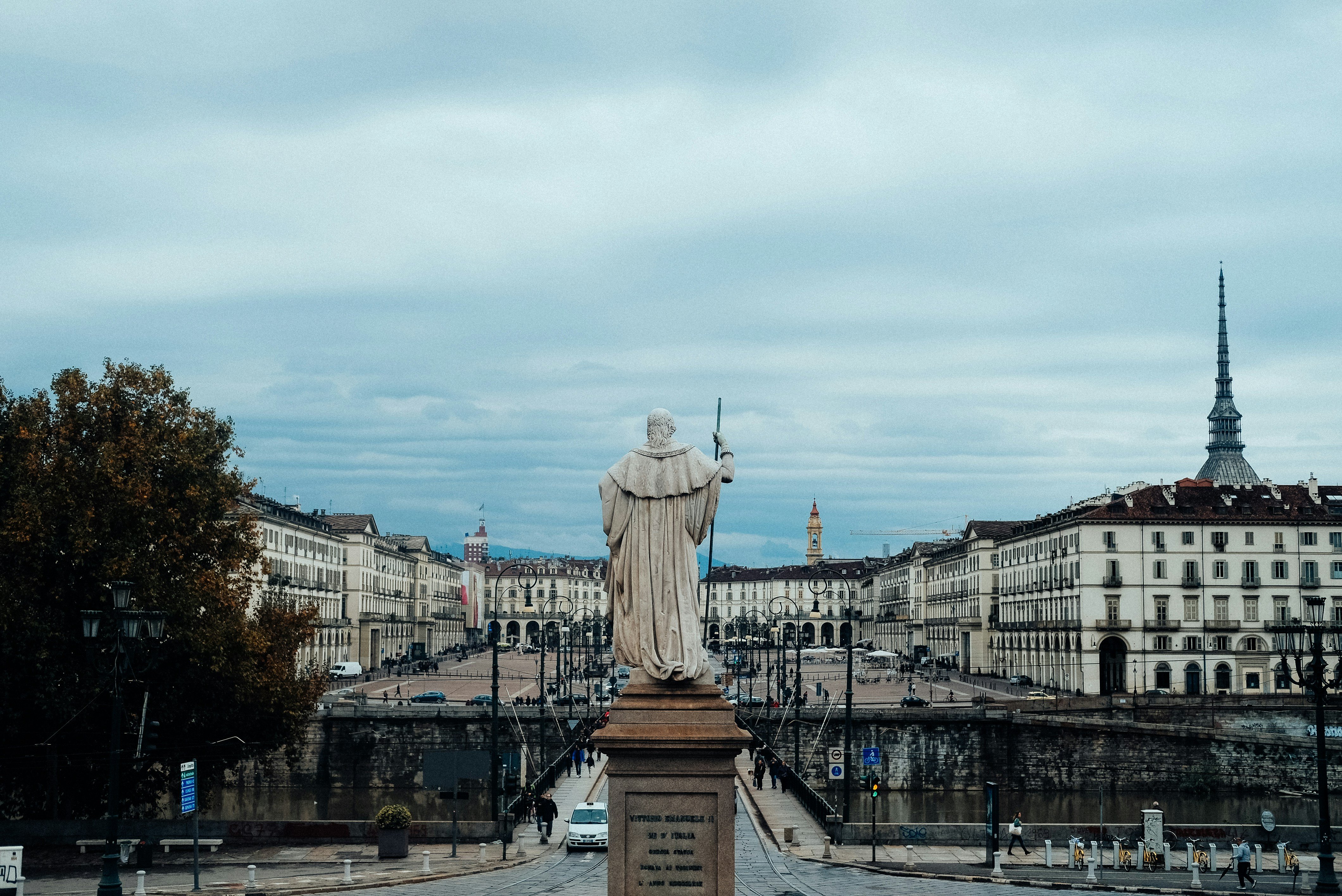
- Stroll Via Po to Piazza Vittorio Veneto. Via Po runs from Piazza Castello to the river under continuous arcades, past old bookshops and student bars. It ends at Piazza Vittorio Veneto, one of the largest arcaded squares in Europe.
- Cross the river and climb Monte dei Cappuccini. Walk over the Ponte Vittorio Emanuele I, pass the domed Gran Madre church, and take the short, steep climb (about ten minutes) up to the church terrace. At sunset you get the whole city, the Mole and, on a clear day, the Alps lined up behind them. The National Mountain Museum sits up here too.
- Finish with aperitivo. Vermouth was invented in Turin in 1786, and early-evening aperitivo, roughly 6pm to 8pm, is a local ritual. Order a vermouth-based drink and the snacks arrive with it. Pastis on Piazza Emanuele Filiberto, back in the Quadrilatero, is a long-standing favourite and an easy spot to sit alone.
Day Two: The Neighbourhoods Locals Choose
Day one shows you the Turin on the postcards. Day two is where you see how people live.
San Salvario
A few minutes south of Porta Nuova station, San Salvario is the city's most multicultural neighbourhood and its liveliest after dark. Mornings here are quiet. Come for gelato at Mara dei Boschi on Via Berthollet, one of the most respected gelaterias in the city, where many flavours are made without lactose. The Marotto, a gelato take on the gianduiotto chocolate, is the one to try first. In the evening, Affini on Via Nizza is a well-loved aperitivo bar for vermouth cocktails, and Madama Piola on Via Ormea serves updated Piedmontese classics; the stuffed onion is the dish everyone talks about. Note that Madama Piola is closed on Tuesdays and mostly opens for dinner.
Parco del Valentino
San Salvario runs straight into Valentino Park along the Po. It is Turin's oldest park and the obvious place for a solo walk with a book or a picnic from the market. Follow the river south past the rowing clubs and the Valentino Castle, a former Savoy residence now used by the Polytechnic University.
The Lingotto and La Pista 500
Take the metro to Lingotto to see one of the strangest views in Italy. The old FIAT factory had a car test track on its roof, and today that 1.1-kilometre loop is La Pista 500, a rooftop garden with more than 40,000 plants and outdoor contemporary art installations, run by the Pinacoteca Agnelli. Walking a curved race track five storeys above the city, with the Alps in the distance, is one of those Turin experiences that no other Italian city can match. Check opening days on the Pinacoteca's site before you go.
Vanchiglia
North of Via Po, Vanchiglia is where students, artists and young families live. It has none of the big monuments and all of the neighbourhood life. Orso Laboratorio Caffè is a specialty coffee bar by day that switches to natural wine and vermouth in the evening, and the streets around Piazza Santa Giulia fill up with locals on warm nights.
Optional: Superga
If you have a spare half day, head up to the Basilica of Superga, Filippo Juvarra's baroque church on a hilltop at 672 metres. The most fun way up is the Sassi to Superga rack tramway, a historic line in service since 1934, which climbs through the woods from the Sassi station. Football fans should walk behind the basilica to the memorial for the Grande Torino team, killed when their plane crashed into the hill in 1949. Timetables change by season, so check GTT before setting off.
Where to Eat Alone in Turin

The piola is the answer. A piola is Turin's version of the old neighbourhood tavern: simple Piedmontese food, house wine, low prices and no fuss about a single diner. Ask any Turin local where to eat cheaply and well, and these names come up again and again.
Cianci Piola Caffè (Largo IV Marzo 9/b). The busiest piola in the centre, open for lunch and dinner every day, with an outdoor area on one of the prettiest small squares in the Quadrilatero. The menu is short and changes with the seasons, and prices are famously low. Expect a queue at peak times. Solo diners tend to get seated faster, since single spots free up first.
Piola da Celso (Via Verzuolo 40). Out in the residential San Paolo district, west of the centre, this family-run piola feels like being fed by someone's aunt. At lunch there is a set menu of Piedmontese classics, served with plenty of warmth and very little English. Locals rate it as a comfortable place to eat alone, and it rewards the trip out.
Caffè Mulassano (Piazza Castello 15). For a light lunch on the move, two or three tramezzini at the counter will do the job.
What to order. Look for vitello tonnato (cold veal in tuna sauce, far better than it sounds), agnolotti del plin (small pinched pasta parcels), tajarin (thin egg pasta, often with ragù) and bonet, a chocolate and amaretti pudding. In autumn, bagna cauda, the warm garlic and anchovy dip, appears on menus across the city.
Gelato. Alberto Marchetti on Via Po and Mara dei Boschi in San Salvario are the two names Turin locals argue about. Try both and pick a side.
Is the Mole Antonelliana Worth It Alone?
The Mole Antonelliana is Turin's symbol, a 167-metre tower that now houses the National Cinema Museum. Inside, a glass panoramic lift rises through the empty centre of the building to a viewing terrace at 85 metres in 59 seconds, which is a thrill in itself. Book the lift online in advance, as slots sell out, especially at weekends. The museum and the lift are closed on Tuesdays.
If you're watching your budget, Monte dei Cappuccini gives you a view that includes the Mole, which the Mole itself obviously can't. Many solo travellers do the museum for the cinema history and save the sunset for the hill.
Safety and Practical Tips for Solo Travellers
- Turin is a safe city overall, but pickpockets work crowded spots. Keep your phone and wallet in front of you at Porta Palazzo, especially on Saturday mornings when the market is packed.
- At night, stay alert around Porta Nuova station and Porta Palazzo. Both are fine in the daytime and can feel rough after dark. San Salvario and Vanchiglia are busy and sociable in the evening.
- Mind the closing days. Al Bicerin closes on Wednesdays, the Mole on Tuesdays, Porta Palazzo on Sundays, and Madama Piola on Tuesdays. Plenty of smaller restaurants close one day a week, so check before you walk across town.
- Eat on Italian time. Lunch runs from about 12:30 to 2:30pm and dinner rarely starts before 7:30pm. Aperitivo fills the gap.
- Carry a little cash. Cards work almost everywhere in the centre, but market stalls and small bars appreciate coins and small notes.
- Pack for weather. Turin can be foggy and cold in winter and hot in July and August. The arcades help in both cases.
Explore Turin With a Lokafyer

Turin is easy to walk alone, but it is a city that hides its best parts in plain sight: the courtyard behind an unmarked door, the piola with no sign, the café where the barista knows everyone's order. That is where a local makes the difference.
Take a private, personalised walking experience with Lokafy in Turin and spend two to six hours with a Lokafyer, a local who shows you their city the way they would show a friend. You choose the focus: the Savoy palaces and royal history, a long wander through the piole and markets, the aperitivo bars of San Salvario, or a mix of everything. Your Lokafyer meets you wherever suits you, at your hotel, a landmark or a café, and the walk is shaped entirely around your interests. No group of strangers joins you, and cancellation is free up to 24 hours before.
For solo travellers, it is also the fastest way to feel at home: by the end of the walk you'll have a list of places to go back to and someone's advice on how to spend the rest of your trip.
Book your Turin experience with a local
Frequently Asked Questions
Is Turin good for solo travellers?
Yes. Turin has fewer tourists than Rome, Florence or Venice, a long café tradition where sitting alone is completely normal, and a compact, walkable centre. Piole and aperitivo bars are relaxed about single diners, which makes it one of the easiest Italian cities to visit alone.
Is Turin safe to walk alone at night?
Generally, yes. The centre, San Salvario and Vanchiglia stay busy in the evenings. Take extra care around Porta Nuova station and Porta Palazzo after dark, and watch for pickpockets in crowded places like the Saturday market.
How many days do you need in Turin?
Two days covers the historic centre, the Egyptian Museum, the Mole Antonelliana and a sunset from Monte dei Cappuccini, plus one or two neighbourhoods. Add a third day for Superga, the Lingotto and slower meals.
Is Turin walkable?
Very. The centre is flat, laid out on a Roman grid and lined with covered porticoes, so most major sights are within about 20 minutes on foot of Piazza Castello. Public transport is only needed for outlying areas such as the Lingotto or Superga.
Where can I eat alone in Turin?
Traditional piole are the best bet. Cianci Piola Caffè in the Quadrilatero is central, cheap and open every day, while Piola da Celso in San Paolo offers a family-run set lunch. For something quick, the tramezzini at Caffè Mulassano on Piazza Castello are a Turin institution.
Is the Mole Antonelliana panoramic lift worth it?
For most visitors, yes. The glass lift climbs to an 85-metre terrace in 59 seconds, with views over the city to the Alps. Book online in advance and avoid Tuesdays, when it is closed. For a free alternative, Monte dei Cappuccini gives a view that includes the Mole itself.
When is the best day to visit Porta Palazzo market?
Saturday is the most atmospheric, as the food market runs all day and the Balon flea market fills Borgo Dora next door. It is also the busiest and the most popular with pickpockets. Weekday mornings are calmer. The market is closed on Sundays, except for the Gran Balon antiques market on the second Sunday of each month.
Enjoyed this article?