I have a soft spot for Christmas markets that still feel like they belong to the town around them, and Riga is one of the few capitals in Europe that pulls it off. This is the city with the first written record of a decorated Christmas tree, back in 1510, and yet its markets never make a fuss about it. You get a cathedral square packed with wooden stalls, a park where kids feed carrots to a village of rabbits, a Saturday craft fair in a quarter of old wooden houses across the river, and a red-brick market hall where families do their real holiday shopping. Crowds stay manageable compared with the big German markets, and with daylight gone before 4pm, every string of lights gets hours to show off. Here is how to do it well.
Quick Guide: Riga Christmas Markets Key Takeaways
- Primary Recommendation: The Old Town Christmas Market on Doma laukums (Cathedral Square), open daily from the end of November into the first days of January. Go after dark on a weekday for the best atmosphere with the thinnest crowds.
- Top Choice for Local Crafts: The Kalnciema Quarter Christmas market, held on Saturdays in December across the Daugava. Latvian ceramicists sell here, so leave room in your suitcase.
- Value Pick for Families and Food Lovers: Āgenskalns Market's weekend Christmas fair (Friday to Sunday) with a street-food floor upstairs, plus Esplanāde Park's Rabbit Kingdom and small Ferris wheel for kids.
- The Best Way to See the City: Take a private, personalized walking experience with Lokafy in Riga and discover the markets, winter food and Old Town stories with a local.
When Are the Riga Christmas Markets Open?
The main Riga Christmas market opens at the end of November and runs into the first days of January, which makes it one of the longer seasons in Europe. Unlike markets that pack up on 24 December, Riga's keeps going through New Year, so a trip between Christmas and New Year's Eve still gets you the full experience. The city confirms exact dates each autumn on riga.lv and the market's own site.
Opening hours usually run from late morning until 8pm to 10pm depending on the day, with the longest evenings on Fridays and Saturdays. Expect shorter hours on 24 and 25 December, when Latvians celebrate at home. The smaller markets across the river are weekend affairs that run through December and generally close around Christmas.
Plan around the light. In December the sun rises close to 9am and sets before 4pm, and temperatures hover around freezing. Use the daylight for walking across the river and save the Old Town for the evening, when the markets look their best.
Doma laukums: The Main Riga Christmas Market
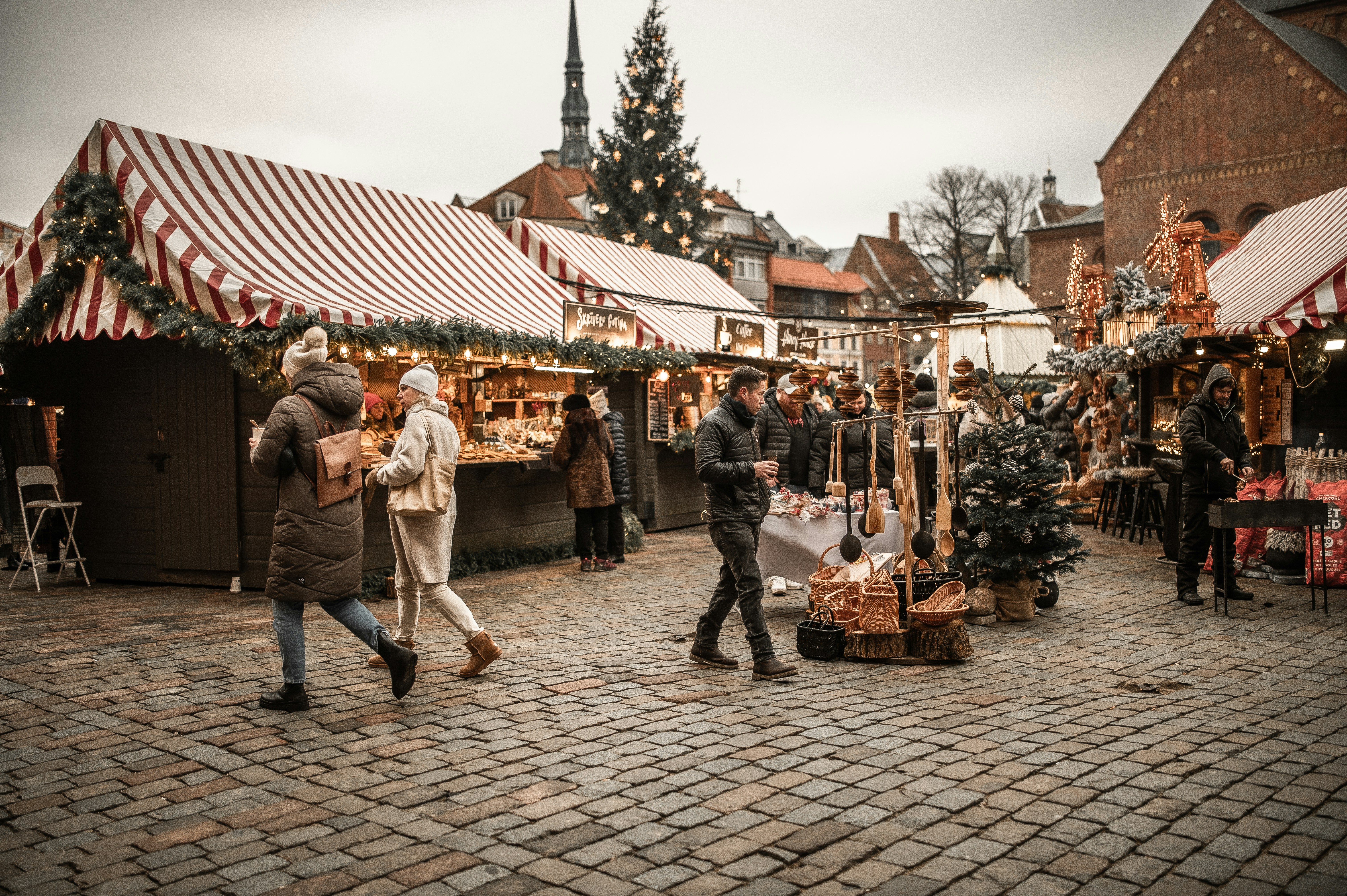
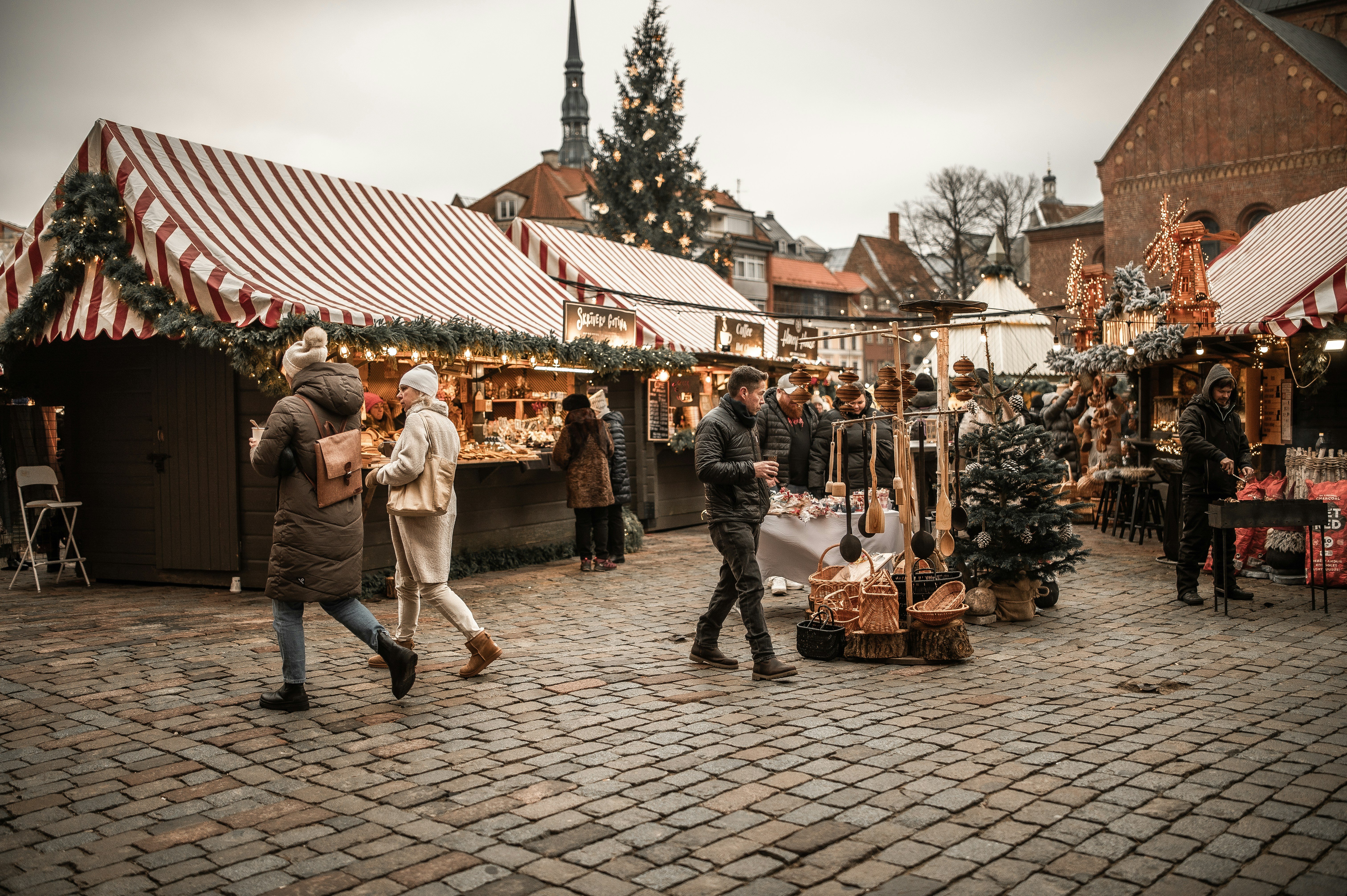
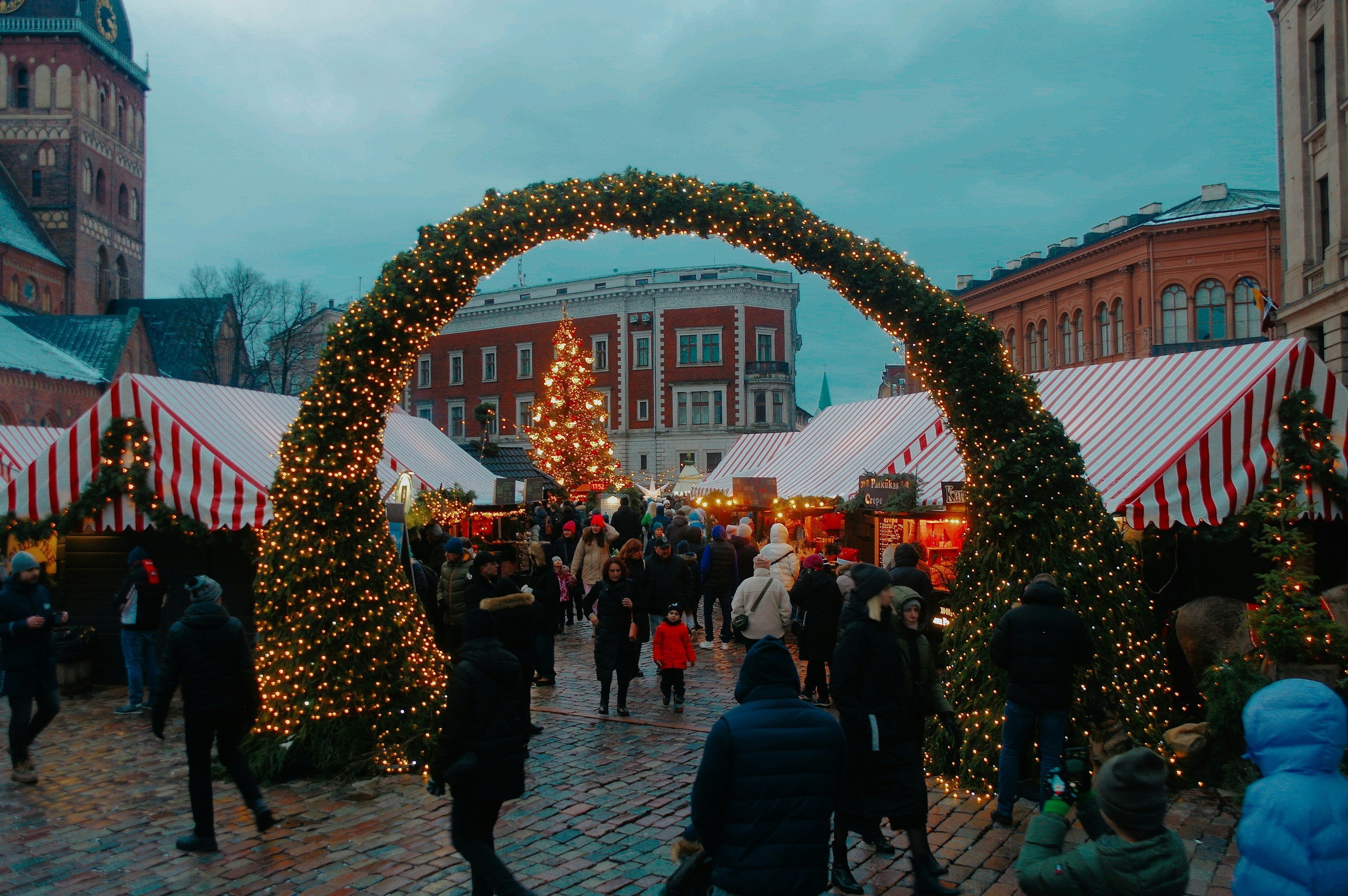
Doma laukums is the largest square in the Old Town, sitting under the towers of Riga Cathedral, the biggest church in the Baltic states. The modern market started here in 2000, and in recent seasons it has hosted more than 80 traders around a tall spruce strung with lights.
The stalls lean heavily Latvian. Look for patterned wool mittens, turned wooden candlesticks, jars of local honey, beeswax candles, amber and silver jewellery, and hand-knitted socks that will outlast anything you buy at home. Families get Santa's house, a small carousel, pony rides and a sheep pen, and kids can post a letter to Lapland from the square.
Weekends bring a stage programme. In recent years Fridays have belonged to DJs, Saturdays to choirs and ensembles, and Sundays to folk musicians, which is the best night to hear Latvian songs sung by people who grew up with them.
A fair warning from locals: Doma laukums is the postcard market, and its prices reflect that. A cup of karstvīns (mulled wine) runs roughly €5 to €6, and not every craft stall sells Latvian-made goods, so ask the seller who made the piece. Treat this square as your evening drink-and-atmosphere stop, and save serious gift shopping for the markets below.
The Riga Christmas Markets Locals Prefer
Kalnciema Quarter (Kalnciema kvartāls)
Across the Stone Bridge, in the Āgenskalns neighbourhood, a cluster of restored 19th-century wooden houses at Kalnciema iela 35 hosts a Christmas market every Saturday in December. This is where Riga residents shop for presents. The focus is handmade: ceramics from studios around Latvia, woven scarves, candles, organic food and small-batch sweets. In recent seasons there have been open-air concerts, elves roaming around for the kids and tree-decoration workshops.
It is roughly a 30-minute walk from Doma laukums, or a short tram ride over the river. Arrive in the morning, since the market wraps up by mid-afternoon.
Āgenskalns Market (Āgenskalna tirgus)
About ten minutes on foot from Kalnciema Quarter stands a handsome red-brick market hall at Nometņu iela 64. After years of neglect it was restored and reopened in 2022, and it has since become the city's favourite indoor market. Through December it runs themed Christmas fairs from Friday to Sunday, both inside the hall and outside it.
Head upstairs for lunch. The second floor is a street-food area with everything from Latvian plates to Georgian and Uzbek cooking, and it is full of locals on weekends. Pairing Kalnciema in the morning with Āgenskalns at lunchtime makes for the most local Saturday you can have in Riga in December.
Esplanāde Park
Next to the Freedom Monument and the gold-domed Nativity of Christ Cathedral, Esplanāde Park runs a smaller, family-focused market in wooden chalets. Its claim to fame is the Rabbit Kingdom, a fenced village of tiny houses (there is even a little church) where dozens of rabbits hop around. Buy carrots from the stall beside the enclosure rather than feeding them your own snacks. Add a small Ferris wheel and a few craft stalls, and you have the best Riga Christmas market for kids. Go in the late afternoon so children see the rabbits before dark.
Art and Design Fairs
Riga's creative crowd has its own December calendar. JAUNmarka at the Art Academy of Latvia runs from mid-December into early January, with more than 400 students selling paintings, ceramics, jewellery and more, often in person. Zuzeum, the private art museum on Lāčplēša iela, has held a weekend Christmas gift market in mid-December with original artworks, design pieces, mulled wine and gingerbread. Dates shift each year, so check their social channels before you go.
What to Eat and Drink at Riga's Christmas Markets
Karstvīns. Latvian mulled wine, spiced and served hot at every market. Stalls also pour non-alcoholic versions made with berry juice, and blackcurrant is the flavour you will see everywhere.
Hot Riga Black Balsam. The city's herbal liqueur was first made by a pharmacist named Abraham Kunze in 1752, and legend says it cured Catherine the Great of an illness during a stop in Riga. Neat, it tastes like a very serious cough syrup. Mixed hot with blackcurrant juice, it is the best thing you can hold on a cold evening, and the markets serve it this way.
Piparkūkas. Latvian gingerbread, whose name translates to "pepper cakes". Expect thin, spiced biscuits cut into stars, hearts and Santas, often iced by hand.
Grey peas with speck (pelēkie zirņi ar speķi). Latvia's great Christmas dish: large grey peas stewed with onions and smoky bacon, often finished with sour cream. The peas are unique enough that Latvian large grey peas gained EU protected status in 2015.
Round things out with smoked meats, roasted almonds and oven-baked cheese bread at the stalls.
Where to sit down and warm up:
- Black Magic, Kaļķu iela 10. A candlelit café and bar a few minutes from Doma laukums, full of apothecary bottles, with a bookcase that opens onto a hidden cellar. Order a Black Balsam cocktail, a slice of cake or a hot chocolate. It is touristy, and it is still worth the stop.
- Folkklubs ALA Pagrabs, Peldu iela 19. A huge vaulted cellar under the Old Town with dozens of Latvian beers and ciders on tap, hearty food (the rye garlic bread and grey peas are local favourites) and live music most nights. Wednesdays are folk dance nights. Book ahead for Fridays and Saturdays.
- Milda, Kungu iela 8. A Michelin Bib Gourmand restaurant cooking Latvian and Lithuanian home food with a light touch: pelmeni, cepelinai and grey peas with bacon. It is closed on Mondays.
- Riga Central Market. Huge pavilions built from the frames of old German Zeppelin hangars, next to the train station. Come here for dark rye bread, local honey, smoked fish and cheese to take home.
A One-Day Walking Plan for Christmas in Riga
Riga's centre is compact, and everything below is walkable. Wear boots with good grip, because the Old Town cobblestones get slick in December.
- 10:00, Riga Central Market. Start with coffee and a wander through the pavilions to pick up edible gifts before the crowds arrive.
- 11:30, Town Hall Square. Walk ten minutes into the Old Town. Look for the small plaque in the square marking the spot of the 1510 tree, a few steps from the House of the Blackheads, whose merchant guild decorated it with artificial roses before setting it alight. Tallinn, up the coast, claims it decorated a tree first, and the two cities have never quite settled the argument.
- 12:30, lunch at Milda. Order cepelinai and a bowl of grey peas.
- 14:00, Doma laukums in daylight. Browse the stalls while they are calm and the light is good for photos.
- 15:30, Black Magic. Duck in for hot Black Balsam as the sky darkens.
- 16:30, the canal walk to Esplanāde. Follow the city canal through Bastejkalns park, where the city usually hangs winter light installations, to the Freedom Monument, then continue to Esplanāde Park for the rabbits and the Nativity of Christ Cathedral.
- 18:30, back to Doma laukums. The square is at its best after dark, with the tree lit and the stage running on weekends.
- 20:00, dinner at Folkklubs ALA Pagrabs. Finish underground with a honey beer and live music.
If you have a Saturday: cross the Stone Bridge in the morning for Kalnciema Quarter, walk ten minutes to Āgenskalns Market for lunch upstairs, and return to the Old Town before the light goes.
Tips for Visiting the Riga Christmas Markets
- Weekdays are calmer, weekends have the programme. Pick a Tuesday or Wednesday evening for relaxed browsing and a Saturday for concerts and the cross-river markets.
- Carry a few euros. Cards are widely accepted, but small craft stalls and snack huts are quicker with cash.
- Book dinner around 24 and 25 December. Christmas Eve is the main family celebration in Latvia, so plan meals early if you are in town that week.
- Watch for the winter solstice. Latvians mark the longest night on 21 December, and in past years folk groups have dragged a Yule log (bluķis) through the Old Town before burning it to leave the year's troubles behind. It is one of the most local sights of the season if it lines up with your visit.
- Layer up for the evenings. Temperatures near freezing feel colder by the river after dark, and a hat makes more difference than a heavier coat.
Explore Riga's Christmas Markets with a Local

Riga's markets are easy to find, and most visitors see Doma laukums, drink a karstvīns and move on. The better version of December in Riga comes from someone who grew up here: the stall with the best piparkūkas, the ceramicist at Kalnciema whose mugs sell out, the courtyard where the Old Town goes quiet, and the story of how a guild of unmarried merchants gave the world its first recorded Christmas tree.
A Lokafy Riga experience pairs you with a local host for a private walk of 2 to 6 hours, built around what you want to see. Spend it on a Christmas market crawl, a gift-shopping mission across the river, a winter food walk, or the Art Nouveau streets around Alberta iela once the market lights come on. Your host meets you at your hotel, a café or a landmark, and it is only your group, never strangers. Families are welcome, with children under 3 joining free and ages 3 to 12 at half price, and free cancellation up to 24 hours before.
Book your private Riga walk with a local on Lokafy
Riga Christmas Markets FAQ
When is the Riga Christmas market open?
The main Riga Christmas market on Doma laukums opens at the end of November and runs into the first days of January, staying open through Christmas and New Year. Hours are typically late morning to between 8pm and 10pm, with shorter hours on 24 and 25 December. Official dates are announced each autumn.
Where is the main Christmas market in Riga?
The main market is on Doma laukums (Cathedral Square) in the Old Town, in front of Riga Cathedral. Other markets run in Esplanāde Park near the Freedom Monument, at Kalnciema Quarter on Saturdays in December, and at Āgenskalns Market from Friday to Sunday.
Is the Riga Christmas market worth visiting?
Yes. Riga combines a UNESCO-listed Old Town, a strong Latvian craft tradition and smaller crowds than the big German and Austrian markets. The city also claims the first recorded decorated Christmas tree, from 1510. For the most local experience, pair Doma laukums with the Kalnciema Quarter and Āgenskalns markets across the river.
Which Riga Christmas market do locals prefer?
Many Riga residents do their gift shopping at the Kalnciema Quarter Saturday market and Āgenskalns Market rather than Doma laukums. Both sit across the Daugava, focus on Latvian makers and food producers, and feel more like a neighbourhood outing than a tourist attraction.
What food and drinks should I try at the Riga Christmas markets?
Try karstvīns (Latvian mulled wine), hot Riga Black Balsam mixed with blackcurrant juice, piparkūkas gingerbread, smoked meats and roasted almonds. For a sit-down meal, order grey peas with speck, Latvia's traditional Christmas dish.
Is the Riga Christmas market good for kids?
Yes. Doma laukums has Santa's house, a carousel, a sheep pen and pony rides on weekends. Esplanāde Park adds the Rabbit Kingdom, where children can feed rabbits carrots bought on site, and a small Ferris wheel.
How expensive is the Riga Christmas market?
Entry to every market is free. At Doma laukums, a cup of mulled wine costs roughly €5 to €6 and small food portions start around €5. Craft prices are lower at Kalnciema Quarter and Āgenskalns Market, where you buy directly from makers.
How many days do you need in Riga in December?
Two days covers the main Christmas markets, the Old Town and one Saturday across the river for Kalnciema Quarter and Āgenskalns Market. Add a third day for museums, the Art Nouveau district and a slower pace in the short winter daylight.
Enjoyed this article?