I almost skipped Graz entirely. My original plan had me in Vienna for four days, then straight on to Slovenia, and Graz was a name on the map that kept showing up when I searched for things to do near the border. A friend who had studied in Austria told me I was making a mistake. She said something I still think about: "Vienna is where Austria shows off. Graz is where Austria actually lives." That sentence is the entire reason I rerouted my trip, and it turned out to be the best change I made on that entire journey through Central Europe.
Graz is Austria's second largest city, sitting in the green hills of Styria about two and a half hours south of Vienna. It has a UNESCO listed Old Town, a hill with a fortress that even Napoleon could not take by force, a university population that keeps the streets young, and a food culture built around pumpkin seed oil and Styrian wine instead of schnitzel and sachertorte. None of that is a knock against Vienna. It is a different city with a different rhythm, and once you slow down to match it, you start to understand why so many Austrians quietly prefer it.
Quick Guide: Graz Key Takeaways
Primary Recommendation: Walk the Old Town first, then ride up the Schlossberg in the late afternoon for the best light over the rooftops.
Top Choice for Food: Kaiser-Josef-Markt for breakfast among the stalls, with a pro tip to arrive before 10am on a Saturday when the farmers themselves are still setting up and the market is at its loudest and freshest.
Value Pick: The Lend district for travelers who want a creative, lived-in neighborhood without the price tag of a guided tour.
The Best Way to See the City: Take a private, personalized walking experience with Lokafy in Graz and discover the Styrian side of the city with a local who actually lives there.
Why Graz Is Not a Smaller Vienna
The comparison is almost unavoidable because Graz is the second biggest city in a country where one city dominates every guidebook. But thinking of Graz as a smaller Vienna misses what makes it interesting. Vienna was built as an imperial capital, all palaces and grand boulevards designed to impress visiting dignitaries. Graz grew up as a trading town and a university city, and it still carries that identity. The pace is slower, the architecture is warmer in color (a lot of ochre, terracotta, and faded pink instead of imperial grey), and the whole place runs on a Styrian identity that has nothing to do with the capital ninety minutes north.
Styria is its own region with its own food, its own wine, and its own sense of humor about being underrated. Locals here will tell you, half joking and half serious, that Graz has better restaurants per capita than Vienna and a far easier time getting a table. With around 60,000 students out of a population near 300,000, the city also has a youthful energy that the average imperial capital simply does not have. You feel it in the bars near the university district and in how late the cafes stay full on a Tuesday.

The Schlossberg, Graz's Defining Hill
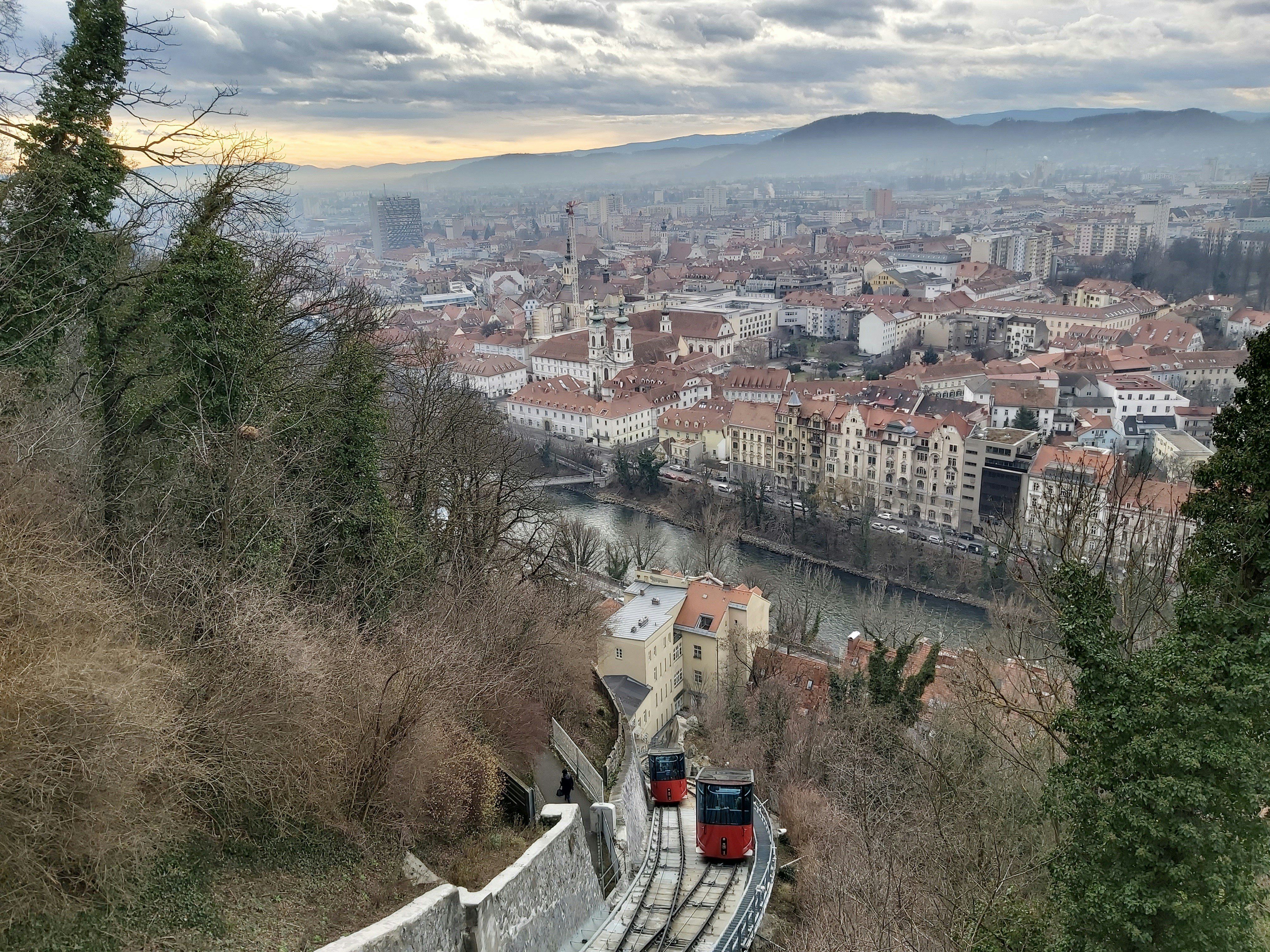
If Graz has one unmissable feature, it is the Schlossberg, the dolomite hill rising directly out of the city center near Hauptplatz. A fortress stood here for centuries and was considered nearly impossible to capture. Napoleon's army found that out the hard way in 1809. They besieged the city but could not take the castle by force, and the only reason it came down at all was a treaty that forced its demolition. Furious about losing such an iconic symbol, the citizens of Graz raised the money to ransom the clock tower and bell tower from destruction, and both still stand today as the only original pieces of the old citadel.
You can reach the top three ways. The Schlossbergbahn funicular has been running since 1894 and climbs the hill on a steep glass-roofed track in a couple of minutes, departing roughly every fifteen minutes from the base station on Kaiser-Franz-Josef-Kai near the Mur river. There is also a glass lift cut straight through the rock that takes about thirty seconds and gives you a strange, beautiful view of the illuminated tunnel walls as you rise. Or you can walk, either up the winding garden paths or up the dramatic 260 step staircase carved into the hillside, which takes about fifteen to twenty minutes depending on your pace.
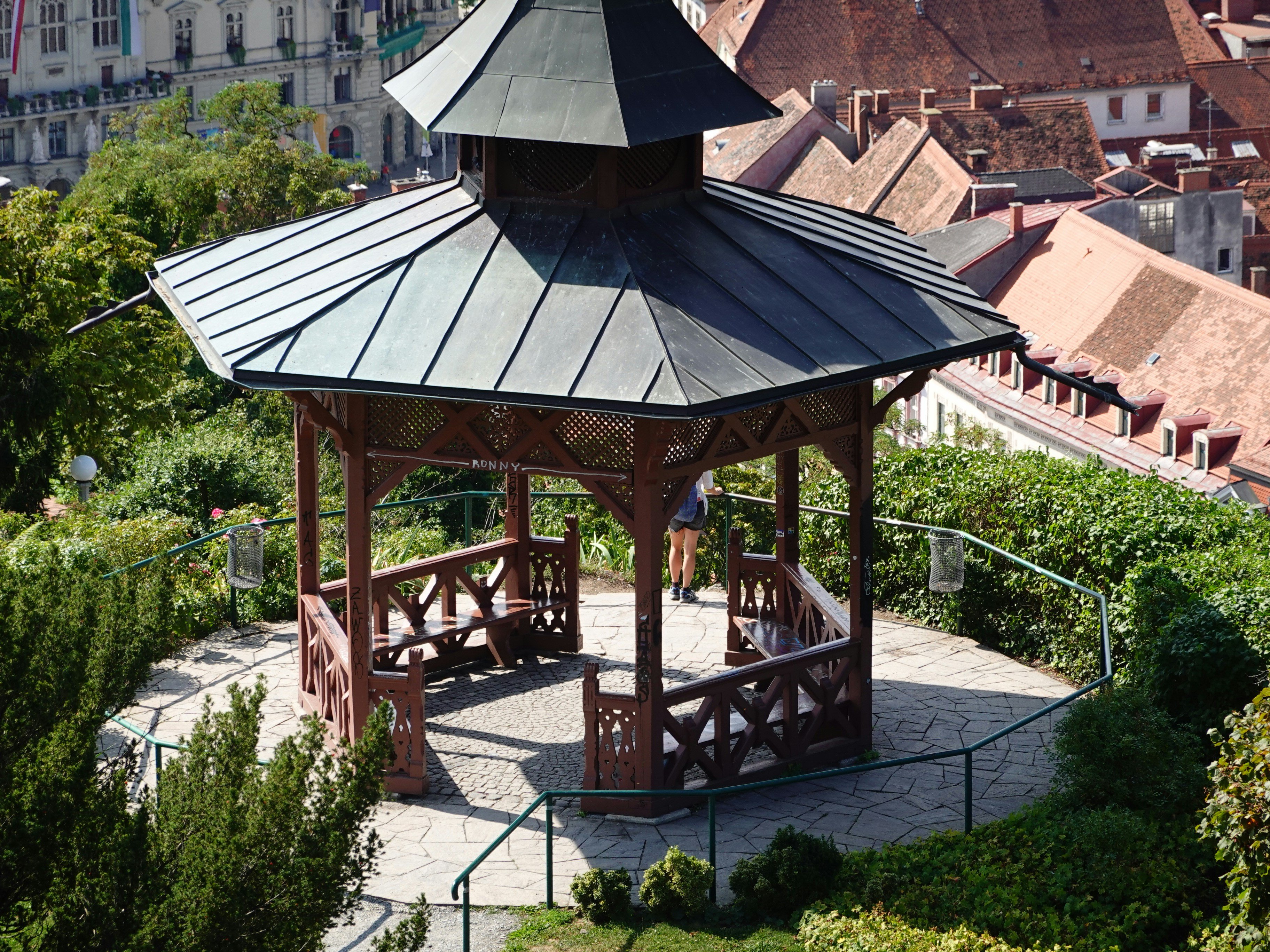
What locals actually do up there is less about the funicular ride and more about the time of day they choose. Hardly anyone treats Schlossberg as a five minute photo stop and then leaves. Plan for at least an hour, more if you want to sit at Starcke Haus, the hilltop cafe and restaurant, and watch the city change color as the sun drops. The terrace near the Uhrturm clock tower is the obvious viewpoint, but walk a little further to the quieter Herberstein Garden on the south side of the hill, away from the crowds gathering for photos, and you get the same skyline with almost nobody else around. Access to the hill itself, the paths, and the clock tower exterior is free. The funicular and lift each cost a few euros per ride, and both are covered if you are already holding a Graz public transport ticket or a Graz Card.
The Old Town on Foot
Graz's Altstadt earned its UNESCO World Heritage status in 1999, and walking it is less about checking off individual monuments and more about noticing details most people walk straight past. Start at Hauptplatz, the main square that has functioned as the city's meeting point since the Middle Ages, framed by the Rathaus town hall and the ornate Luegghaus on the corner, a thirteenth century building whose stucco facade is so detailed that locals still point out hidden faces tucked into the floral patterns.
From there, walk down Herrengasse, the grand pedestrian street that connects Hauptplatz to Jakominiplatz. At Herrengasse 3 look up for the Painted House, a building whose entire 220 square meter facade was covered in mythological frescoes back in 1742. Most visitors miss it because it sits slightly above eye level. A few doors down at Herrengasse 16 is the Landhaus, the seat of the Styrian regional government, and stepping inside its courtyard is the single best surprise in the Old Town. From the street it looks like an ordinary government building. Inside, you find a three story Italian Renaissance arcade with Tuscan columns and a bronze fountain, the kind of space that feels imported from Lombardy and forgotten in the middle of Austria.
Right next door is the Landeszeughaus, the Styrian Armoury, which holds the largest historical collection of arms and armor in the world with more than 32,000 pieces spread across four floors. Even if armor museums are not usually your thing, the sheer scale of it is worth thirty minutes. After that, take a detour onto Sporgasse, a steep, narrow street that feels noticeably more local than Herrengasse, lined with small boutiques and the oldest courtyard in the city. It leads up toward Graz Castle, where the Gothic double spiral staircase, built in 1499, is one of those architectural details photographers travel specifically to see and most general tourists never find.
Save time for the unmarked part of the walk too: the hidden courtyards. Many buildings along Herrengasse and the surrounding lanes hide arcaded inner courtyards behind plain doorways, and the only way to find them is to actually push open a few doors that look like they might lead somewhere. That sense of discovery is most of what makes the Old Town memorable, more than any single landmark.
Experience Graz Like a Local

Reading about hidden courtyards is one thing. Actually finding the right doors, the right market stalls, and the right Buschenschank that your Airbnb host would never think to mention is another. This is exactly the gap Lokafy fills.
Instead of following a printed map between landmarks, you walk the city with someone who grew up here, who can tell you which courtyard café still makes its own apple strudel and which Schlossberg viewpoint the tour buses never find. It turns a checklist into an actual afternoon with a person who knows the place.
Styrian Food Culture
Styria calls itself the green heart of Austria, and the food culture backs that claim up. The signature product is Kernöl, dark, nutty pumpkin seed oil pressed from a regional variety of pumpkin grown almost exclusively in this part of the country. Roughly ninety percent of Austria's pumpkins come from Styria, and the oil shows up everywhere, drizzled over salads, stirred into pumpkin seed oil ice cream, and sold by the liter directly from farmers who pressed it themselves that week.
The best place to understand this is Kaiser-Josef-Markt, located on Kaiser-Josef-Platz near the Opera House in Graz's Old Town, a short walk from Hauptplatz. It is the oldest and largest farmers market in the city, running daily except Sunday from early morning until around 1pm, with Saturday being the busiest and most rewarding day to go. Around 350 producers sell everything from Käferbohnen, the scarlet runner beans that are a true Styrian specialty, to fresh Murodner potatoes, local wines, and that famous pumpkin seed oil straight from the farm. Inside the market, Genießerei am Markt has built a reputation on cooking with whatever the kitchen team bought from the surrounding stalls that same morning, which means the lunch menu genuinely changes day to day.
Beyond the market, Styrian beef and the region's Buschenschanken wine taverns are the other half of the local food identity. A Buschenschank is a working wine farm that also serves food, usually a cold board of cured meats, cheese, bread, and pickled vegetables called a Brettljause, paired with the farm's own wine. They are common throughout the surrounding hills and the southern Styrian wine road, and locals treat a Buschenschank visit less like a meal out and more like a slow Sunday tradition, often stretching across an entire afternoon with no rush to leave. If you want the closest version of this inside the city itself, look for restaurants in the Lend district or off Sporgasse that lean into seasonal, farm sourced menus over typical tourist fare, and order a glass of Welschriesling or Sauvignon Blanc, the two whites Styria does best.
The Lend District
Cross the Mur river from the Old Town and you land in Lend, the neighborhood that has quietly become the most interesting part of modern Graz. For most of its history this was a working class district, home to factories, a red light area, and a reputation that kept the wealthier side of the city away. That history is exactly why Lend feels different today. Rather than tearing everything down, the city let artists, students, and small business owners move into the cheap former industrial spaces through the 1990s and 2000s, and the district grew into its current identity from the ground up rather than from a planning committee.
The center of it all is Lendplatz, home to a second farmers market that runs the same hours as Kaiser-Josef-Markt but with a noticeably younger, more local crowd. Around the square you will find design shops, small galleries, and cafes that double as evening bars once the produce stalls close down. The Kunsthaus Graz, the biomorphic blue building locals affectionately call the Friendly Alien, anchors the district right at the riverside, and the Mur Island, a floating amphitheater shaped structure in the middle of the river, connects Lend back to the Old Town on foot.
Walk a little further toward the train station and you reach what the city calls its Smart City zone, a still evolving area of converted industrial buildings and new sustainable architecture, including a research tower powered by geothermal and solar energy. It is rougher around the edges than the postcard Old Town, and that is precisely the appeal. Street art from local collectives covers walls throughout the district, the bars stay open later than anywhere near Hauptplatz, and the whole area has the unmistakable feeling of a neighborhood still figuring out what it wants to be, in the best possible way.
Day Trips That Only Locals Know
Graz works well as a city break on its own, but the surrounding Styrian countryside is close enough that locals treat day trips as a normal weekend habit rather than a major undertaking.
The Styrian wine road, or Südsteirische Weinstraße, runs through the rolling hills south of the city and is the easiest of the three trips, reachable by car in under an hour. The region produces some of Austria's best Sauvignon Blanc and Welschriesling, and the drive itself, past vineyard covered slopes and small wine villages, is half the reason to go. Stop at a Buschenschank along the way for the Brettljause experience described above, ideally on a weekend afternoon when the farms are open and unhurried.
Riegersburg Castle sits about 38 kilometers northeast of Graz, roughly a forty five minute drive through the Styrian countryside, perched dramatically on top of an extinct volcano. It is one of the most fortified hill castles in the region, and inside you will find a trio of museums covering the castle's history, a genuinely unsettling exhibit on regional witch trials, and historic weaponry. The site also runs a bird of prey flight show that draws a crowd even among visitors who came purely for the architecture. It opens daily from May through September between 9am and 6pm, with shorter hours in spring and autumn, so check the current schedule before you go since hours shift by season.
From Riegersburg, locals often continue another twenty five minutes south to the thermal spa region around Loipersdorf, roughly 65 kilometers from central Graz. Therme Loipersdorf is one of the largest thermal spa complexes in Austria, with multiple indoor and outdoor pools and an extensive sauna landscape, and it makes a natural second half to a day that started with castle walls and ends with hot mineral water. If you would rather combine the spa day with something playful, the Zotter chocolate factory sits a short drive from Riegersburg as well and is worth the detour for anyone traveling with kids, or honestly for anyone who likes chocolate.
Frequently Asked Questions
Is Graz worth visiting? Yes, and increasingly travelers are realizing it rather than treating it as a stopover between Vienna and Slovenia. Graz offers a genuine UNESCO Old Town, one of Europe's most dramatic city hill fortresses, and a regional food culture built around Styrian wine and pumpkin seed oil that feels distinct from anything in Vienna. It rewards a slower pace better than most Austrian cities its size.
How many days do I need in Graz? Two full days covers the Old Town, Schlossberg, and Lend district comfortably without rushing. Add a third day if you want to fit in a single day trip, such as the Styrian wine road or Riegersburg Castle, since both work best as a relaxed half day or full day rather than a quick add on.
Graz or Vienna, which should I visit? This is not really an either or question if your trip allows for both, since they are only about two and a half hours apart by train. Choose Vienna for imperial grandeur, opera, and big museum collections. Choose Graz if you want a smaller, younger, more food focused city where you are less likely to be standing in a queue. Many travelers who base themselves in Vienna add Graz as a two day extension and come away saying it was the highlight of the trip.
Is Graz expensive? Graz runs noticeably cheaper than Vienna for food and casual dining, partly because there is far less tourist pricing pressure on restaurants near the Old Town. A market lunch at Kaiser-Josef-Markt or a Brettljause at a Buschenschank typically costs less than a comparable meal in central Vienna, while hotel prices sit in a similar mid range bracket to other regional Austrian cities.
What is Graz known for? Graz is known for its UNESCO listed Old Town, the Schlossberg fortress hill with its clock tower and bell tower, the large student population that keeps the city culturally active, and its Styrian food identity centered on pumpkin seed oil, regional wine, and farm to table Buschenschanken in the surrounding countryside.
Best time to visit Graz? Late spring through early autumn, roughly May to September, gives you the longest daylight for Schlossberg evenings and outdoor wine tasting along the Styrian wine road. December has its own appeal thanks to the Christmas markets that take over Hauptplatz and the Landhaus courtyard, with the regional ice nativity scene as one of the more memorable seasonal sights in Austria.
How do I get to Graz from Vienna? Direct trains run regularly between Vienna and Graz on Austria's ÖBB rail network, with the journey taking roughly two and a half hours each way and tickets bookable in advance through the ÖBB website. It is also a manageable drive of a little over two hours by car if you want the flexibility to stop in smaller towns along the way.
Graz rarely makes anyone's first list of European city breaks, and that is exactly why it still feels like a discovery when you actually go. Walk the Old Town slowly, ride the Schlossberg at golden hour, eat where the market stalls point you, and you will understand why the locals here have never really minded being the second city. To go beyond the surface and see Graz the way someone who actually lives there would show you, explore a Lokafy experience and let a local guide the day.
Enjoyed this article?