Greece is one of those idyllic destinations that everyone dreams about visiting. Enjoying its beaches, white cities and delightful food are more than enough reasons to have the country on the top of your dream vacation list. Nonetheless, there are certain hidden gems in Greece that at the first glance, aren’t as popular or interesting as let’s say Athens or Santorini, but once you get to know them, you’ll wonder why you didn’t think about them earlier! That’s precisely the case of Thessaloniki, the city that we’re going to explore in today’s blog.
Introducing Thessaloniki like that may seem paradoxical, because it is the second biggest city of Greece, so it’s not like nobody has ever heard of it or that it is a remote little village difficult to access. However, despite its importance for the country in demographic or economic terms, the city is not that well-known in the tourism world, and most visitors prioritize other destinations in the country. This is unfortunate, because Thessaloniki is a city filled with history, culture and beautiful landscapes. Of course, scattered across town you’ll find proof of the empires and civilizations that thrived here, as well as how they influence the city’s life even today. Nowadays it is a colorful, vibrant and multicultural city where you can enjoy some very special days for a (very) reasonable price. If you still need more reasons to add Thessaloniki to your itinerary in Greece, keep reading and at the end we guarantee you’ll be ready to hop on the next flight.
History across Thessaloniki:
As you might know, Greece is recognized by the amazing ruins that detail how the Greeks, Romans and Byzantines lived during their times. It gives you the opportunity to walk the same paths and be in the same places where so many stories about pride, glory and war took place. Fortunately for you, Thessaloniki has some incredible ruins that will take you back to a whole different era. Something curious about the city’s ruins is that the most important ones are all closely associated with Galerius, a 4th-century Roman emperor who was a protagonist in the rise of Thessaloniki to prominence as a key city of the Empire.
One of the city’s landmarks is the Rotunda of Galerius (or St. George), that was built by the emperor as his tomb, but that ended up becoming Thessaloniki’s first church. It is one of the oldest monuments in the city, and across sixteen centuries, it has been a pagan monument, a Christian church and a Muslim mosque. Obviously, this means that the construction has become a beautiful mix of all its past lives, with countless particular details that create a special atmosphere. On the other hand, we also have the Arch of Galerius, a great sight that shows the perfect contrast between a popular shopping street and an imposing monument with numerous sculptures that commemorate Galerius’ victory over the Persians. Both the Rotunda and the Arch, are part of the 15 Paleochristian and Byzantine Monuments of the city that have been part of the UNESCO World Heritage List since 1988.
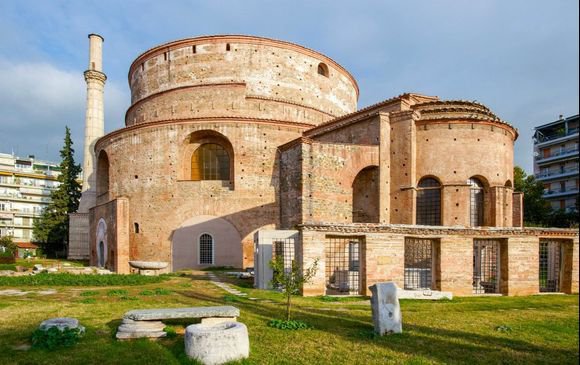
Galerius was a Roman Emperor that is still all over Thessaloniki through the various constructions he ordered during his rule.
Another way to look at Thessaloniki’s history:
Oftentimes, museums are the perfect place to dive deep into a city or country’s history, understanding its origins, development and expectations for the future. Even though Thessaloniki gives you the opportunity to watch and feel its history in its streets through all of its magnificent ruins, it also has a fine selection of museums to explore every little detail of how the city came to be. For example, one of Thessaloniki’s most important institutions is the Archaeological Museum, home to some of the region’s most significant archaeological discoveries regarding prehistoric Macedonia and the Hellenistic and Roman periods. As a fun fact, here at the museum you’ll find the Derveni Papyrus, the oldest surviving papyrus piece in Greece (from around 320-250 BC), which is regarded by UNESCO as Europe’s oldest book.
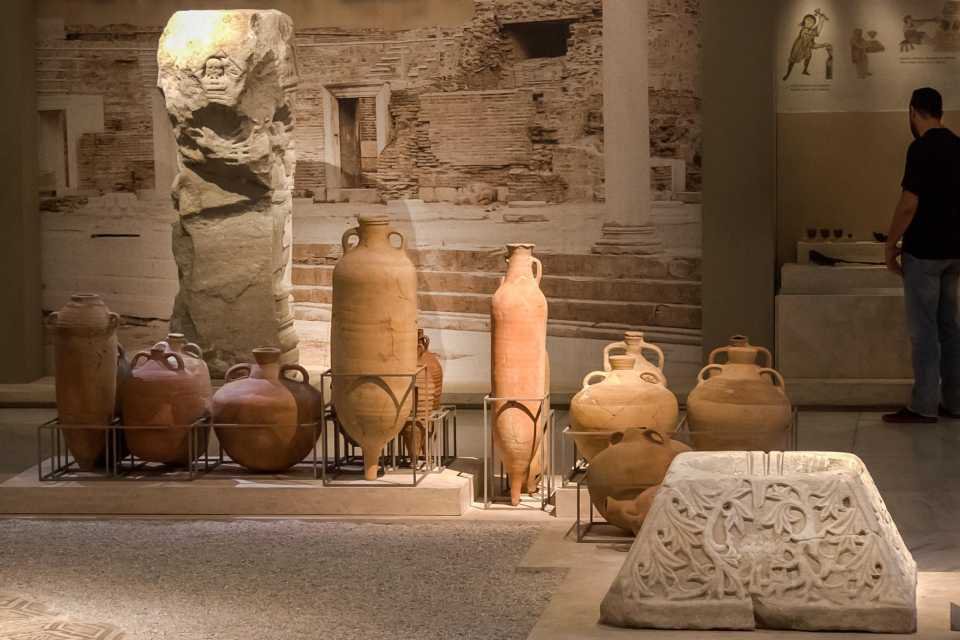
The Archaeological Museum will show you with amazing detail how life in the Macedonian region was during the Hellenistic and Roman periods.
Additionally, the Museum of Byzantine Culture is another of the city’s jewels. Of course, as its name indicates, the museum is dedicated to exploring how the Byzantine Empire affected and shaped Thessaloniki, as well as depict its culture and the everyday lives of its inhabitants. Carefully placed, you’ll find more than 3000 Byzantine objects such as mosaics, tomb paintings and jewelry, all sharing bits of the story of one of the most important empires of ancient times. Finally, we would like to mention the White Tower, a Byzantine construction later turned into a fortress by the Ottomans in the 16th century. It has a harrowing past as a prison and execution site, but nowadays it stands as a welcoming site for visitors to better understand Thessaloniki. As a 34 m-high tower, it has breathtaking views of the city, the Thermaic Gulf and the surrounding hills. It is truly a worthy sight, don’t miss it!

The Museum of Byzantine Culture will take you on a journey through the Byzantine Empire and its impact on Thessaloniki.
The most authentic version of Thessaloniki:
Now that we’ve explored so much of the city’s rich history, it is time to get to know it from a different angle. No more ruins or museums, you just have to walk down its cobblestone streets, pay attention to its alleys and enjoy the exquisite restaurants and cafés along the way. The best part of the city to do all this is Ano Poli, or Upper City, nicknamed as the “City Above the City“, which is the heart of Thessaloniki, because although it is its most ancient part, being around 2300 years old, it has embraced modernity becoming a creativity hub and the most colorful and vibrant zone of the city. Scattered across this part of town, you’ll find plenty of Byzantine constructions and churches with its mosaics and frescoes, creating an enchanting atmosphere and inviting you to get lost again in history and spirituality. Also, if you’re tired and need to relax for a bit, Tsinari, a lively yet peaceful district of Ano Poli is the best place to do so. Head to one of its numerous taverns and have a bite and drink.
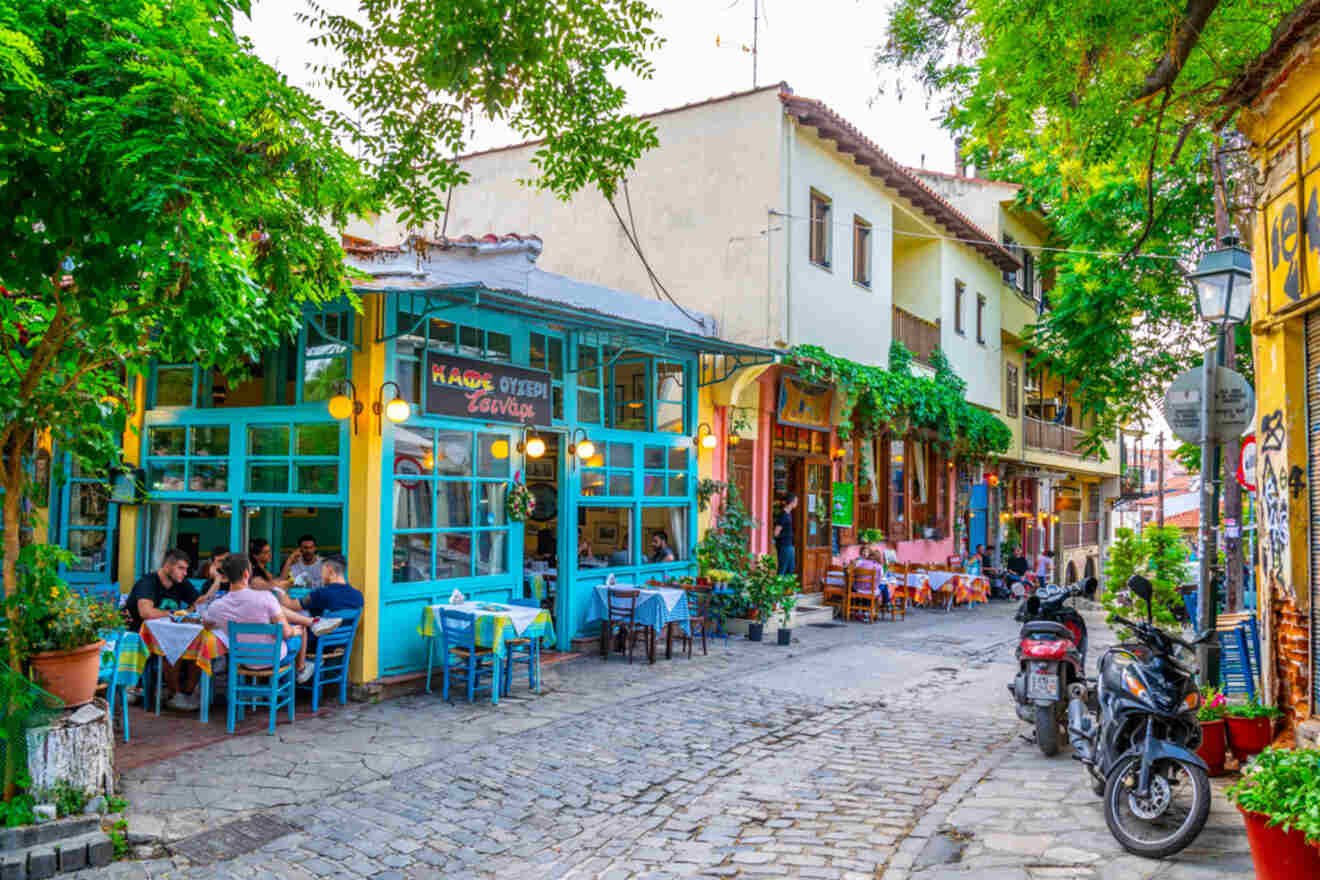
Ana Poli might be the oldest part of Thessaloniki, but it has a youthful atmosphere that will make you want to stay a bit longer.
Where the locals eat:
Finally, we cannot end our blog without talking about where to eat like a local in Thessaloniki… There are 2,000 years of cuisine here, it’s simply impossible to ignore! If we take into account that the local cuisine has been influenced by different cultures throughout history, we can begin to imagine the exquisite flavors and scents that await in Thessaloniki’s restaurants. Undoubtedly, the best place to taste local food is Ladadika, a district at the city’s historical center that was designated as a historical landmark location and that went through a restoration process in which most buildings became recreation and entertainment venues. In this district, there are plenty of taverns, restaurants and cafés that serve authentic Mediterranean food with fresh locally-sourced products. Choose your favorite and enjoy the most delicious meal of all.

With such a rich culinary history, it is a necessity to eat in Thessaloniki like a local! And there’s no better place to do that in Ladadika.
Now it is indeed time to wrap up our adventure in Thessaloniki. We’ve gone through some of the things that make Greece’s second-largest city so important and attractive to visit. Even though there are other destinations in the country that take the crown as the most popular or most visited, it is clear that Thessaloniki has all the potential and right now is a hidden gem. Become part of the lucky ones that include the city in their itinerary and enjoy a charming stay there.
Enjoyed this article?