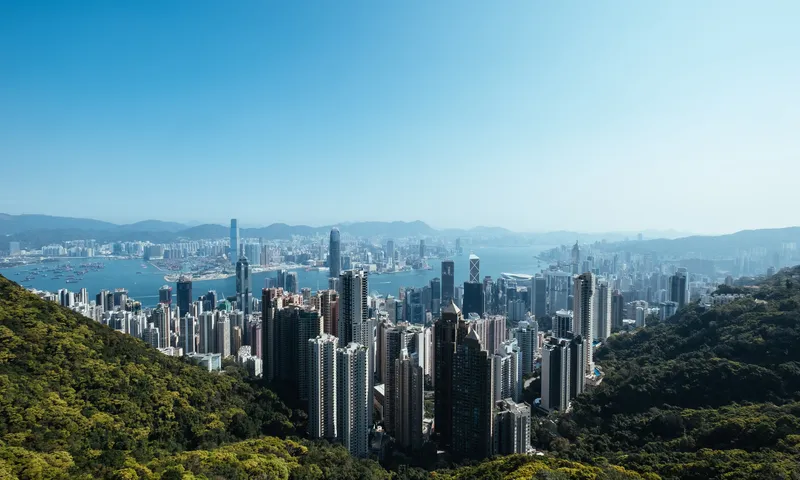
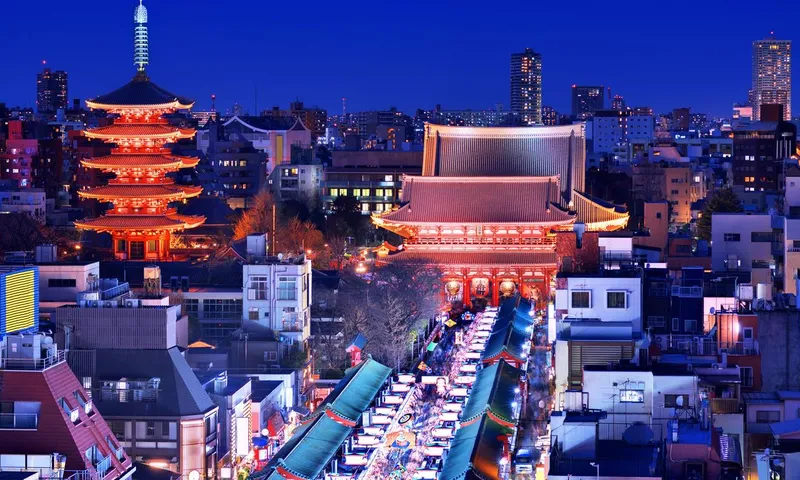
Dubai has cut the desert through skyscrapers and sustainable designs, and it has branched itself out to the ocean through artificial islands. Nowadays, you find a sea of glass and steel in what can only be described as a splendid and modern oasis. However, that doesn’t mean that the city has forgotten its origins, because even some of the new constructions’ designs have been inspired by the traditional architecture of the Emirates. For example, before Dubai became a world referent on architecture, the city’s design was centered around its cultural identity, deeply connected with Islam. Fortunately for visitors today, not everything in Dubai has been turned into a skyscraper, and there are whole districts that maintain traditional structures and that serve as a constant reminder of where Dubai began and the long path that it had to take to become what it is today.
Taking into account that the first skyscraper built in Dubai was its World Trade Center in 1979, it is safe to say that the city’s development has been recent, and that in a few decades it has irrevocably changed the desert’s outline. From that moment on, the architecture of Dubai has done nothing more than progress towards state-of-the-art designs and technologies that have created an aesthetically marvelous skyline which nonetheless echoes certain parts of traditional Arab styles.
Precisely, for this blog, we wanted to go over some of the most important and breathtaking buildings in Dubai, because that way we can learn more about the city’s history, as well as get to know the different facades of Dubai as a city of business, pleasure, culture and art. Keep reading as we dive into the wonders of Dubai’s architecture.
Burj Khalifa:
Undoubtedly, we have to begin talking about the Burj Khalifa, the best example of how far Dubai’s architecture has gone. Since 2010, it has been branded as the tallest building in the world with a staggering height of 2,717 feet, in a structure surrounded by 28,000 glass panels. Clearly, such a massive building has to shatter some other records, such as having the highest occupied floor and the elevator with the longest travel distance. Even 13 years after its construction, the Burj Khalifa is still the most famous symbol of Dubai, representing the uniqueness of the city and its capacity to touch new heights. And if you look closely, regardless of its absolutely modern design, you’ll see that it still was inspired by Islamic architecture, best represented in the fact that it rises up from a flat desert foundation and begins ascending in a spiral pattern.
Now, you may be wondering what happens inside the tallest building in the world and how is it possible to fill so much space. Well, first off, in its 163 floors the Burj Khalifa houses the ultra luxurious Armani Hotel, some of the most exclusive residential units of the city, as well as restaurants and bars, completing a cycle of luxury, entertainment and relaxation. Obviously, at those heights, there should be a way to let people enjoy those beautiful views, and that’s the task of the “At Top of the Sky” experience, the world’s highest outdoor observation deck at approximately 1820 feet, with will allow you to appreciate a set of panoramic views that you won’t find anywhere else in the world.
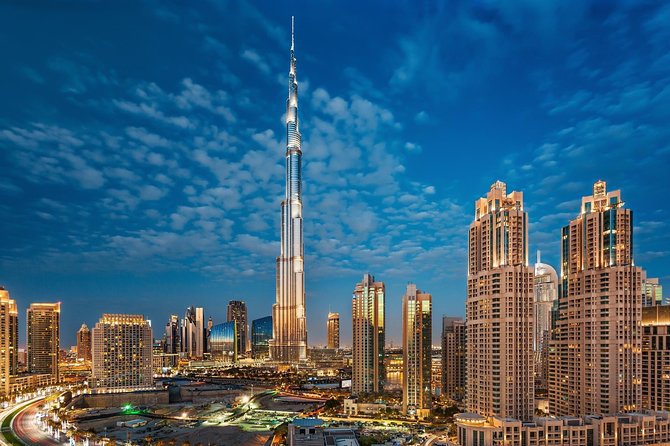
Since 2010, the Burj Khalifa has been the tallest building in the world.
Burj Al Arab:
We can’t ignore one of the most famous and luxurious hotels in the world, because its sail-like design has made it an iconic view of Dubai. The Burj Al Arab is the third-tallest hotel on Earth, and it floats on its own artificial island, which tells you all you have to know about the city’s opulence. If you think that its exterior design is breathtaking, wait until you see what’s inside the hotel: dancing fountains, shiny marble, and baths that can be filled with champagne. There are 202 lavish suites in the Burj Al Arab, and to give you an idea of just how lavish it can be, there’s a two-story Royal Suite, which costs $24,000 a night. Clearly, a feat for just a few. But don’t worry if the hotel exceeds your budget, because there’s still some ways to enjoy the luxury of the Burj Al Arab without spending thousands of dollars. For example, you could make reservations for cocktails, some tea or a dinner in the underwater restaurants. Yes, we’re all thinking the same… while visiting Dubai, one has to budget slightly differently than in other destinations.

The Burj Al Arab might not be the tallest building in Dubai, but this hotel is certainly one of the city’s most iconic views.
Museum of the Future:
The next architectural wonder of Dubai that we’re going to explore is the Museum of the Future, a fairly new addition to the city’s collection of exuberant designs. As its name says, the museum poses the question of how society could evolve in the near future, using the tools science and technology have been providing. Since it has been branded as a “living museum”, you’ll see that aside from the traditional exhibitions, there are immersive theater and themed attractions, much like an interactive movie set, where people will be able to discover what the future holds for humanity. Of course, as what we have seen with other landmarks of the city, the museum was built with a clear vision in mind, expecting that this new structure could symbolize Dubai’s vision on the future: it was designed as an asymmetric torus clad, made up in steel and glass, which stands out even more thanks to the golden Arabic calligraphy that surrounds the whole facade. Thus, it isn’t surprising that since its grand opening in 2022, it has been named as one of the most beautiful museums in the world. From topics like space traveling and living, climate change and wellness, among others, you’ll have the opportunity to embark on a journey through existential questions that have been in humanity’s minds for centuries.

The Museum of the Future stands out from all of Dubai’s skyscrapers.
Al Fahidi Historic District:
We’ve talked extensively about the most futuristic sights in Dubai, but behind all of those skyscrapers and glass and metal, there are still some traditional districts that let you know how Dubai was before it began its sophisticated transformation. The Al Fahidi Historic District is the most popular one, and its restored heritage area is perfect to provide a clear image of what a historic Middle Eastern architectural style and culture looked like. When the traffic noise starts to quiet down and the highways begin to become narrower, you know you’ve arrived at the restored area, which once was known as the Bastakiya Quarter. In 50 buildings arranged in the area, you’ll find craft shops, cafés, restaurants serving local food, small heritage museums and art galleries. With all of this, you’ll understand that not all of Dubai’s spirit is in its tallest skyscrapers and most complex structures, but a part of it is still in the labyrinth of traditional houses.
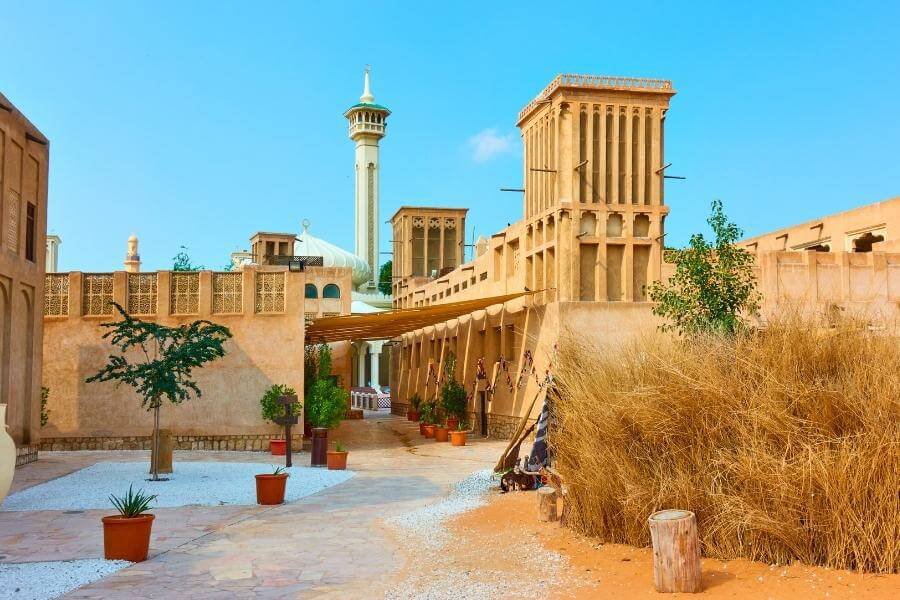
The Al Fahidi Historic District is a popular restored heritage area which illustrates what Dubai looked like before its transformation.
Dubai Frame:
The perfect way to end our blog on the city’s architecture is to talk about the Dubai Frame, presented as the largest picture frame in the world with 492 ft high and 344 ft wide dimensions. It first opened in January 2018 as a way to bridge the new and old Dubai, because its location at the Zabeel Park means that depending on where you’re standing, you’ll see the structure framing the outline of the modern part of the city, while on the opposite side you’ll see the historic part. Not only that, but visiting the Dubai Frame means taking on a chronological journey, which first explores the galleries on the ground floor, dedicated to telling the story of how Dubai came to be, exploring its past. Afterwards, visitors will be taken to a viewing platform at roof level to appreciate the present view of the city, while afterwards they are taken to another gallery that exhibits the vision for the Dubai of the future, thinking about the transformations bound to happen in the next 50 years.
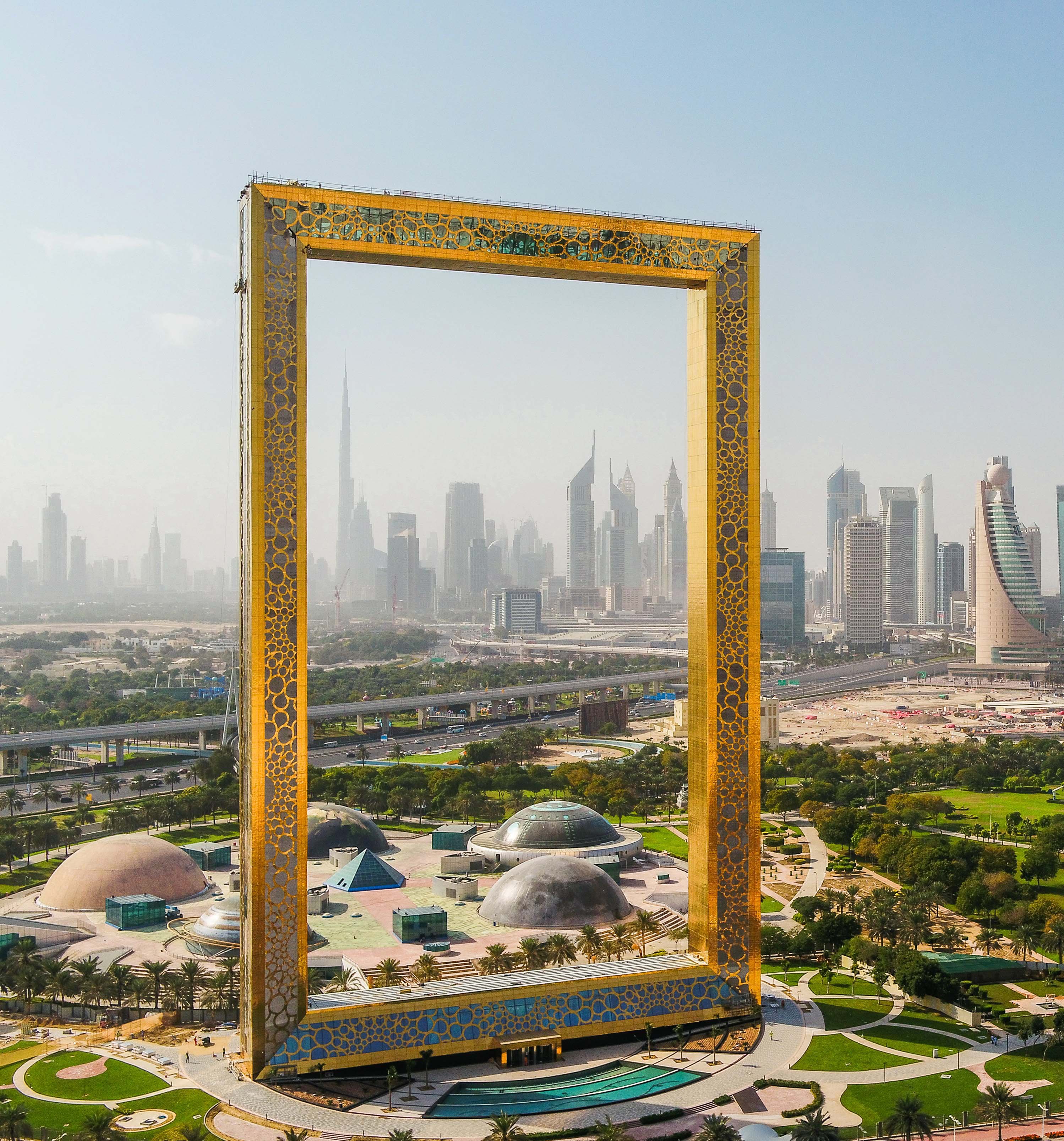
The Dubai Frame is the perfect way to represent Dubai’s contrasts and its incredible transformation; a way to pay homage to its past, present and future.
It has been a marvelous look into Dubai, don’t you think? And as you probably have guessed, there’s still quite a lot left to discover, but it is better to do so by roaming through the streets of Dubai and looking with your own eyes all of the architectural wonders that have been created and that are planned for the future. What you can be certain of, is that all of what you find is going to be as luxurious, ambitious and innovative as the rest of the city, because that’s the spirit of Dubai and the image that the city wants to reflect onto the world.
Enjoyed this article?